A Ball Made From a Sock
Pelé was born Edson Arantes do Nascimento in 1940, in Brazil. His parents named him after the American inventor Thomas Edison. He never knew for sure where his famous nickname came from, but thought it probably began when he mispronounced the name of his favourite player, a goalkeeper called Bilé.
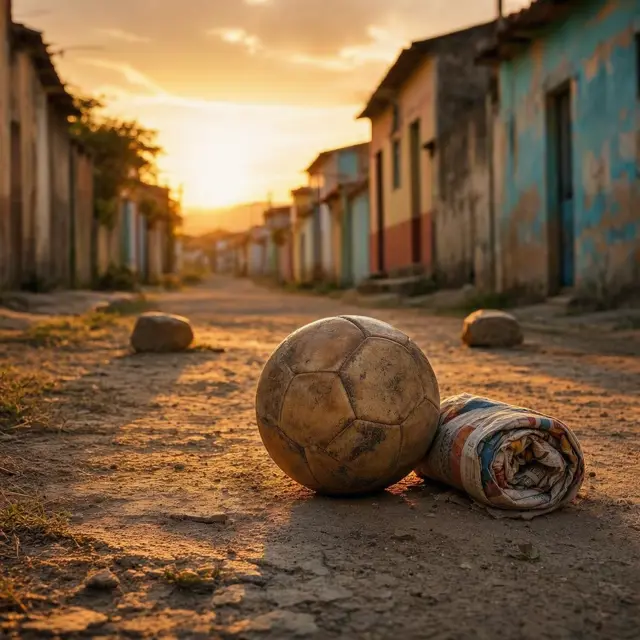
He grew up poor in the town of Bauru and earned money serving in tea shops. His father, a footballer himself, taught him to play. The family could not afford a proper ball, so Pelé usually played with a grapefruit or a sock stuffed with newspaper.
As a teenager, he also played futsal, a fast indoor version of football. He later said it taught him to think quickly, because everyone was so close together. At about 14, he was nearly left out of one futsal tournament for being too young, and ended up as its top scorer.
In 1956, his youth coach took him to the club Santos and told its directors that the 15-year-old would be the greatest football player in the world.
A National Treasure
Pelé signed his first professional contract with Santos at 15 and scored in his very first senior match, a 7 to 1 win. By 16, he was the top scorer in his league. In 1958, he scored 58 league goals in one season, a record that still stands.
Just ten months after turning professional, he was called up to the Brazil national team.
Rich European clubs, including Real Madrid, Juventus and Manchester United, all tried to sign him. Inter Milan even got a contract agreed, but it was torn up after Santos fans revolted.
In 1961, Brazil's government stepped in. President Jânio Quadros declared Pelé an official national treasure, to stop him from being transferred out of the country.
On 19 November 1969, he scored his 1,000th goal, from a penalty kick against Vasco da Gama at the Maracanã Stadium. The moment was so eagerly awaited in Brazil that the goal got its own name: O Milésimo, The Thousandth.
Three World Cups
Pelé arrived at the 1958 World Cup in Sweden with a knee injury and missed the first two matches. A team psychologist even said the 17-year-old was too childish to play. The coach picked him anyway.
He became the tournament's youngest goalscorer, scored a hat-trick in the semi-final against France, and scored twice in the final, a 5 to 2 win over Sweden. When the final whistle blew, he fainted on the pitch. At 17, he is still the youngest player ever to win a World Cup.
His famous number 10 shirt came about by accident. Brazil's football federation had not given out shirt numbers, so FIFA chose number 10 for him. In 2026, the shirt he wore in that final sold for 4.9 million dollars.
Brazil won again in 1962, and in 1970, in Mexico, Pelé starred in a Brazil team often called the greatest in history. He scored the opening goal of the final against Italy, Brazil's 100th World Cup goal. He remains the only player to have won three World Cups.
The King Goes Global
Pelé was nicknamed O Rei, the King. He could shoot powerfully with either foot, head the ball brilliantly and dribble past defenders with sudden changes of direction. He is credited with linking football to the phrase The Beautiful Game.
Even his misses became legendary. In 1970, England's goalkeeper Gordon Banks blocked his header in what became known as the save of the century. Pelé later said that he had scored more than a thousand goals, yet people always asked him about the one he did not score.
In 1975, he came out of semi-retirement to join the New York Cosmos, and was credited with greatly boosting interest in football in the United States. His very last match, in 1977, was between the Cosmos and Santos, and he played one half for each team. It rained during the second half, and a Brazilian newspaper wrote: Even The Sky Was Crying.
His 1,279 goals in 1,363 games, counting every friendly match, are recognised by Guinness World Records. He was named Athlete of the Century by the International Olympic Committee in 1999, and he died in December 2022.