Years on a Four-Metre Rock
Here is a strange truth about rock climbing: height has nothing to do with difficulty. Climbers have spent as many years trying to climb Burden of Dreams, a route just 4 metres (13 ft) tall, as they have on The Nose, a route over 1,000 metres high on El Capitan. In 2016, Nalle Hukkataival became the first to climb Burden of Dreams, setting the top bouldering grade for men, V17.
Routes range from a few metres to over 1,000 metres tall, and sideways routes called traverses stretch even farther. The world's longest rock climb is the El Capitan Girdle Traverse, at 4,500 metres (14,800 ft). Climbers have found routes on 43 kinds of rock, with granite, limestone and sandstone the most popular.
Before a climb, many people study the beta, the exact moves needed to get up a route. Popular routes have step-by-step videos online, and websites have even fought legal battles over who owns the beta. Guidebooks record a grade for each route, and when that grade is lower than the real difficulty, climbers call it sandbagging.
Free, Aid and Everything Between
The big split in climbing is about help. In aid climbing, gear can be used to pull yourself upward. In free climbing, the focus of modern climbing, no gear may help you move up. Ropes and protection are only there to catch a fall.
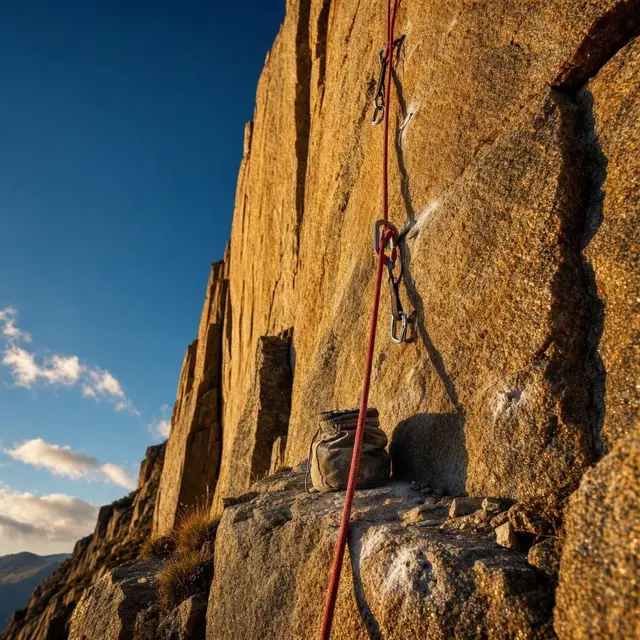
Free climbing comes in several forms. Bouldering means short routes up to about 5 metres, with only crash mats on the ground. In sport climbing, bolts are drilled into the rock ahead of time and climbers clip their rope into them. In traditional climbing, the leader places removable gear into cracks while climbing, which is harder work and riskier. Free solo climbing uses no protection at all, and Alex Honnold's 2017 free solo of Freerider on El Capitan became the Oscar-winning film Free Solo.
There is also a style code. Climb a route on your first try without ever seeing it or hearing any tips, and it is an onsight. Do it first try but with tips, and it is a flash. Succeed after many attempts, and it is a redpoint. Most major new first free ascents are done as redpoints.
Chalk, Rubber and Moves With Funny Names
Early 20th-century climbers had almost no gear. The lead climber looped the rope around natural spikes of rock, and the partner below held it by wrapping it around their waist. Today, climbers clip the rope into protection devices along the way. Grippy rubber shoes, chalk for dry hands and even medical tape for sore skin are now standard.
New techniques pushed the sport forward as much as new gear. Jamming means pushing body parts into cracks and pulling on them, from a single finger up to the whole body. Smearing uses the rubber of the shoe to grip smooth rock that has no holds at all. Welsh climber Johnny Dawes is known for "no-hands" demonstrations, climbing extreme routes using only his feet.
Some moves have fun names. The drop knee is also called the "Egyptian". The "Gaston" is named after its creator, Gaston Rébuffat, and works like prying open an elevator door. The knee-bar lets climbers wedge a knee in place to rest their arms, and using it with knee pads was once controversial. Today it is generally accepted.
From Hammered Spikes to Drilled Bolts
Rock climbing's main styles began in late 19th-century Europe: bouldering in Fontainebleau, big walls in the Dolomites, and single-pitch climbing in the Lake District and Saxony. In 1911, Austrian climber Paul Preuss started a famous "piton dispute" by arguing for climbing with far less aid. In 1913, rules were published for Saxon Switzerland allowing only natural holds, and they are still in use today.
In 1958, a team led by Warren Harding made the first ascent of The Nose on El Capitan. They hammered in 600 pitons and 125 bolts over 47 days. The climb won worldwide fame, but it was controversial for using so much aid. In 1993, Lynn Hill made the first free ascent of The Nose, a prize that had beaten every earlier attempt. Even that free route relies on a traverse that Ray Jardine chipped out of the granite.
In the late 1970s and early 1980s, French climbers like Patrick Edlinger wanted to climb blank rock with no cracks for gear. They drilled bolts into the rock for protection, creating sport climbing. It was much safer, and standards shot up. In the US, arguments over bolts got so heated in the 1980s and 1990s that people called them the "bolt wars".
Gyms, Grades and the Olympics
In 1964, a new climbing wall was built in a corridor at Leeds University. Students who trained only on that wall could then climb some of the hardest routes in Britain outdoors. That helped spark a boom in indoor climbing. Today, the MoonBoard wall has a grid of 200 holds that can be climbed in over 50,000 sequences, created and graded by an online community.
Competition climbing became an Olympic sport at the 2020 Summer Olympics, with lead climbing, bouldering and speed climbing as medal events. In speed climbing, pairs race each other on a standard wall, so times can be tracked as world records. Janja Garnbret became the most successful competition climber in history.
At the very top, grades keep rising. The hardest lead grade is 9c (5.15d) for men, first reached by Adam Ondra on Silence in 2017, and 9b+ (5.15c) for women, first reached by Brooke Raboutou in 2025. The best women's grades are only one or two levels below the men's in every type of climbing. Climbing has also been linked to better fitness, strength, balance and mood.