Racing Backwards on Purpose
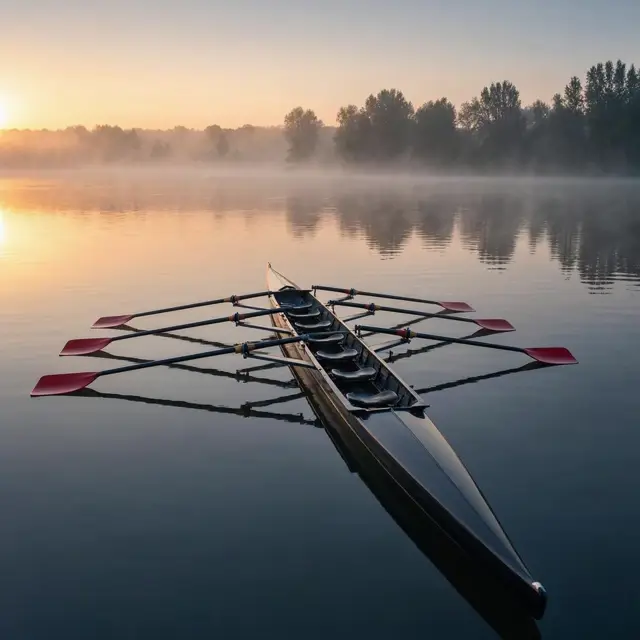
Rowing has an odd quirk built in: you race facing backwards. Rowers sit facing the stern, the back of the boat, and drive the boat forward toward the bow. Each oar is attached to the boat with a rowlock, and that is what separates rowing from paddling sports, where the paddle is held free.
There are two styles. In sculling, each rower holds two oars, one in each hand. In sweep rowing, each rower holds a single oar with both hands. Boats carry 1, 2, 4 or 8 rowers, from the single scull up to the eight, which also carries a coxswain to steer.
Most elite and championship races run on calm water over 2 kilometres, with several lanes marked by buoys. In the United States, the sport is often called crew. Today, 150 countries across six continents have rowing federations taking part in the sport.
From River Taxis to the Boat Race
Modern racing began with working boatmen. In London, professional watermen ran ferry and taxi services on the River Thames, and by the early 17th century they were racing each other for prizes. The oldest surviving race of this kind, Doggett's Coat and Badge, was first held in 1715 and still runs every year.
Students soon joined in. The Boat Race between Oxford and Cambridge first took place in 1829. Interest in it led the town of Henley-on-Thames to start its own yearly regatta in 1839. Founded in 1818, Leander Club is the world's oldest public rowing club.
America has its own fun origin story. During an 1837 parade in Providence, a group of boatmen boasted that they were the fastest crew on the bay. Some locals challenged them to a race and won. Six of those locals went on to found the Narragansett Boat Club in 1838. The Harvard-Yale Regatta, held since 1852, is the oldest college sporting event in the United States.
Inside a Single Stroke
Each stroke has two key moments. The catch is when the flat end of the oar, called the spoon, goes into the water. The finish, or release, is when it comes out. Between them comes the drive, when the rower does the hard work.
The drive starts with the legs. The rower pushes hard, sliding the seat toward the bow and levering the boat forward. As the legs straighten, the body swings back, and finally the arms pull in until the hands meet the chest just above the diaphragm. At the very end, the hands drop slightly so the spring stored in the bent oar pushes the boat on.
Then comes the recovery. The rower lifts the spoon out and turns it flat to the water, a move called feathering. The arms go out, the body leans forward, and the legs fold slowly. That slow slide gives the rower a moment of rest while the boat glides, which rowers call run.
Light Boats and Painted Blades
Racing boats, called shells, are long and narrow to cut drag. They were once made of wood. Now most use a composite of carbon fiber reinforced plastic around a honeycomb core, which is strong and light. To stop teams buying speed with expensive materials, World Rowing sets minimum weights for each boat class.
Here is a surprise: two scullers beat two sweep rowers. Sculling pushes evenly on both sides, so a double scull is faster than a coxless pair. Oars are long poles, 250 to 300 cm for sculling and 340 to 360 cm for sweep. Clubs paint their spoons in club colours, so boats can be told apart from far away.
On land, rowers train on an ergometer, a rowing machine that also measures fitness. It cannot copy the balance or the feel of real water, so crews are not picked on machine scores alone. Rowers sum it up with a saying: ergs don't float.
Sprints, Head Races and Bumps
Most spring and summer races are sprints, with all boats starting together. The Olympic distance is 2 kilometres, but the Boat Race is a dual race more than three times that long. Losing boats can sometimes get a second chance through a repechage.
From autumn, head races take over. Boats set off 10 to 20 seconds apart and race the clock. The Head of the Charles Regatta in Boston is now the largest rowing event in the world. Strangest of all are bumps races. Crews line up along a river, start at once and chase the boat ahead. Catch it or touch it and you earn a bump, so damaged boats are common.
Rowing is one of the oldest Olympic sports. It was on the 1896 programme, but bad weather stopped the races. Men have raced since 1900 and women since 1976. In many events the cox must weigh at least 55 kg, and a lighter cox may have to carry sandbags.