Surfers With No Waves
Skateboarding was probably born in California in the late 1940s or early 1950s, when surfers wanted something to do on days when the waves were flat. It was called sidewalk surfing. Early riders copied surfing moves and even skated barefoot. The very first boards were wooden boxes or planks with roller skate wheels attached to the bottom. No one knows who made the first one. Several people seem to have had the same idea at about the same time.
The first factory-made boards were ordered by Bill Richard, a Los Angeles surf shop owner, who got the Chicago Roller Skate Company to make wheels for square wooden boards. By the mid-1960s the craze was big. Patti McGee, one of the earliest sponsored skaters, made the cover of Life magazine in 1965. That same year, Wile E. Coyote rode a skateboard in two Road Runner cartoons.
Then it fizzled. By 1966 sales had dropped sharply, and the first skateboarding magazine had stopped publishing after only four issues.
A Better Wheel and a Very Dry Summer
The comeback started with a wheel. In the early 1970s, Frank Nasworthy began making skateboard wheels from polyurethane. Before that, wheels were metal or clay. The grip was so much better that after the new wheel came out in 1972, skateboarding took off again. Skaters also rode storm-water structures and gave them names like the Fruit Bowl, the Rabbit Hole and the Sewer Slide.
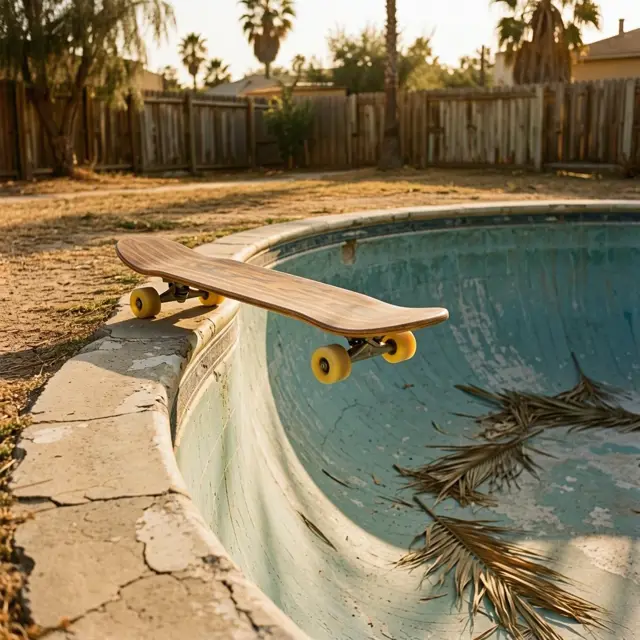
Then came a lucky break. During the 1976 California drought, many swimming pools were left empty. Skaters, including the Z-Boys from Santa Monica, began riding up their curved walls. This started the vert trend. With better control, skaters could go faster and try bolder tricks.
A skatepark boom followed. In March 1976, the first two large US skateparks opened a week apart, one in Florida and one in California. They were the first of about 200 skateparks built by 1982, partly because investment journals called them a good investment. But rising insurance costs closed many, and by the early 1980s the sport had faded again.
The Little Jump That Changed Everything
Early tricks were simple and a little wild. Skaters rode on two wheels, spun on the back wheels and did the 'hippie jump', leaping over a bar and landing back on the board. Some long-jumped from one board to another, often over small barrels or fearless teenagers.
Then, in 1976 in Florida, Alan 'Ollie' Gelfand invented a no-hands jump that took his nickname: the ollie. It stayed mostly a Florida trick until Gelfand visited California in the summer of 1978, and from there it spread around the world. In 1982, Rodney Mullen adapted the ollie to flat ground. Because it lets skaters do tricks in mid-air with nothing but the board, the flat-ground ollie became the basis of many street tricks.
Mullen kept going. He invented the 'Magic Flip', later renamed the kickflip, along with the 360 kickflip and many other tricks. The limits kept moving too. In 2012, Tom Schaar became the first skater ever to land a 1080.
Sneakers, Deck Art and an $800,000 Collection
Skaters have always cared about personal style. Since they do not usually wear uniforms, they show personality through the art on the bottom of the deck. Jim Phillips's 'Screaming Hand' design became the main logo of Santa Cruz Skateboards and ended up as a tattoo on thousands of people. Famous artists such as Andy Warhol and Keith Haring created limited-edition designs and prints for collectors.
Collecting got serious. In January 2019, Sotheby's in New York auctioned the full set of 248 deck designs ever sold by the brand Supreme. A 17-year-old from Vancouver bought it for $800,000. Back in 2014, a gold-plated board went on sale for $15,000, then the most expensive skateboard in the world.
Shoes became a badge too. Vans was the first sneaker company to back a professional skateboarder, Stacy Peralta. Tony Hawk once said, 'If you were wearing Vans shoes in 86, you were a skateboarder.' He has also said plenty of legendary pros started skating after seeing Back to the Future.
From Forest Ramps to the Olympics
Not everyone welcomed skaters. Norway banned the use, ownership and sale of skateboards from 1978 to 1989 over safety concerns. So Norwegian skaters built ramps in the forest and other hidden spots to avoid the police, while the whole country had just one legal skatepark, in Frogner Park in Oslo.
Still, the sport kept growing. By 2001, more Americans under 18 rode skateboards, 10.6 million, than played baseball, 8.2 million. By 2006 there were over 2,400 skateparks worldwide. SMP Skatepark in China covers 12,000 square meters and comes with a 5,000-seat stadium. Since 2003, Go Skateboarding Day has been celebrated every year on June 21.
The biggest stage came next. Skateboarding made its Olympic debut at the Tokyo 2020 Games, with competitions held in July and August 2021. There were men's and women's events in two disciplines, street and park. The sport returned for the 2024 Games, a long way from bored surfers on a flat day.