A dad's toy called the snurfer
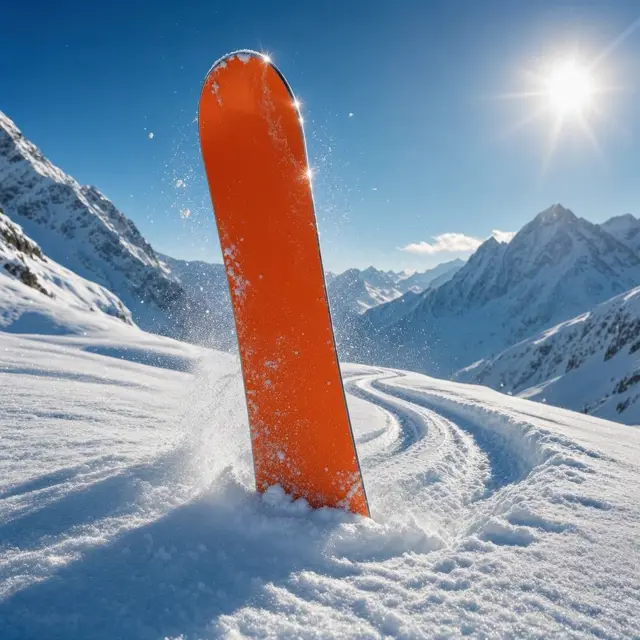
Snowboarding started with a father making something fun for his kids. In 1965, Sherm Poppen, an engineer in Muskegon, Michigan, fastened two skis together for his daughters. He tied a rope to one end so they had some control as they stood up and slid downhill.
His wife Nancy named it the "snurfer," a mix of snow and surfer. The toy was a hit with his daughters' friends, so Poppen licensed the idea to a company. Over the next ten years, about a million snurfers were sold. In 1966 alone, more than half a million flew off the shelves.
Other kids were tinkering too. In the 1960s, an eighth grader named Tom Sims made a snowboard in his school shop class. He glued carpet to the top of a piece of wood and stuck aluminum sheeting on the bottom. Sims later became one of the sport's big pioneers.
Jake Burton and the bindings
The next big step was keeping your feet on the board. In 1977, Jake Burton Carpenter, a Vermont native who had loved snurfing since age 14, showed up at a Michigan snurfing contest. He wowed the crowd with bindings he had designed to hold his feet in place.
That same year he started Burton Snowboards in Vermont. Sales were slow at first. People thought the 38-dollar price was too high, and many ski hills did not allow the boards. Yet Burton would grow into the biggest snowboarding company in the business.
In 1979 he entered the National Snurfing Championship with a board of his own design. Some people protested because it was not a snurfer. So the organizers created a special "Open" division. Burton was its only entrant, and he won prize money. That race is seen as the start of competitive snowboarding.
Banned from the slopes
For years, ski resorts did not want snowboarders at all. Skiers and snowboarders had a long feud. Early snowboards were banned from many slopes. At some places, snowboarders had to pass a small skills test before they could ride the chairlift. The fear was that an unskilled snowboarder would "wipe the snow off the mountain."
In 1985, only 7 percent of US ski areas allowed snowboarding. Being turned away helped create a whole culture. Snowboarders had their own way of talking, acting and dressing, with a rebel, outsider feel.
As gear and skills got better, attitudes changed. By 1990 most major ski areas had separate slopes for snowboarders. Today about 97 percent of ski areas in North America and Europe allow it. Still, as of 2026, three North American resorts say no to snowboards: Alta, Deer Valley and Mad River Glen.
From backyard fun to Olympic gold
The sport grew up fast. The first World Championship half-pipe contest was held at Soda Springs, California, in 1983. Two years later, the first World Cup took place in Zürs, Austria. In 1998, at the Winter Olympics in Nagano, Japan, snowboarding became an official Olympic event. France's Karine Ruby won the first women's gold and Canada's Ross Rebagliati won the first men's gold.
There are now many ways to compete. In snowboard cross, 4 to 6 riders race side by side down a course of jumps and banked turns. In big air, riders launch off one huge jump and try wild tricks. Half-pipe walls can stand between 8 and 23 feet tall.
Not every event is serious, though. Snowboarding also has "Anti Contests" built around fun and friendship. And since 2014, para-snowboarding has been a medal event at the Paralympic Winter Games.
Goofy riders and the Tamedog
Snowboarders have a language all their own. If you ride with your left foot first, that is a regular stance. Right foot first is called goofy. Riding the opposite of your normal way is called switch.
The trick names are even better. A Tamedog is a cartwheel over the nose of the board. A Wildcat is a cartwheel over the tail. A cork is a spin where the board leads through the air, while in a rodeo, your head leads. Trick names stack up, so you can hear something like a Backside Triple-Cork 1440.
Then there is jibbing, which means sliding or jumping on things that are not snow, such as rails, benches, walls or logs. Some riders prefer pure carving, linking smooth turns on hard snow. It can feel like a roller coaster. Shaped skis even owe some of their design to these carving snowboards.