Born From a Punctured Ball
Squash grew out of an older game called rackets, which was played in London's prisons in the 19th century. Then, around 1830, boys at Harrow School noticed something. A punctured ball that "squashed" when it hit the wall gave the game far more variety.
The idea spread to other schools. The first Harrow courts were actually risky, with water pipes and ledges sticking out. Students shortened their rackets to play in such tight spaces, and in 1864 the school built four outdoor courts.
The game soon crossed the Atlantic. North America's first squash court was built in New Hampshire in 1884, and the world's earliest national squash association formed in Philadelphia in 1904. By 1912, the game had even gone to sea. The Titanic had a first-class squash court on G-Deck, available for 8 pence. Passengers could use it for one hour, and spectators watched from a gallery one deck above.
A Ball That Needs Warming Up
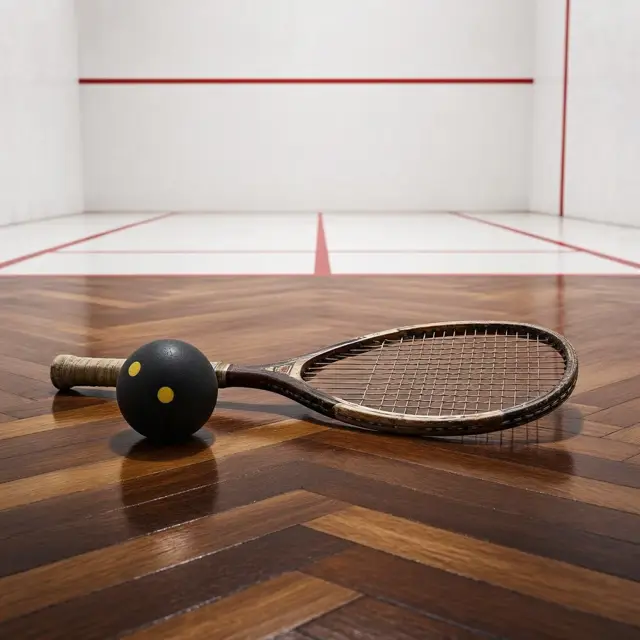
A squash ball is about 40 millimetres wide and weighs just 23 to 25 grams. It is made from two pieces of rubber compound glued together into a hollow sphere.
Here is the strange part. A cold squash ball barely bounces. Players must hit it dozens of times at the start of a session just to warm it up. Small coloured dots on the ball show how bouncy it is. Since 2000, the competition standard has been the double-yellow dot ball. There is even an orange dot ball for use at high altitude.
Curiously, better players use slower balls with less bounce. These balls tend to "die" in the corners, making winning shots easier to finish. Beginner balls bounce far more. Dunlop's blue dot ball, for example, bounces 140 percent as high as its pro ball. Rackets used to be made from a single piece of English ash. Today most weigh just 90 to 150 grams.
Whoever Holds the T Wins
The court is a box with four walls. Players take turns hitting the ball onto the front wall, above the tin, a half-metre-high metal strip at the bottom, and below the out line near the top. The ball can bounce off the side and back walls, but it may touch the floor only once before it must be returned.
The key spot is the centre of the court, called "the T" after the shape of the floor lines. Skilled players hit a shot, then rush back to the T, ready to reach any corner.
The most basic shot is the rail, hit straight along a side wall to a back corner. A soft drop shot into a front corner forces the opponent to sprint. Players also aim for the nick, the exact join between the floor and a side wall. Top players can spot an opponent's shot a few tenths of a second sooner than average players.
Bumping, Lets and Scoring to 11
Two players sharing a small box will get in each other's way. The rules give each player a clear path to the ball, room to swing and a clear shot at the front wall.
When a player is blocked, they can appeal for a let, and the point is replayed. If the blocking was bad enough, the referee can award a stroke instead, handing over the point. If a player is standing right in the path of the other's swing, a stroke is always given.
Today's matches use point-a-rally scoring to 11. Whoever wins a rally gets the point, no matter who served. A game must be won by two clear points, and matches are usually best of five. The older English system worked differently. Only the server could score, and games went to 9. At 8-8, the first player who reached 8 chose whether to play to 9 or 10.
Healthiest Sport, Olympic Newcomer
Squash is a serious workout. Players can burn roughly 600 to 1,000 food calories an hour, and rallies between strong players can run to 30 shots or more. In 2003, Forbes rated squash the number-one healthiest sport to play.
About 20 million people play regularly in over 185 countries, but one country stands out. In November 2019, Egypt held 15 of the top 50 spots in the men's world rankings and 13 in the women's, including ranks one through four in both.
Some records look almost impossible. Australia's Heather McKay went undefeated in competitive matches for 19 years and won sixteen British Open titles in a row. Yet for decades squash kept missing out on the Olympics, mostly because the action is hard to follow on television. That finally changed on 16 October 2023, when it was approved for the 2028 Summer Olympics in Los Angeles.