Win by Sending Him Out of a Circle
Sumo — the name literally means "striking one another" — has one of the simplest win conditions in all of sport. A rikishi, or wrestler, must force his opponent out of the ring or make him touch the ground with any body part other than the soles of his feet. Usually by throwing, shoving or pushing him down.
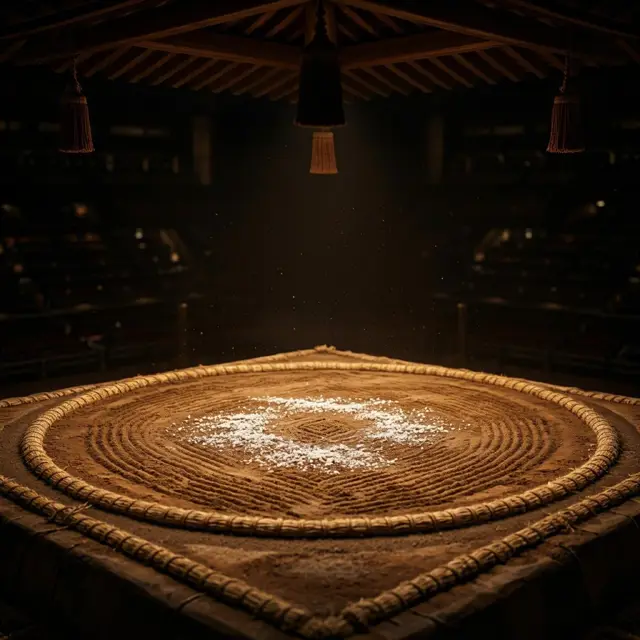
The ring is the dohyō, a circle of 15 shaku — about 4.55 metres across — built from rice-straw bales on a raised pedestal.
That simplicity produces astonishing brevity. Most bouts last a few seconds. The top division allows officially up to four minutes, but the vast majority are decided almost instantly, in the collision itself. Years of training, a body built over a decade, and the whole thing resolves in less time than it takes to read this sentence. Sumo originated in Japan and is practised professionally only there, where it is the national sport.
The Rank You Can Never Lose
Sumo's ranking system, the banzuke, runs through six divisions, descending from makuuchi — the top division, capped at 42 wrestlers — down to jonokuchi. Within makuuchi sit four titleholder ranks: yokozuna, ōzeki, sekiwake and komusubi.
Getting to the top is brutally defined. An ōzeki must win the championship in two consecutive tournaments to be promoted to yokozuna.
And then something unusual happens: a yokozuna can never be demoted. No run of defeats removes the rank. This sounds like a reward but functions as a trap — a yokozuna performing poorly is expected to retire rather than continue holding a rank he cannot live up to. Six honbasho tournaments are held annually, a schedule in place since 1958: three in Tokyo (January, May, September), plus Osaka, Nagoya and Fukuoka. Each runs 15 days, one bout per wrestler per day.
Ten Bowls of Stew and Fifteen Fewer Years
Modern wrestlers average over 150 kilograms, with a recorded average reaching 166 kg as of January 2019. That mass is built deliberately, and the method is not a secret.
The staple is chankonabe, a hot-pot stew. Wrestlers eat five to ten bowls per meal, often with beer alongside to push the calorie count higher. It is a training regime aimed squarely at size, because in a contest decided by shoving a man out of a circle, mass is leverage.
The cost is measured in years. Sumo wrestlers have a life expectancy of around 65 — roughly 15 years shorter than the average Japanese man. This is not an incidental risk like injury in other sports; it is the direct consequence of the body the sport requires. Every wrestler who succeeds does so by making a trade that is fully understood in advance.
A Life Entirely Prescribed
Professional sumo is not a job you go home from. Wrestlers are required to live in communal training stables called heya, each led by an oyakata, a former wrestler.
Inside the heya, tradition dictates nearly everything — meals, manner of dress, daily routine — under rules regulated by the Japan Sumo Association. The hierarchy is strict and physical: junior wrestlers perform chores, while senior sekitori are served by them. You do not simply train alongside your seniors; you cook for them.
The sport is classified as gendai budō, meaning a modern Japanese martial art, but it carries centuries of preserved ritual. Salt purification before a bout — throwing salt to symbolically cleanse the ring — comes directly from Shinto. Women cannot compete professionally or even enter the dohyō, an exclusion rooted in Shinto and Buddhist beliefs that treat women as impure because of menstrual blood.
Scandals, Foreigners, and a Recovery
Between 2008 and 2016, a run of high-profile controversies and scandals damaged sumo's reputation, hurt ticket sales, and made it harder to attract new recruits — a serious problem for a sport that needs teenagers willing to sign up for the heya life.
Meanwhile the composition of the top ranks shifted. Foreign-born wrestlers came to dominate the upper divisions: since January 2009, five of the nine wrestlers promoted to ōzeki have been foreign-born. Between 1998 and 2017 there was no Japanese yokozuna at all — a nineteen-year gap in the national sport's highest rank.
Sumo has since recovered. Popularity and attendance rebounded, helped by having multiple yokozuna at once for the first time in years and by other high-profile wrestlers capturing public attention. The sport that looked to be in decline turned out to need what every sport needs: someone worth watching.