Books for a Net, Books for Bats
The sport started in Victorian England as an after dinner parlour game among the upper class. One suggestion is that rough versions were worked out by British military officers in India around the 1860s or 1870s, who brought the idea home with them.
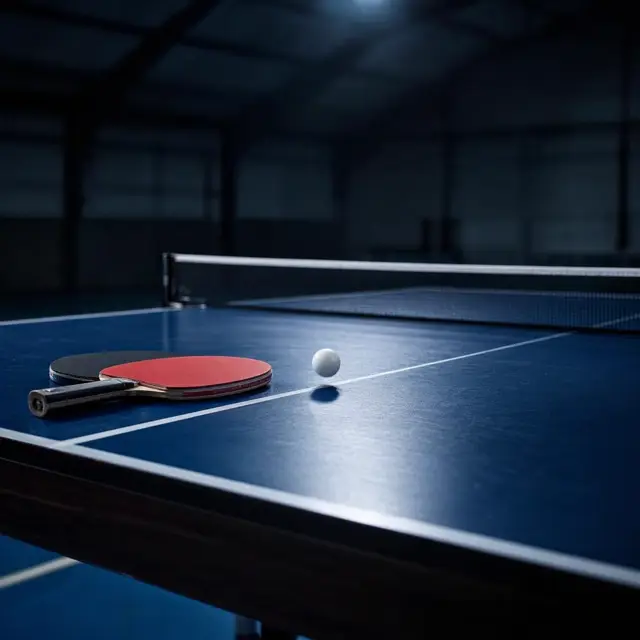
The early setup was improvised from whatever was on the table. A row of books stood upright down the middle as a net. Two more books served as bats. The ball was a golf ball, knocked back and forth across the dinner table.
Manufacturers noticed. In 1883 the British sporting goods company Slazenger filed a patent for a table tennis net, and the invention is also credited to David Foster in 1890. By 1901 the game had grown enough that tournaments were being organised, books were being written about it, and an unofficial world championship was held in 1902. The scoring in those days was borrowed straight from lawn tennis.
The Name Nobody Could Use
Ping-pong is onomatopoeia. The word imitates the sound of the ball hitting the table and the bat, and it was in wide use before anyone owned it.
Then the British manufacturer J. Jaques and Son trademarked it in 1901. From that point, ping-pong meant the game played with Jaques's rather expensive equipment, and every other manufacturer had to call it table tennis instead.
The same thing happened across the Atlantic. Jaques sold the American rights to Parker Brothers, who enforced the trademark in the 1920s and pushed the various associations into renaming themselves. That is why the governing bodies are called table tennis associations rather than ping-pong associations, and why the sport carries the duller of its two names officially. The American trademark for ping-pong is owned today by a sporting goods company.
The International Table Tennis Federation was founded in 1926, the same year London hosted the first official World Championships.
Celluloid, Rubber and Spin
Two changes in 1901 turned a parlour game into a sport. James Gibb, a British enthusiast, came across novelty celluloid balls on a trip to the United States and found them ideal. That same year E. C. Goode invented the modern bat by fixing a sheet of pimpled rubber to the wooden blade.
The next leap came in the 1950s, when players began using rubber backed by a sponge layer. That combination dramatically increased both spin and speed, and it changed how the game was played. From the mid-1980s, speed glue pushed spin and speed further still, to the point that the equipment rules had to be adjusted to slow things back down.
How you hold the bat also varies by region. The penhold grip, held the way you hold a pen, is popular among players from China, Japan, South Korea and Taiwan, while most European players use the shakehand grip. Table tennis became an Olympic sport in 1988.
Rules Rewritten for Television
After the 2000 Olympics in Sydney, the sport's governing body decided the game had become too fast to follow on screen and changed several rules at once.
First the ball grew. The old 38 millimetre ball was replaced by a 40 millimetre one in October 2000, which meets more air resistance and therefore travels slower. Months later, games went from 21 points to 11, effective September 2001, and the serve rotation dropped from five points to two.
Then came the serve itself. From 2002, players could no longer hide the ball during service, and the ball must be thrown at least 16 centimetres into the air so the receiver can see the serve happening. Since July 2014 all events use a plastic ball rather than celluloid.
There is also a rule against stalling. Under the expedite system, if a game is unfinished after 10 minutes and fewer than 18 points have been scored, the server must win the point before the opponent returns the ball 13 times.