It Started as Rugby in a Pool
One of the earliest water ball games on record, played at Bournemouth in 1876, lasted just 15 minutes. It ended when the ball burst. Back then, water games were a show of strength and swimming skill at fairs and festivals in England and Scotland.
The rules of modern water polo are credited to William Wilson, thought to be a baths master at the Arlington Baths Club in Glasgow. The first games of "aquatic football" were played there with a ball made of India rubber. People called it "water rugby". The name "water polo" came from the English way of saying pulu, the Balti word for ball.
Early matches were rough. Players could wrestle each other and hold rivals underwater to win the ball. The goalie did not even stand in the water. He waited outside the playing area and jumped in on anyone trying to score by placing the ball on the deck.
A Game With No Floor
Water polo is played between two teams of seven: six field players and one goalkeeper. A match has four quarters, and the team with more goals wins. The twist is the pool. It is usually deep all the way across, so players can never touch the bottom.
That means everyone spends the whole game swimming or treading water. Players stay up with the eggbeater kick, which keeps their hands free to pass, catch and shoot. It is no surprise that water polo is often called one of the hardest sports to play.
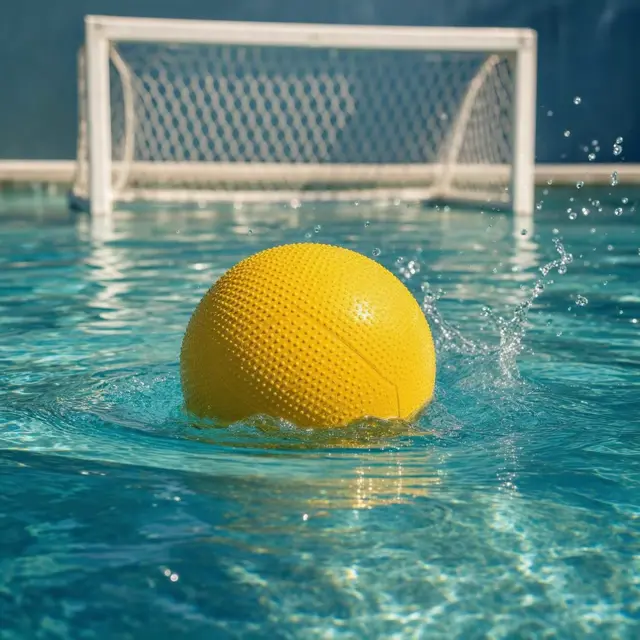
The gear is simple. The ball is about the size of a soccer ball, made to float, with a grippy surface. The goals either float in the water or attach to the sides of the pool. Players wear numbered caps with ear protectors. Home players wear dark caps, visitors wear white, and both starting goalkeepers wear red caps with the number 1.
Holes, Wings and the Washing Machine
Unlike most team sports, water polo has little fixed positional play. Players switch roles as the game demands. Those who can handle every spot are called utility players.
The key attacker is the center forward, nicknamed the "hole set", who waits right in front of the goal and directs play. Around them sit two wings, two drivers and a "point" player farthest from the goal. Left-handed players are especially wanted on the right side, so teams can attack from both directions.
Teams get creative with formations. One popular setup is called the "arc", "umbrella" or "mushroom". The perimeter players curve around the goal like the cap, and the hole set is the stalk. Another, nicknamed the "washing machine offence", has four players swimming in a constant square loop. It makes defenders' jobs harder, but it is also very tiring. Teams use it most when they lack a strong center forward.
Twenty Seconds Out of the Game
Fouls in water polo come with a clock. If a defender holds or sinks an attacker who doesn't have the ball, or splashes water in an opponent's face, they are excluded for twenty seconds. The attacking team now has six against five, a situation called man-up. They usually line up four players near the goal and two farther out, passing until someone gets an open shot.
Passing has its own tricks. A wet pass lands in the water just out of the hole set's reach, so they can swim onto it. A dry pass goes straight into their hand, which is harder to pull off.
Defenders can be sneaky too. In a move called sloughing, a defender commits a small foul on purpose, then drops back to double-team the hole set. Meanwhile, the goalkeeper has special powers inside the five-metre area. Only there can they touch the ball with both hands or punch it with a closed fist.
Extra Swimsuits and Spin-Off Sports
Grabbing an opponent's suit is a common foul. So players wear tight suits, and many layer several suits at once for extra security. Women's suits usually zip up the back, leaving no straps for anyone to grab.
Water polo has a long Olympic history. Men's water polo was the first team sport at the modern Olympics in 1900, introduced alongside cricket, rugby, football, rowing and tug of war. Women's water polo joined at the 2000 Sydney Games, after protests from the Australian women's team.
The sport has also inspired fun variations. In inner tube water polo, field players float in inner tubes, so casual players can join in without heavy training. Surf polo was played on surfboards on the beaches of Waikiki in the 1930s and 1940s. Flippa ball is played in shallow water where players may stand. In Singapore, it has even become a fitness activity for senior citizens.