It Started at a Croquet Club
The world's most famous tennis tournament began at a club for a different game. The All England Club was founded in 1868 as a croquet club. Lawn tennis was added in 1876, and the very next year, the club held its first Lawn Tennis Championship.
That first tournament in July 1877 was small. Just 22 men paid to enter. Rain delayed it by four days. In the final, Spencer Gore won in just 48 minutes, watched by about 200 spectators who paid one shilling each.
Today it is the oldest tennis tournament in the world and widely seen as the most important. It is one of the four Grand Slam events, and the only one still played on grass.
Dressed in White
Wimbledon is famous for its strict rules on clothing. Every player must wear all white, or almost all white. The rule became official in 1963, when the tournament enforced its first dress code.
Small splashes of colour are allowed, but not if they look like a company's logo. The tournament's own colours, dark green and purple, are everywhere around the grounds, just not on the players.
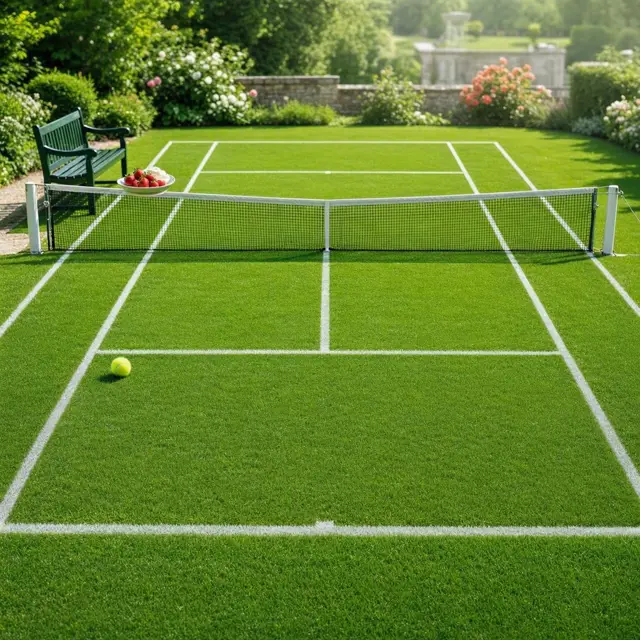
The courts get just as much care. Since 2001, they have been sown with 100% perennial ryegrass, a tough grass chosen to stand up to the modern game. The two main show courts are normally used for only two weeks a year.
Strawberries, Cream and 34,000 Kilograms
No visit to Wimbledon is complete without strawberries and cream. The tradition is so strong that the dessert has become a symbol of the tournament.
One story says it goes back to King Henry VIII, who was served wild strawberries and cream at a nearby palace, making the dish fashionable. The numbers today are huge. In 2017, fans ate 34,000 kilograms of British strawberries and 10,000 litres of cream. In 2019, 191,930 portions were served.
Wimbledon keeps other traditions too. Advertising around the courts is kept minimal. The company Slazenger has supplied the tennis balls since 1902, the longest-running sponsorship in sport.
A Roof, a Curfew and No More Line Judges
The old ways have slowly met the new. Because rain is common in English summers, a retractable roof was built over Centre Court before 2009. It can open or close fully in about 20 minutes.
The roof allowed matches to go on after dark under lights. But Wimbledon sits in a quiet residential area, so the local council set a limit. All matches must finish by 11 pm, making Wimbledon the only Grand Slam with a night-time curfew.
The biggest change came in 2025. After 147 years, human line judges were replaced by electronic systems that call whether the ball is in or out. Centre Court itself holds almost 15,000 fans, with a Royal Box at its south end.