A Sci-Fi Idea Before It Was Real
3D printing was described in a story before anyone built it. In his 1945 short story Things Pass By, writer Murray Leinster imagined a machine arm that drew shapes in the air, with plastic coming out of the end and hardening as it went.
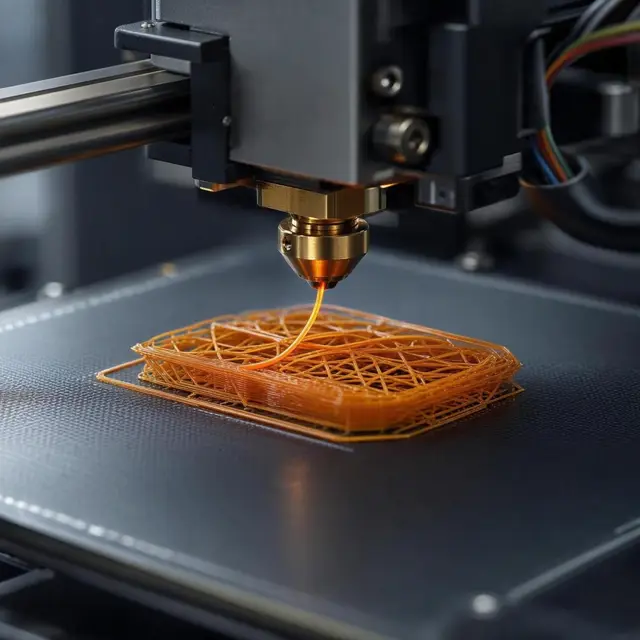
The real thing works in a similar way. Instead of carving a shape out of a block, a 3D printer builds an object from a digital model, adding material one thin layer at a time. That material might be melted plastic, a liquid, or fine powder fused together under computer control. Its official name is additive manufacturing.
This flips normal manufacturing on its head. Cutting methods start big and throw away everything that is not needed. Printing starts with nothing and only adds material where it belongs, which means far less waste. It can also make shapes that would be very hard to make any other way, like hollow parts, or parts with a light inner frame instead of solid metal.
The Inventor Whose Boss Was Not Interested
Some of the first working ideas came from Japan, and they were almost lost. In April 1980, Hideo Kodama at a research institute in Nagoya invented two ways to build 3D plastic models by hardening a liquid with ultraviolet light.
He published his results in 1981. Nobody reacted. His boss showed no interest, his research budget was just 60,000 yen a year, about 545 dollars, and the project was shut down.
Others pushed ahead. In 1984, Chuck Hull filed a patent for stereolithography, a system that builds objects by hardening thin layers of liquid with light. His company, 3D Systems, released the first commercial 3D printer, the SLA-1, in 1987 or 1988. Hull also created the STL file format that is still used to prepare models for printing.
In 1988, S. Scott Crump developed fused deposition modeling, which squeezes melted plastic through a nozzle. It went on to become the most common method of all. Back then, owning a 3D printer cost more than 300,000 dollars.
From 900 Parts to 16
For years, 3D printing was mostly used for quick test models, which is why it was once known as rapid prototyping. In the 2010s that changed, and the aviation industry was one of the first to notice.
In 2016, Airbus delivered the first of GE's LEAP jet engines with 3D-printed fuel nozzles. Twenty separate parts became one, and the nozzle got 25 percent lighter. A year earlier, Airbus had announced that its A350 XWB plane contained over 1,000 printed components. Then, in 2017, GE Aviation revealed a helicopter engine built from 16 parts instead of 900.
Cars followed. Urbee was the first car made using 3D printing, with its bodywork and windows printed. In 2014, a company called Local Motors showed off Strati, a working vehicle printed from plastic and carbon fibre, apart from the parts that make it move.
Meanwhile, prices crashed. By 2020, a decent entry-level printer could be bought for less than 200 dollars.
Printing Eyes, Faces and Bridges
The most personal uses are in medicine. In the mid-1990s, doctors began using printed models of bones to plan surgery. Soon came implants shaped to fit one single patient.
In November 2021, a British patient named Steve Verze received the world's first fully 3D-printed prosthetic eye from Moorfields Eye Hospital in London. In 2025, a UK cyclist named Dave Richards received a full-face printed prosthesis after severe burns. Researchers have also printed artificial blood vessels as strong as natural ones, and scientists are exploring bioprinting, building up layers of living cells to one day make tissue and organs.
The machines keep getting bigger, too. In July 2021, the world's first 3D-printed steel bridge opened over a canal in Amsterdam. Robotic arms printed more than 4,500 kilograms of stainless steel to make it. In 2024, the University of Maine revealed the world's largest 3D printer, able to make objects 29 metres long.
It is not perfect. Printing uses a lot of energy, and some of its waste cannot be recycled.