Broken Before the War Even Began
Here's a fact that sounds impossible: Poland cracked the supposedly unbreakable Enigma code in December 1932, almost seven years before World War II started. Germany hadn't invaded anyone yet, and its most guarded machine was already an open book to a handful of Polish mathematicians.
The breakthrough came from Marian Rejewski, a young mathematician working at Poland's Cipher Bureau. He didn't need a stolen machine to start. He used permutation theory to reverse-engineer Enigma's internal wiring, then exploited sloppy German habits to recover daily keys. By January 1933, Poland was reading German military messages regularly, years before anyone else even suspected it was possible.
A Keyboard That Rewires Itself With Every Letter
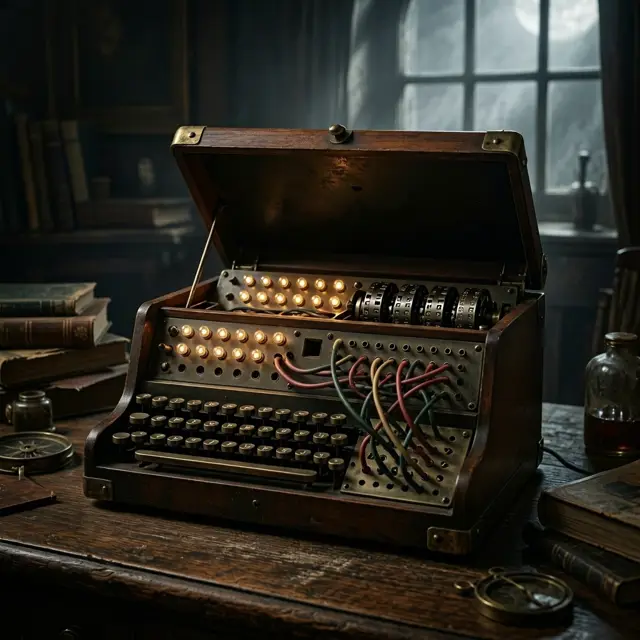
Enigma looked like an ordinary typewriter, but it hid something strange inside: three spinning discs called rotors, each wired to turn one letter into another. Every keystroke clicked at least one rotor forward, so the machine effectively switched to a brand-new secret code with every letter typed. Type the same letter twice in a row, and it could come out as two completely different letters.
A plugboard on the front let operators swap pairs of letters before the signal even reached the rotors, adding a whole extra layer of scrambling. A reflector then bounced the signal back through the rotors a second time, which is what let one machine decode what another had encoded. Add it all up, and a military Enigma had roughly 159 quintillion possible settings. On paper, it looked unbreakable.
The Spy Who Cracked the Door Open
Poland's mathematicians were brilliant, but they also got a very human head start. A German civil servant named Hans-Thilo Schmidt secretly sold Enigma operating manuals and key lists to French intelligence. France didn't think the documents alone were useful enough to break the cipher, so they passed copies along to Poland instead.
That decision changed history. Rejewski combined Schmidt's stolen paperwork with his own mathematics to reconstruct Enigma's internal wiring completely, without ever holding a real military machine in his hands. It's a rare case where old-fashioned espionage and abstract mathematics solved a puzzle that neither could have cracked alone.
Poland Hands Over the Keys, Weeks Before Invasion
On July 26, 1939, just five weeks before Germany invaded Poland, Polish intelligence officers met secretly with French and British counterparts near Warsaw. They handed over everything: reconstructed Enigma machines, their rotor-testing sheets, and blueprints for an automated codebreaking device called the bomba.
British codebreakers at Bletchley Park built on that foundation instead of starting from scratch. One of their own leaders later admitted the effort would never have gotten off the ground without Poland's head start. The resulting intelligence, codenamed Ultra, fed Allied commanders a steady stream of decoded German communications, and many historians believe it shortened the war substantially.
The Navy's Machine Even Poland Couldn't Beat
Not every Enigma was equal. Germany's navy, worried about leaks, ran tighter procedures than the army or air force, printing backup codes in water-soluble ink that dissolved instantly if a ship was about to be boarded. In 1942, U-boats got a fourth rotor, pushing their machines to a new level of complexity right as Britain was starting to gain ground.
That fourth rotor never turned during use, but it could be manually set to any of 26 starting positions, multiplying the possible combinations without changing the machine's size at all. It plunged Allied codebreakers back into darkness on U-boat traffic for months, a reminder of just how fragile their advantage really was.