The Internet Started as a Cold War Thought Experiment
Long before smartphones, computer scientists dreamed of linking machines together. In the late 1950s, J. C. R. Licklider pictured a universal network where anyone could reach any computer from anywhere. He worked at the Pentagon's Advanced Research Projects Agency (ARPA), the same office that would later fund the internet's earliest ancestor.
The real breakthrough was an idea called packet switching. Paul Baran at the RAND Corporation proposed a distributed network built from small message blocks in the early 1960s. Around the same time, Donald Davies at Britain's National Physical Laboratory invented the same idea independently, and even proposed a national UK data network. Neither scientist knew the other was working on it.
One Government Contract Built the First Network
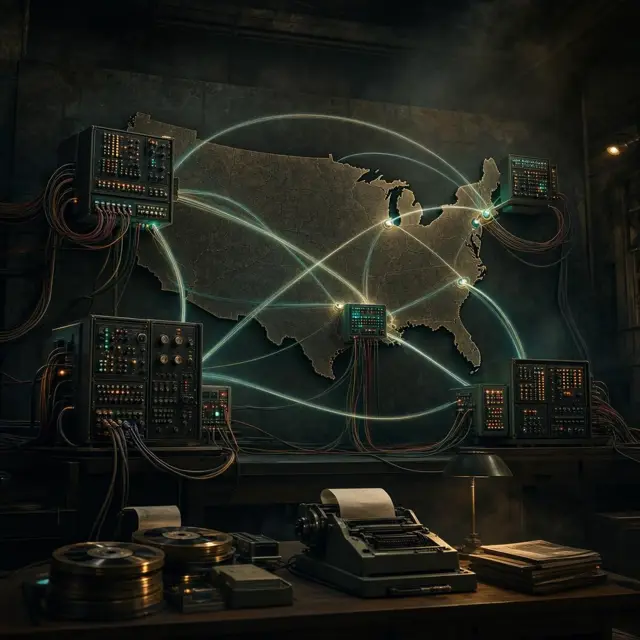
In 1969, ARPA signed contracts to build ARPANET, directed by Robert Taylor and managed by Lawrence Roberts. The project adopted Davies's packet-switching idea and even sought input from Baran himself. Machines called Interface Message Processors, built by a team at Bolt, Beranek, and Newman, formed the network's backbone.
The rules for how computers would actually talk to each other weren't written by generals or executives. They were mostly worked out by graduate students, led by Steve Crocker at UCLA alongside Jon Postel. Within a few years, ARPANET had grown beyond the United States, reaching the United Kingdom and Norway.
Stitching Separate Networks Into One
By the 1970s, several different packet-switched networks existed, and none of them could talk to each other. Researchers Louis Pouzin and Hubert Zimmermann at France's IRIA lab pioneered a simpler way to connect networks together. Peter Kirstein put the approach into practice at University College London in 1973, while Bob Metcalfe worked out the theory behind Ethernet.
The real glue arrived in 1974, when Vint Cerf and Bob Kahn published a paper describing what became TCP/IP, the two protocols that still run the internet today. Their design borrowed ideas from France's CYCLADES project. Meanwhile, Leonard Kleinrock at UCLA supplied the mathematics proving these packet networks could actually work at scale.
From Military Project to Public Utility
Through the late 1970s, national data networks sprang up using a protocol called X.25. In the United States, the National Science Foundation funded supercomputing centers at universities, then linked them together in 1986 with NSFNET. That project, plus the new Domain Name System and wider adoption of TCP/IP, is really where the internet as we'd recognize it began.
Commercial internet service providers appeared in the US and Australia in 1989, letting ordinary companies buy a connection for the first time. But the government-run NSFNET backbone kept a lid on commercial traffic until it was finally decommissioned in 1995, handing the network over to companies like Sprint, MCI, and AT&T.
A Scientist in Switzerland Adds the Web
The internet already existed for two decades before most people could easily use it. That changed when British computer scientist Tim Berners-Lee, working at CERN in Switzerland, built the World Wide Web in 1989-90. It let anyone link documents together and jump between them from any connected computer, using nothing more than a click.
The web arrived just as fiber-optic cables and a technology called wave division multiplexing were dramatically expanding how much data networks could carry. Together, they unlocked email, instant messaging, internet phone calls, video chat, blogs, social networking, and online shopping, reshaping culture and commerce almost overnight. What had been a tool for scientists and the military quickly became something ordinary households wanted in their own homes.
How the Internet Swallowed Global Communication
The internet's takeover of how humans communicate happened astonishingly fast. In 1993, it carried just 1% of all information flowing through the world's two-way telecommunications networks. By 2000, that figure had rocketed to 51%. By 2007, more than 97% of everything communicated over telecom networks traveled over the internet, leaving traditional phone lines and telegrams as an afterthought.
Speeds kept climbing too, with fiber-optic networks reaching 800 gigabits per second by 2019, letting more people stream, upload, and connect than ever before. Growth shows no sign of stopping, driven by ever more online information, commerce, entertainment, and social networking, though regional differences may still shape how the network's future unfolds.