Billions of Switches, One Fingernail
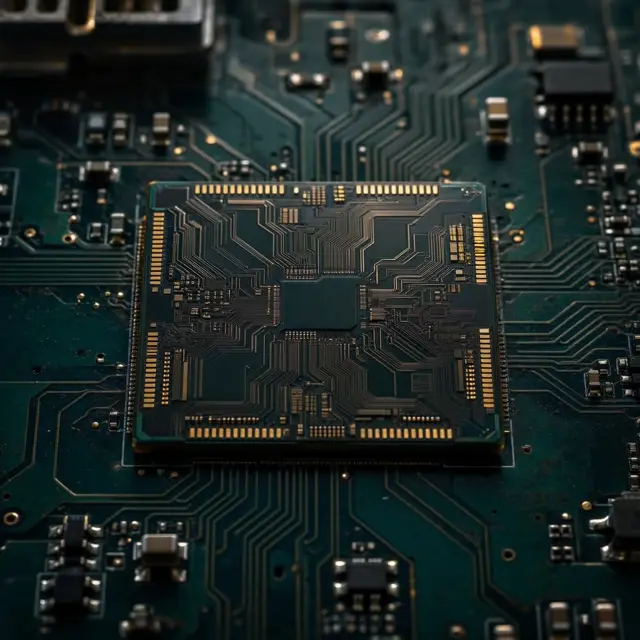
Hold up your finger and look at the nail. A modern chip built to fit inside that same tiny footprint can hold many billions of transistors, the tiny switches that make electronics think. They're all printed onto one flat piece of silicon, wired together without a single hand-soldered joint.
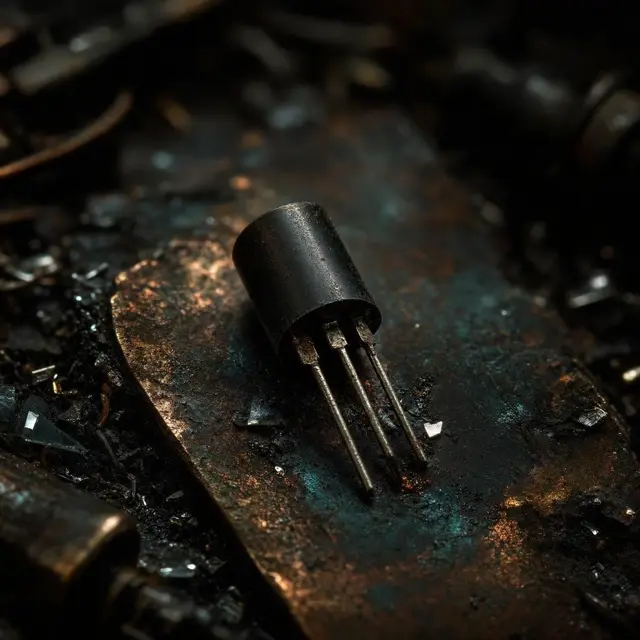
That single sliver is an integrated circuit, often just called a chip or a microchip. Before it existed, every transistor, resistor, and capacitor in a circuit was its own separate part, wired to its neighbors one at a time. Building anything complex meant building it huge.
Cramming an entire circuit onto one piece of semiconductor material did more than shrink electronics. It made them dramatically faster, cheaper, and far more reliable, since there were suddenly far fewer wires and connections left to fail.
The Six-Month Race That Changed Electronics
In July 1958, engineer Jack Kilby at Texas Instruments started sketching an idea: what if every part of a circuit came from the same block of material, instead of being wired together separately? By September 12, 1958, he had a working demo, built from germanium with fragile external gold wires holding it all together.
Kilby's chip proved the idea worked, but those gold wires made mass production impossible. About six months later, Robert Noyce at Fairchild Semiconductor solved that problem with a genuinely monolithic chip, built entirely from silicon using methods that let every connection be printed rather than hand-wired.
Both approaches mattered, but Noyce's version was the one manufacturing could actually scale. Kilby was awarded the Nobel Prize in Physics in 2000 for starting it all.
Printed, Not Wired: How a Chip Gets Built
A chip isn't assembled piece by piece. It's printed. Manufacturers start with a round silicon wafer, up to 300 millimeters across, and repeat three steps over and over: photolithography to mark out a pattern, deposition to lay down new material, and etching to cut away what isn't needed.
Each round of these steps adds another paper-thin layer of transistors, insulators, or metal wiring, stacked on top of the last. As of 2022, factories were routinely printing transistors just 5 nanometers across.
None of this comes cheap. Building a single fabrication facility capable of this precision can cost more than 12 billion US dollars, which is exactly why chip factories are among the most expensive buildings on Earth.
From Ten Transistors to Five Trillion
Chips didn't start out packed. The earliest commercial integrated circuits, launched in 1964, held somewhere between one and ten transistors, a scale engineers later nicknamed small-scale integration. Four years later, that number had already climbed into the hundreds.
By 1971 chips held thousands of transistors, entering the era of large-scale integration, and eventually hundreds of thousands, an era called very-large-scale integration. In 1986, the first one-megabit memory chips arrived, each holding more than a million transistors.
Microprocessors crossed the million-transistor mark in 1989 and the billion-transistor mark in 2005. By 2023, the densest chips on the market held more than 5.3 trillion transistors, a number that would have sounded like science fiction to the engineers of 1964.
Why Nearly Everything Runs on This One Invention
The integrated circuit didn't stay a lab curiosity for long. NASA's Apollo program became the single largest buyer of integrated circuits between 1961 and 1965, betting the moon landing on a technology barely a few years old.
That early bet paid off fast. A single chip cost about 50 dollars in 1962; by 1968 the price had fallen to just 2.33 dollars, and it kept falling from there. Cheap, tiny, reliable circuits suddenly made sense for far more than rockets.
Today integrated circuits sit inside computers, smartphones, televisions, and even the appliances in a kitchen. They're smaller, faster, and less expensive than any circuit built from separate discrete components ever could be, which is exactly why almost nothing electronic is built without one.