The Tiny Switch Hiding Inside Everything You Touch
You are probably touching a transistor right now. Your phone alone holds billions of them, packed onto a chip smaller than a fingernail. By 2018, more of these devices had been built than any other object humans have ever made — over 13 sextillion of them, a number with 21 zeros.
And yet almost nobody has ever seen one work, or even thinks about it. The transistor is the invisible gatekeeper inside every phone, laptop, computer, and car on the planet. It doesn't glow, it doesn't move, and it barely gets warm. But without this single invention, none of modern electronics would exist.
Two Gold Wires, One Crystal, and a Six-Week Experiment
The story starts at Bell Labs in New Jersey, in the winter of 1947. Between November 17 and December 23, scientists John Bardeen and Walter Brattain pressed two gold point contacts against a small crystal of germanium. When they ran a signal through it, the output came out stronger than the input that went in.
That was the first working transistor: no glass, no filament, no glow. It could do the same job as a bulky vacuum tube — control and boost electrical signals — using a tiny sliver of crystal instead. Bardeen, Brattain, and their colleague William Shockley shared the 1956 Nobel Prize in Physics for the discovery.
How a Whisper of Electricity Controls a Shout
A transistor's whole trick is deceptively simple: a small electrical signal at one set of contacts controls a much bigger signal at another set. Flip that small signal, and the transistor can act as an on-off switch. Feed it a weak signal, and it can act as an amplifier, turning a whisper into a shout.
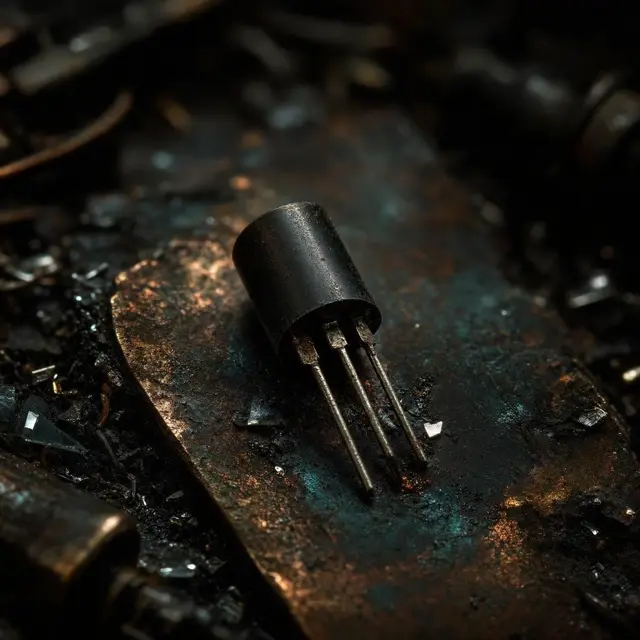
There are two main designs. A bipolar junction transistor uses three terminals called the base, collector, and emitter. A field-effect transistor instead uses a gate, source, and drain. Both do the same basic job through different internal plumbing, using a semiconductor material that conducts electricity only when told to.
The Upgrade Nobody Noticed That Changed Everything
The 1947 transistor was a breakthrough, but it wasn't the design that took over the world. That came more than a decade later. Between 1955 and 1960, researchers at the same Bell Labs built a new kind of transistor called the MOSFET. Mohamed Atalla and Dawon Kahng proposed the design in 1959 and demonstrated a working version in 1960.
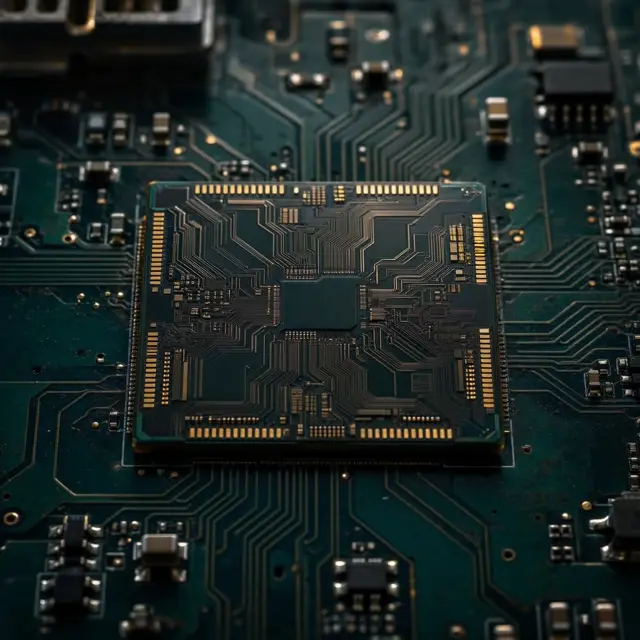
The MOSFET turned out to be smaller, cheaper, and far easier to manufacture in bulk than the original transistor. Today it makes up 99.9 percent of every transistor built on Earth. A single modern computer chip can now hold as many as 92 billion of them, wired together on a piece of silicon smaller than a stamp.
From Car Radios to Every Pocket on the Planet
The transistor's first big public debut wasn't a supercomputer, it was a radio. In the fall of 1955, Chrysler's Mopar 914HR became the first car radio built entirely from transistors instead of vacuum tubes. Two years later, in 1957, Sony's TR-63 became the first mass-produced transistor radio, small enough to fit in a coat pocket.
Those pocket radios were the transistor's first taste of everyday life, and they never looked back. The same basic idea, a tiny switch controlling electricity, scaled from one radio to billions of copies wired onto a single chip. It quietly became the foundation underneath computers, phones, and nearly every electronic object made since.