Three Centuries of Trying
People chased artificial cold long before they got it. In 1558 Giambattista della Porta described chilling ice far below freezing by mixing it with potassium nitrate. In 1620 Cornelis Drebbel put on a demonstration called Turning Summer into Winter for James I, cooling part of a hall in Westminster Abbey with troughs and vats.
In 1758 Benjamin Franklin and the Cambridge chemist John Hadley tested evaporation as a cooling method. Using a bellows to speed the evaporation of volatile liquids, they drove the bulb of a thermometer down to minus 14 degrees Celsius while the room sat at 18. Ice formed on the glass. Franklin concluded that one might see the possibility of freezing a man to death on a warm summer's day.
The 19th century supplied the machinery. Michael Faraday found in 1820 that compressed and liquefied ammonia could chill air as it evaporated. In 1842 a Florida physician, John Gorrie, built a compressor to make ice for cooling his patients, and imagined centralised cooling for entire cities. He patented it in 1851, then his main backer died and it went nowhere.
Built for Paper, Not People
The first modern electrical air conditioning unit was built in 1901 by Willis Carrier, and installed the following year at a lithographing and publishing company in Brooklyn.
Comfort was not the goal. The plant had a printing problem: changing humidity made the paper change size and threw the ink layers out of alignment. Carrier's machine controlled temperature and humidity together, which kept the paper stable. He patented air conditioning in 1906 and later founded the company that still carries his name.
The phrase came from somewhere else. In 1906 Stuart Cramer, working on a textile mill in North Carolina, filed a patent claim using the term air conditioning by analogy with water conditioning, a known process for making textiles easier to work. Carrier adopted the term.
There was an earlier thread too. From 1894 the Hungarian engineer Istvan Rock was building ammonia compressors driven by electric motors, and by 1896 his factory was making dry air cooling equipment for hospitals, theatres and public halls.
Into the House and the Car
Domestic cooling started awkwardly. The first home installation went into a Minneapolis house in 1914, a unit roughly 2 metres by 2 metres by 6 metres. It may never have been used, since the owner had died the year before and the house stood empty.
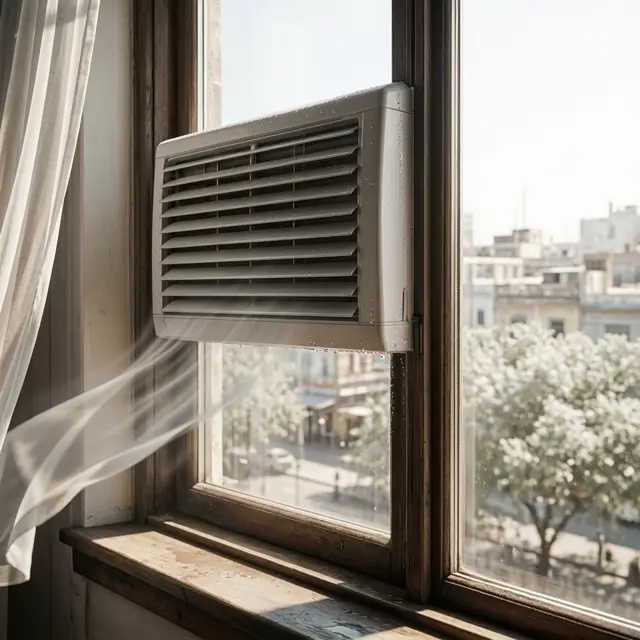
In 1931 two engineers developed the window ledge unit that became the standard form. It went on sale in 1932 at 10,000 to 50,000 dollars, equivalent to hundreds of thousands today. Cars followed quickly: the first automotive systems were offered in 1933, and Packard became the first manufacturer to offer one in 1939.
Prices came down after the war. In 1945 Robert Sherman invented a portable window unit that cooled, heated, humidified, dehumidified and filtered, and Henry Galson made a cheaper, more compact version that sold more than 43,000 units by 1947.
In 1954 an architect built 22 air-conditioned houses on a treeless plot in Austin, Texas, and the residents were studied for a year. Among the findings: families baked more, ate heavier food, and complained about scorpions seeking the shade.
How It Works and What It Costs
A conventional system runs on the vapor-compression cycle. A refrigerant is pushed around a loop and forced to change between liquid and gas, carrying heat out of the room and dumping it outside. A heat pump uses almost the same parts plus a reversing valve, which lets it run the cycle backwards and heat instead.
Drying the air is a side effect of the same process. If the evaporator coil is colder than the dew point of the air passing over it, moisture condenses out, which is why an air conditioner drips.
The scale is now enormous. As of 2016 there were an estimated 1.6 billion units worldwide, over half of them in China and the United States. The International Energy Agency expects about 4 billion by 2050.
The ledger runs both ways. Air conditioning is credited with averting an estimated 190,000 heat-related deaths a year, and historians rank it among the forces that shaped postwar city growth. It also used about 7 percent of the world's electricity in 2022.