One Forest, One Tenth of All Species
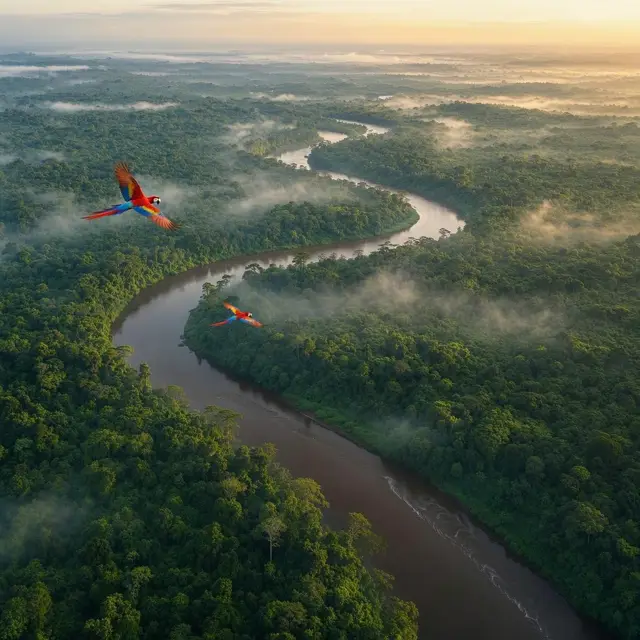
The Amazon is nature running up the score. The Amazon basin spans 7 million square kilometers across nine nations, with roughly 6 million covered by rainforest, 60 percent of it in Brazil, followed by Peru and Colombia. That single forest represents over half of all the rainforest left on Earth.
Its inventory reads like a misprint: an estimated 390 billion individual trees belonging to about 16,000 species, some 2.5 million insect species, 2,200 fish, 1,294 birds, and 427 mammals. All told, one in ten known species in the world lives in the Amazon rainforest.
The density is as astonishing as the totals. A single hectare of forest can hold around 310 tree species, more than many entire countries, and about 160 species of birds.
Named After Warrior Women
The forest's name comes from a battle story. When the explorer Francisco de Orellana fought indigenous women warriors along the great river, the encounter reminded him of the Amazons of Greek legend, and the mythological name stuck to a real place.
People are part of the forest's fabric, not visitors to it. More than 30 million people from 350 different ethnic groups live in the Amazon, spread across nine national political systems and 3,344 formally acknowledged indigenous territories.
Indigenous peoples make up 9 percent of the total population, and some 60 groups remain largely isolated, living with little or no contact with the outside world. Their territories have become central to the forest's story, both as homelands with deep history and as some of its best-defended remaining strongholds.
Fertilized by the Sahara
The world's greatest forest is fed by the world's greatest desert. An average of 182 million tons of dust are blown out of the Sahara every year, and the portion that crosses the Atlantic carries about 22 million tons of phosphorus, restocking the very nutrient that rain and flooding constantly wash out of Amazonian soils.
The forest repays the planet at scale. It accounts for roughly 10 percent of all the plant growth on land and holds around 110 billion metric tonnes of carbon locked in its wood and soil.
Which is why one recent finding landed like a siren: in 2021 it was reported that the Amazon emitted more greenhouse gases than it absorbed for the first time. The planet's great carbon sponge had, at least temporarily, flipped into a source.
The Tipping Point
The threat is not hypothetical. About 20 percent of the forest has already been transformed and another 6 percent highly degraded, and since 1970, 91 percent of deforested land has ended up as cattle pasture. In 2019 alone, Brazil recorded 72,843 fires, more than half of them in the Amazon region.
Scientists warn of a tipping point: crossing roughly 20 to 25 percent deforestation could flip large parts of the rainforest into dry savanna. Heat compounds the danger, with research indicating a 4 degree Celsius rise by 2100 would kill 85 percent of the rainforest.
There is a hopeful coda. With policy changes, deforestation in 2023 decreased by 56 percent compared to the same period in 2022, evidence that the trend can still be bent, and a reminder that the forest's fate remains a choice.