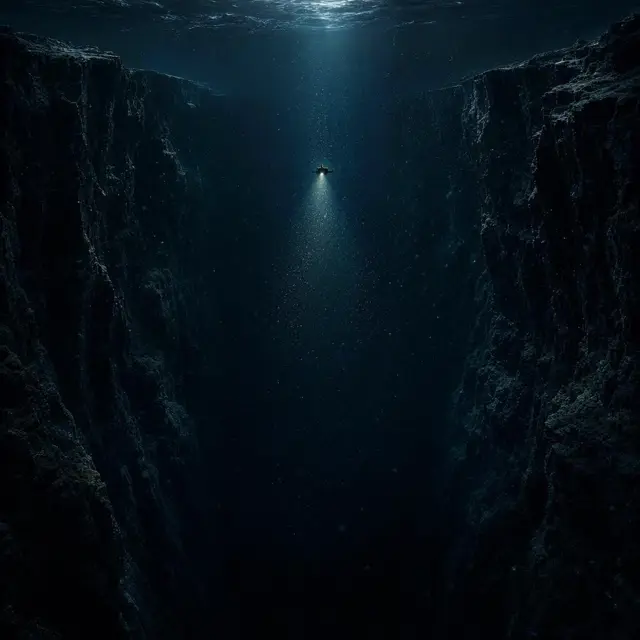
Deeper Than Everest Is Tall
The Mariana Trench is the deepest oceanic trench on Earth, curving through the western Pacific about 200 kilometres east of the Mariana Islands. It is crescent-shaped, roughly 2,550 km long and 69 km wide.
Its deepest known point sits in a small slot-shaped valley in the trench floor called the Challenger Deep, measured at 10,935 ± 6 metres. Put plainly: the bottom of the trench is more than 2 kilometres further from sea level than the peak of Mount Everest is above it. You could sink the world's tallest mountain into this gash and never see it again.
The trench exists because of subduction. It sits in the Izu-Bonin-Mariana subduction zone, where the western edge of the vast Pacific plate is being forced down beneath the smaller Mariana plate. The trench is essentially the seam where one piece of the planet's crust is being swallowed by another.
Eight Tons on Every Square Inch
Depth is the headline. Pressure is the reason almost nothing has ever been down there.
At the bottom, the weight of the water column above exerts 1,086 bar — about 15,750 pounds per square inch, or roughly 1,072 times the atmospheric pressure at sea level. That works out to something near eight tons pressing on every square inch. Any ordinary hull does not leak under that load; it implodes.
The temperature is barely above freezing, between 1 and 4 °C, and no sunlight has ever reached it. Measuring the depth accurately took over a century of steadily better instruments: 8,184 metres from HMS Challenger's survey in 1875, 10,900 metres from Challenger II in 1951, 11,034 metres from the Soviet vessel Vityaz in 1957, and 10,971 metres from RV Kilo Moana in 2009. The Challenger Deep takes its name from that first British survey ship.
The Shortest Guest List on Earth
Far more people have travelled to space than have reached the bottom of the Challenger Deep.
The first crewed descent came on 23 January 1960, when the Swiss-designed bathyscaphe *Trieste* carried Don Walsh and Jacques Piccard to roughly 10,916 metres. Then nothing, for more than half a century.
Film director James Cameron made a solo dive on 26 March 2012 in the *Deepsea Challenger*, reaching 10,908 m. In 2019, Victor Vescovo touched 10,928 m on 28 April and became the first person to descend to the bottom more than once. Each of these journeys required a purpose-built vessel capable of surviving pressure that would crush a submarine like a drinks can, for a few hours at the bottom of a place that has no natural reason to tolerate visitors.
Life Where There Should Be None
Crushing pressure, near-freezing water, permanent darkness — and the trench is still inhabited.
Researchers from the Scripps Institution of Oceanography found single-celled organisms called monothalamea at a record 10.6 km below the surface. Xenophyophores, giant single-celled organisms that can exceed 10 cm across, have been observed at extreme depth. Video has documented amphipods and jellyfish living down there.
In 2014 a Mariana snailfish was found at 8,145 metres, and 2025 research identified over 7,000 new microbial species thriving within the trench. Life did not merely survive the hadal depths; it diversified into them.
That life is not untouched. Vescovo's 2019 dive turned up a plastic bag and candy wrappers on the seafloor, and in 2024 a beer bottle was spotted in the Western Pool. Amphipods sampled from the trench showed 100% ingestion of microplastics, and elevated PCB concentrations have been documented in trench crustaceans.
Protecting a Place Almost Nobody Can Visit
In 2009, the United States established the Mariana Trench Marine National Monument, covering 246,610 square kilometres of trench that falls inside the American exclusive economic zone.
There is a neat geopolitical wrinkle in that protection. The Challenger Deep itself — the single most famous point in the entire trench, and the deepest place on the planet — is not included. It lies inside the exclusive economic zone of the Federated States of Micronesia instead.
So the deepest point on Earth sits outside the monument named after the trench that contains it. Protection here is largely an act of foresight rather than a response to visible damage. Almost nobody goes there, almost nothing can be extracted from there with current technology, and yet the plastic bags and PCB traces confirm that isolation is no longer any guarantee of safety.