A Mountain With Three Names
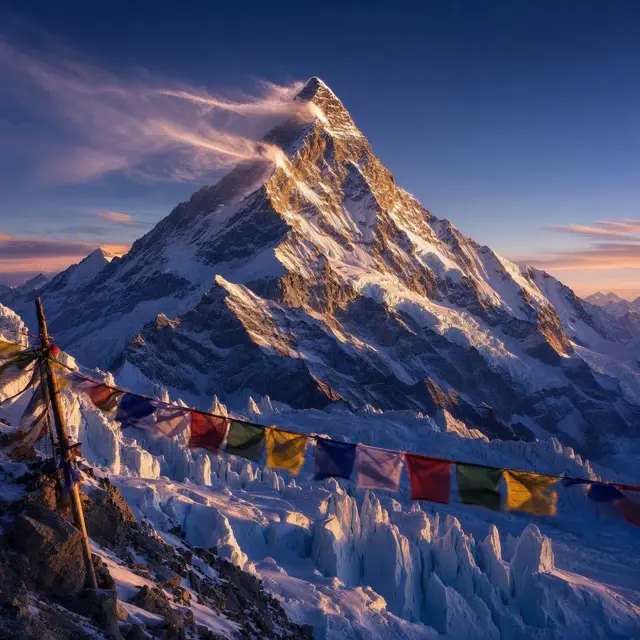
The highest point on Earth answers to three names. In Nepal it is Sagarmāthā — "the head in the great blue sky". In Tibet it is Qomolangma — "holy mother". The English name arrived in 1865, when British surveyor Andrew Waugh claimed he could not find a commonly used local name and proposed honoring his predecessor, Sir George Everest.
The punchline: Everest himself objected. He told the Royal Geographical Society that his name could neither be written in Hindi nor pronounced by the people of India. The society named it after him anyway.
The mountain's official height is freshly precise: 8,848.86 meters, measured jointly by Nepal and China in 2020 — a number that needs periodic re-measuring, because the restless geology beneath the Himalayas keeps adjusting the answer.
The Death Zone Keeps Its Dead
Everest's standard routes pose no extreme technical climbing — and that is precisely the trap. The killers are environmental: altitude sickness in the thin air above 8,000 meters — the infamous death zone — plus brutal weather, wind, avalanches, and the shifting ice towers of the Khumbu Icefall.
As of May 2024, 340 people have died on the mountain. More than 200 bodies remain there, unrecovered because retrieving them from such altitudes is itself too dangerous. Climbers on the main routes pass some of them.
Even reaching the start is an expedition: base camps sit above 5,000 meters. On the Nepalese side, climbers fly to Kathmandu, then Lukla, then trek to South Base Camp — making the full journey from Lukla to summit roughly 6,000 vertical meters of climbing.
The Mystery of 1924
Because Nepal was closed to foreigners, the first assaults on Everest came from the Tibetan north. A British reconnaissance reached 7,000 meters in 1921; the 1922 expedition made history as the first humans ever above 8,000 meters.
Then came mountaineering's greatest mystery. On June 8, 1924, George Mallory and Andrew Irvine set out for the summit from the north — and never returned. Whether they reached the top before dying remains debated a century later; if they did, the history of exploration needs rewriting.
The documented triumph waited until May 29, 1953, when Tenzing Norgay and Edmund Hillary stood on the summit via the Southeast Ridge. Norgay had come achingly close the year before, reaching 8,595 meters with a Swiss expedition. In 1960, a Chinese team completed the first reported ascent of the treacherous North Ridge.
Higher Than the Mountain Itself
Here's a paradox worth savoring: almost nobody climbs all of Mount Everest. The mountain's height is measured from sea level — and the nearest sea, the Bay of Bengal, lies almost 700 kilometers away. Climbers starting from base camp above 5,000 meters ascend less than half the mountain's official height.
One team took the logic literally. In 1990, Tim Macartney-Snape's expedition began at the Bay of Bengal shoreline and traveled the entire way to the summit on foot — the only way to truly climb all 8,848.86 meters.
The mountain remains a magnet for the ambitious and the record-hungry, its two main highways to the sky — southeast from Nepal, north from Tibet — carrying dreams, crowds, and consequences every climbing season.