The Longest River, With a Catch
At 7,088 kilometers, the Nile is the longest river in the world. Yet here is the surprise: it is also something of a lightweight. The Nile carries far less water than other giant rivers, only about one percent of the Amazon's flow and six percent of the Congo's.
It is young, too, at least geologically. The river has followed its present course for only about 15,000 years, a blink of an eye in Earth's history.
Its reach, however, is enormous. The Nile's drainage basin stretches across eleven countries, from Burundi and Tanzania in the south to Egypt in the north, covering roughly 2.93 million square kilometers. That is about ten percent of the entire African continent draining toward one river.
Two Rivers That Become One
The Nile is really two rivers wearing one name. The White Nile, the longer branch, begins near Lake Victoria and flows through Uganda and South Sudan. Lakes and wetlands along its path smooth out its flow, so it runs steadily all year.
The Blue Nile is shorter but far mightier. Rising near Lake Tana in the Ethiopian highlands, it delivers over twice the water volume of the White Nile, contributing about 54 percent of the Nile's annual flow against the White Nile's 32 percent.
The two meet at Khartoum, Sudan's capital, and the junction is visible to the naked eye. The White Nile arrives pale with quartz and feldspar sediment, while the Blue Nile runs dark with clay washed from volcanic rock, two colors flowing side by side before they blend.
The River That Fed the Pharaohs
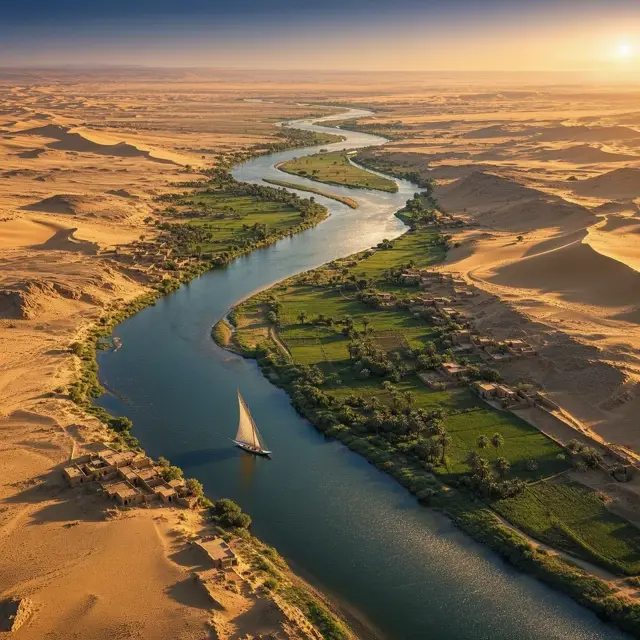
Ancient Egypt was, in a very real sense, a gift of the Nile. Every year the river flooded and left behind a layer of nutrient-rich silt along its banks. That thin ribbon of dark soil supported crops that let a sophisticated civilization thrive in the middle of an inhospitable desert.
The river was also Egypt's highway. It carried trade, communication, transportation, and the machinery of government. The Egyptians barely needed a separate name for it: their word jtrw meant both "river" and "the Nile".
Upstream lay Nubia, home of the ancient Kerma culture and the Kushite Empire. Much later, Europeans became obsessed with a puzzle that had lasted millennia: where does the Nile begin? Their explorations around Lake Victoria in the late 19th century finally traced the river toward its source.
Dams, Disputes, and a Shrinking Delta
The modern Nile is a river under management. Since the late 20th century, over a dozen dams have been built across its basin to irrigate farmland and generate electricity. The most famous, the Aswan High Dam, was completed in 1970 and holds back Lake Nasser, the world's second-largest human-made reservoir.
Control comes at a price. The dams have flattened the river's ancient flood cycle and now trap the silt that once rolled downstream, about 97 percent of which comes from Ethiopia's Blue Nile and Atbarah rivers. Starved of fresh sediment, the Nile Delta has begun to shrink as Mediterranean currents eat away at its edge.
The river has become a diplomatic flashpoint as well. Projects like the Grand Ethiopian Renaissance Dam have triggered international disputes over water scarcity, food security, and the displacement of communities.