A Desert Under Two Kilometres of Ice
Antarctica is Earth's southernmost and least-populated continent, sitting almost entirely south of the Antarctic Circle, surrounded by the Southern Ocean, and containing the geographic South Pole. It is the fifth-largest continent — about 40% larger than Europe, at 14,200,000 km².
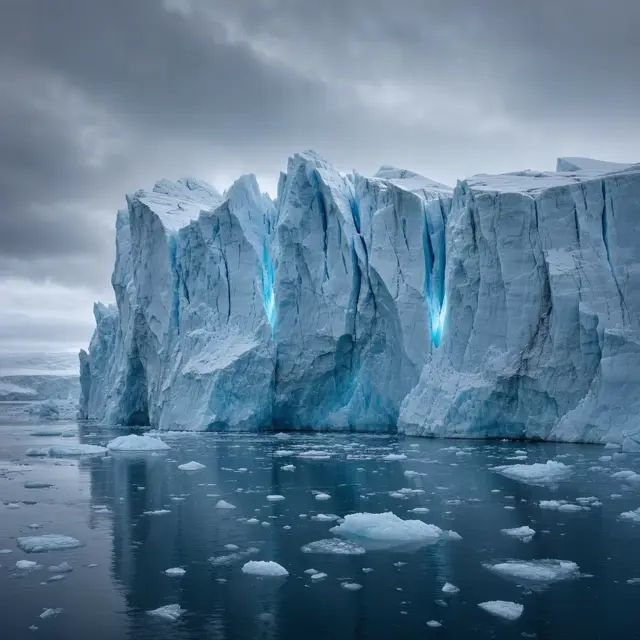
Most of it lies beneath the Antarctic ice sheet, which averages 1.9 km thick. Nearly two kilometres of ice, on average, across a landmass bigger than Europe.
And yet it is classified as a polar desert. Annual precipitation runs a little over 200 mm along the coast and far less inland. Antarctica is on average the coldest, driest and windiest continent, and has the highest average elevation of them all. It holds the record for the lowest measured temperature on Earth: −89.2 °C. Coastal regions, by contrast, can climb above 10 °C in summer — a swing of a hundred degrees across one continent.
Seventy Percent of the World's Fresh Water
About 70% of the world's freshwater reserves are frozen in Antarctica. That single figure explains why the continent dominates conversations about sea level.
If all of it melted, global sea levels would rise by almost 60 metres — two hundred feet. No coastal city on Earth survives that scenario in recognisable form.
Nobody expects the whole sheet to go, but a specific part of it drives the uncertainty. The melting of the potentially unstable West Antarctic ice sheet causes the most uncertainty in century-scale projections of sea level rise. The same melting also affects the Southern Ocean overturning circulation, which can eventually produce significant impacts on Southern Hemisphere climate and on the productivity of the Southern Ocean itself. The ice is not merely a reservoir; it is a lever on the planet's circulation.
Mites, Moss, and Not Much Else
For a continent of that size, the native cast is remarkably short. Native species of animals include mites, nematodes, penguins, seals and tardigrades.
That list rewards a second look. Alongside the famous penguins and seals sit microscopic survivors — nematodes are tiny worms, and tardigrades are the near-indestructible "water bears" renowned for enduring conditions that kill almost anything else. The celebrity wildlife shares the continent with organisms you need a microscope to see.
Vegetation barely registers. Where it occurs at all, it is mostly lichen or moss. There are no trees, no grasses, no soil ecosystem in any ordinary sense. Life here is not thriving in the cold so much as clinging on in the few places the cold permits.
Seen in 1820, Landed On in 1895
Antarctica's exploration history is compressed into a startlingly recent window. Its ice shelves were probably first seen only in 1820, during a Russian expedition led by Fabian Gottlieb von Bellingshausen and Mikhail Lazarev.
Decades of French, American and British expeditions followed, but the first confirmed landing did not come until 1895, by a Norwegian team. Humans had mapped most of the world before anyone reliably set foot here.
The interior fell quickly after that. British explorers Douglas Mawson, Edgeworth David and Alistair Mackay were first to reach the magnetic South Pole in 1909, and the geographic South Pole was first reached in 1911 by the Norwegian Roald Amundsen. Within about ninety years, Antarctica went from a coastline glimpsed from a ship to a pole stood upon.
A Continent Nobody Owns
Antarctica is governed by about 30 countries, all parties to the 1959 Antarctic Treaty System — an arrangement with no real parallel anywhere else on Earth.
Under its terms, four things are simply prohibited across an entire continent:
- Military activity
- Mining
- Nuclear explosions
- Nuclear waste disposal
What remains are tourism, fishing and research. The human population reflects that: during summer about 5,000 people live at research stations, dropping to roughly 1,000 in winter. A landmass larger than Europe is inhabited by fewer people than a small town.
Remoteness, however, buys less protection than it once did. Human activity still reaches the continent significantly through pollution, ozone depletion and climate change. You do not have to be there to affect it.