A Base Called Homey Airport
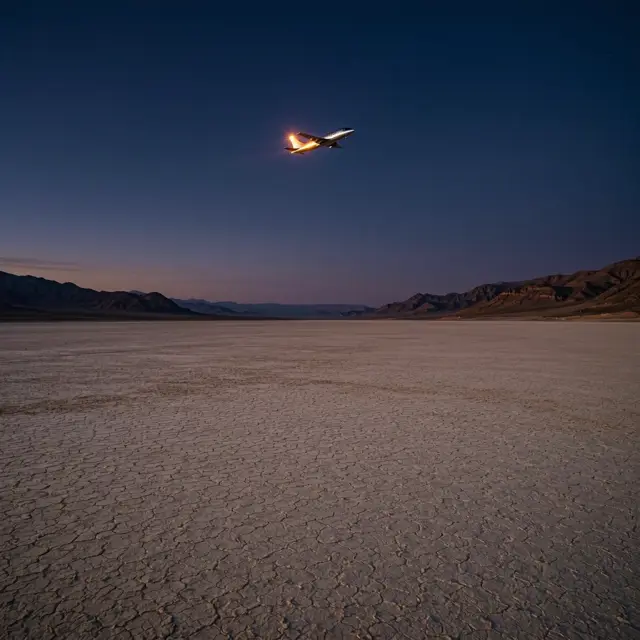
Officially, it is called Homey Airport, or Groom Lake, after the salt flat beside its airfield. Most people know it as Area 51, a highly classified U.S. Air Force facility in southern Nevada, 83 miles (134 km) north-northwest of Las Vegas.
Its nickname Dreamland is also the call sign for the airspace around it. Everything there is Top Secret, and buried motion sensors watch the approaches. Even military pilots training nearby can get in trouble if they stray into the restricted airspace around it. Guards in white pickup trucks patrol the orange posts marking the edge, and enthusiasts call them the camo dudes.
For decades, the government said very little. The Air Force officially acknowledged the site in 1998. On 25 June 2013, the CIA released an official history of its U-2 and OXCART spy plane projects, answering a Freedom of Information Act request filed in 2005. Many reports called it the first admission that the base existed, but it was really the first official word about what went on there.
Smooth as a Billiard Table
The story starts with a spy plane. In April 1955, the CIA set up a test site at Groom Lake for the Lockheed U-2, a high-flying reconnaissance aircraft. The project was so secret that testing could not happen at Edwards Air Force Base or at Lockheed's own site in Palmdale.
Lockheed's U-2 designer, Kelly Johnson, remembered flying over the dry lake. Within thirty seconds, he said, you knew that was the place. It was a perfect natural landing field, as smooth as a billiard table without anything being done to it.
Johnson named the spot Paradise Ranch to tempt workers to move to what the CIA later called the new facility in the middle of nowhere. At first it had little more than a few shelters, workshops and trailer homes. A little over three months later, it had a paved runway, three hangars, a control tower, a movie theater and a volleyball court. To guard the secret, staff flew in on Monday mornings and home to California on Friday evenings.
A Giant Spiral and a Scorpion Mascot
Next came Project OXCART, set up in August 1959 for the Lockheed A-12. Builders laid a new 10,000-foot runway and marked a huge spiral, about two miles across, on the dry lake bed. It was there so that an A-12 pilot running out of runway could abort instead of plunging into the sagebrush. Pilots called it The Hook.
The A-12 needed its own special fuel, so seven tanks were built to hold 1,320,000 U.S. gallons of it. The first A-12 was secretly trucked in from Burbank, California, and made its first flight on 26 April 1962.
Later, the base became a testing ground for stealth aircraft. The Have Blue prototype, a smaller test model of the F-117 Nighthawk, first flew there in December 1977. After finding a large scorpion in their offices, one testing team adopted it as their mascot and called themselves the Baja Scorpions. To stay hidden, F-117s were taken apart, loaded into C-5 cargo planes and moved in and out only at night.
Secret MiGs Over Red Square
For decades from the late 1960s, the United States quietly tested Soviet-made fighter jets at Area 51, and even owning one was a secret. In 1968, a joint Air Force and Navy project called HAVE DOUGHNUT flew a MiG-21 against the American F-4 in dogfight training.
At first the two jets seemed evenly matched, because many pilots would not push either plane to its limits. Then Navy pilot Tom Cassidy climbed into the MiG-21 and flew it right to the edge of a stall, and he got on the F-4's tail. The lesson was that the MiG-21 turned better at low speeds, so the F-4 had to keep its speed up. Data from these tests went to the Navy's new Top Gun school.
Pilots at nearby Nellis Air Force Base were not supposed to know about the American-flown MiGs, so the airspace above the range was closed. On flying maps, the zone was marked in red ink and became known as Red Square, a joke about the famous square in Moscow.
How a Spy Plane Became a UFO
In the mid-1950s, the U-2 began flying above 60,000 feet, far higher than airliners, and UFO reports went up. Most came in the early evening, when airline pilots flying west saw the U-2's silver wings catch the setting sun and glow like fire.
The Air Force's UFO investigation, Project Blue Book, checked U-2 and later OXCART flight records and explained most of the reports it got. But it could not tell the letter writers what they had really seen. Veterans say the A-12's wide, disk-like body and titanium skin, racing past at more than 2,000 mph, could make anyone think UFO. They believe the rumors helped keep the real work secret.
In 1988, a TV broadcast first publicly tied Area 51 to aliens. Its secrecy has made it the subject of many a conspiracy theory and a frequent setting in science fiction, from the film Independence Day to The X-Files. In July 2019, more than 2,000,000 people responded to a joke Facebook post about storming Area 51. In the end, 1,500 to 3,000 people showed up at two music festivals in rural Nevada.