Morse Code, Stretched Downward
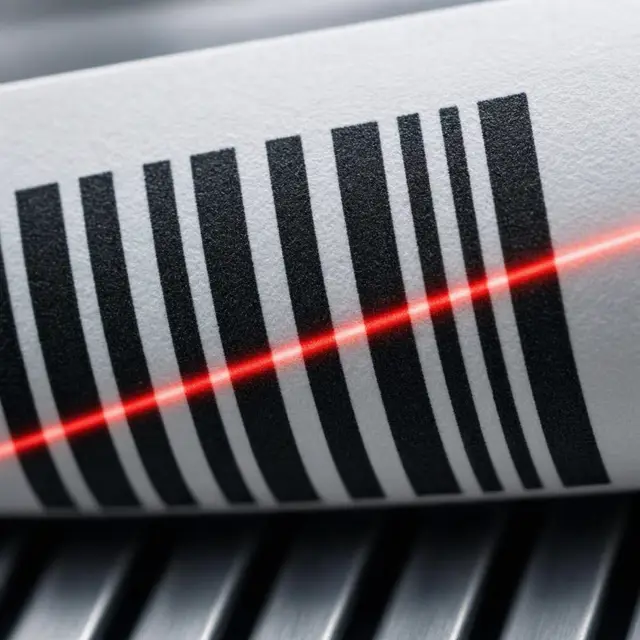
A barcode is a method of representing data in a visual, machine-readable symbolic form. The original kind — linear or one-dimensional — encodes information by varying the widths, spacings and sizes of parallel lines, and is read by an optical barcode reader.
The origin is more elegant than most people expect. The barcode was invented by Norman Joseph Woodland and Bernard Silver, and patented in the US in 1952. The invention was based on Morse code, extended into thin and thick bars.
That is the whole conceptual leap: take a system of short and long signals meant for the ear, and stretch it into a system of narrow and wide stripes meant for the eye. Everything since — the scanner beeps at every checkout on Earth — descends from someone realising that dots and dashes could be drawn instead of tapped.
Twenty Years With No Buyers
Having the idea turned out to be the easy part. It took over twenty years before the invention became commercially successful.
The technology worked long before the market wanted it. UK magazine *Modern Railways* recorded in December 1962 that British Railways had already perfected a barcode-reading system capable of correctly reading rolling stock travelling at 100 mph — with no mistakes. Reading a code off the side of a train at motorway speed, in 1962.
An early industrial use was sponsored by the Association of American Railroads in the late 1960s. Developed by General Telephone and Electronics and called KarTrak ACI (Automatic Car Identification), it placed coloured stripes in combinations on steel plates fixed to both sides of railroad cars, encoding ownership, equipment type and identification number. Trackside scanners read them as cars rolled past. The project was abandoned after about ten years, because the system proved unreliable after long-term use.
A Pack of Wrigley's Gum
What finally made barcodes succeed was the supermarket checkout — a task for which they have become almost universal.
The first successful system was at the UK supermarket group Sainsbury's in 1972, using shelf-mounted barcodes developed by Plessey. Then in June 1974, at a Marsh supermarket in Troy, Ohio, a scanner made by Photographic Sciences Corporation read the Universal Product Code on a pack of Wrigley's chewing gum — the first item scanned in the system that now runs global retail.
There is a quiet defeat in this story too. In 1973, the Uniform Grocery Product Code Council chose the barcode design developed by George Laurer over the circular barcode designed by Woodland and Silver themselves. Laurer's vertical bars simply printed better. The original inventors' shape lost to a rival not on cleverness but on ink.
From Bars to Squares
Later came two-dimensional variants, built from rectangles, dots, hexagons and other patterns, known as matrix codes or 2D barcodes. Despite usually being called barcodes, they contain no bars at all.
They can be read by purpose-built 2D scanners — but also, crucially, by any digital camera connected to a computer. Software analyses the photograph, deconstructs the pattern and decodes it, which is why any smartphone became a barcode reader with nothing more than an app. QR codes, one specific type of 2D barcode, rose in popularity through the 2010s precisely because smartphone ownership grew.
Barcodes now cover a huge range of tasks generically called automatic identification and data capture (AIDC). Rival systems have made inroads, but the simplicity, universality and low cost of the barcode has limited their role — particularly before technologies such as RFID became available. A pattern of printed lines has outlasted decades of more sophisticated competitors by being almost free.