Named After a Viking King
Every time you pair your headphones, you invoke a Viking. Bluetooth takes its name from Harald Bluetooth, the 10th-century Danish king who united scattered tribes into a single kingdom — just as the technology was meant to unite different devices under one wireless standard.
The name was proposed in 1997 by Jim Kardach of Intel, who had been reading about Scandinavian history in the novel *The Long Ships*. It was only meant as a placeholder — the official candidates were the considerably less romantic "RadioWire" and "PAN" — but when trademark searches couldn't be finished in time for launch, the Viking won by default.
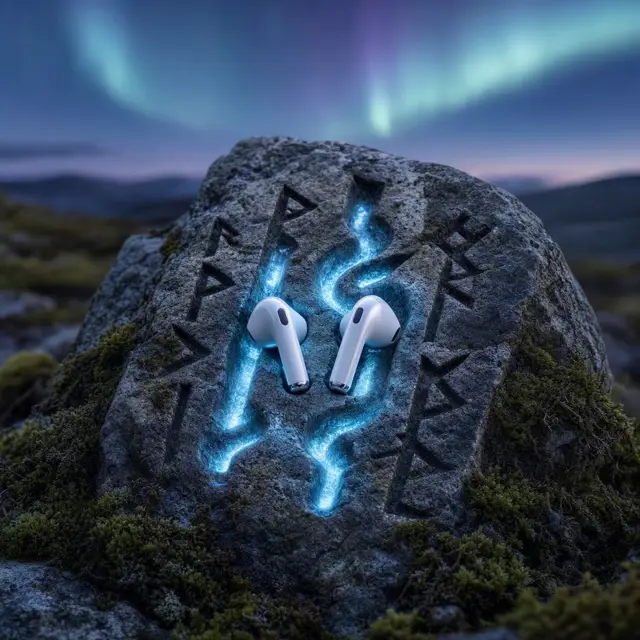
The famous logo seals the joke: it merges the Younger Futhark runes for Harald's initials, H and B, into one symbol. A thousand-year-old king's monogram now glows on billions of screens.
Born in a Swedish Lab
The technology itself began in 1989 at Ericsson Mobile in Lund, Sweden, under Nils Rydbeck, with engineers Jaap Haartsen and Sven Mattisson leading the work. By 1997 they had a working solution, and in May 1998 the Bluetooth Special Interest Group launched with founding members including Ericsson, IBM, Intel, Toshiba, and Nokia. Haartsen's contribution earned him European Patent Office recognition in 2012.
The first commercial Bluetooth device was Ericsson's R520m phone in early 2001, followed months later by the first Bluetooth laptop, an IBM ThinkPad.
From that start, adoption went vertical: the SIG now counts over 35,000 member companies, and as of 2021, manufacturers ship 4.7 billion Bluetooth chips every year — more than one new chip per human being, annually.
1,600 Hops Per Second
Bluetooth lives in the crowded, license-free 2.4 GHz radio band — shared with Wi-Fi, microwave ovens, and countless gadgets. Its survival trick is frequency hopping: a Bluetooth connection jumps between 79 channels 1,600 times per second, dodging interference faster than it can cause trouble, with adaptive hopping steering around the noisiest frequencies.
The classic range is modest by design — about 10 meters at a transmission power of just 2.5 milliwatts, though Class 1 devices reach 100 meters and Bluetooth 5.0 stretched the ceiling to 400 meters.
The other revolution was thrift. Bluetooth Low Energy, introduced with version 4.0 in 2010, redesigned the whole protocol to sip power — as little as a hundredth of a watt — so fitness bands and sensors could run for months on coin-cell batteries. Modern connections are guarded with 128-bit AES encryption.
From Your Pocket to Orbit
What started as a cable-replacement trick became infrastructure. Bluetooth now connects wireless earbuds, car stereos, speakers, game controllers, smart locks, medical sensors, TVs and soundbars — and stranger things: the city of Calgary's traffic division uses Bluetooth-derived travel data to monitor congestion.
The standard keeps evolving. Version 5.2 brought LE Audio and Auracast broadcast audio; version 6.0, released in 2024, added Channel Sounding for precise distance measurement between devices.
And the Viking king's reach now exceeds Earth: in 2024, Bluetooth was demonstrated in space for the first time — an early test aimed at extending the Internet of Things beyond the planet. Not bad for a protocol named as a placeholder joke.