Bread Came Before Farming
The usual story runs: people invented agriculture, grew grain, and then worked out bread. The oldest evidence says otherwise.
The earliest bread-making found so far comes from a 14,500-year-old Natufian site in the north-eastern desert of Jordan. Agriculture arrived around 10,000 BC. That leaves a gap of roughly four and a half thousand years in which people were making bread without farming for it.
The thread may run back further still. Evidence from 30,000 years ago in Europe and Australia shows starch residue on rocks used for pounding plants. It is possible that starch extracted from the roots of plants such as cattails and ferns was spread on a flat rock, set over a fire, and cooked into a primitive flatbread.
Once farming did spread, grain became the mainstay, and bread became one of the oldest prepared foods we have. Common bread wheat now makes the largest single contribution to the world's food supply of any food.
Nobody Invented Rising Dough
Leavening was not discovered so much as noticed. Yeast spores are everywhere, including on the surface of cereal grains, so any dough left to sit will rise on its own.
Somebody, at some point, left the bowl out and came back to something better.
An early leavened bread was being baked as early as 6000 BC in southern Mesopotamia, home of the Sumerians, who may have passed the knowledge to the Egyptians around 3000 BC. The Egyptians refined it and began deliberately adding yeast to flour. The Sumerians were already adding ash to dough as it baked.
Early bakers had several ways to catch yeast. You could leave the dough exposed to the air. Pliny the Elder recorded that the Gauls and Iberians skimmed the foam off beer, called barm, and used it to make a lighter bread than other peoples managed. Wine-drinking regions fermented a paste of grape juice and flour instead. The most common method was the simplest: keep a piece of yesterday's dough, which is sourdough.
Bread Is Technically a Foam
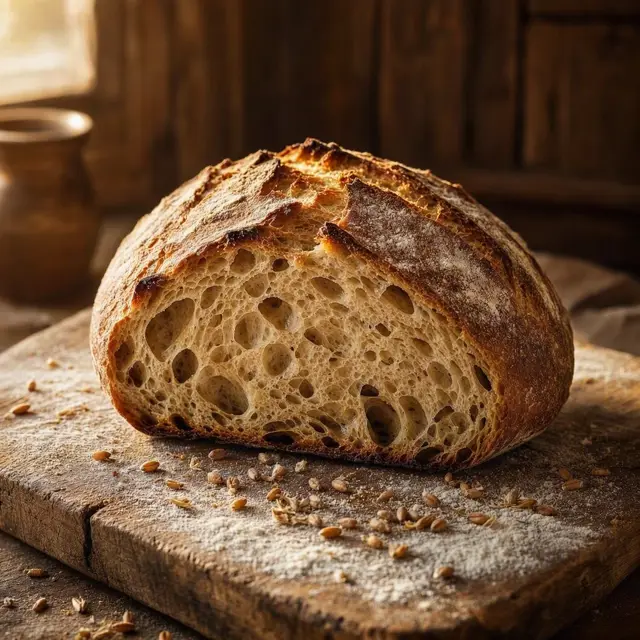
Structurally, bread can be defined as an elastic-plastic foam, which puts it in the same physical category as styrofoam. That is not a joke at bread's expense. It is what bread is.
The air pockets come from fermentation: yeast produces carbon dioxide and ethanol vapour, which inflate the dough. Trap gas inside a solid and you have a foam, or more precisely a gas-in-solid solution.
What does the trapping is gluten, and two proteins divide the labour. Glutenin builds interconnected networks through strong links between chains, and gives dough its elasticity, the ability to spring back into shape. Gliadin attaches more weakly and gives dough its plasticity, the willingness to stay in a new shape once pushed far enough.
This is why gluten-free loaves are genuinely hard to make. Without that network the dough struggles to hold its shape as it rises, and the crumb comes out dense, so bakers add binders such as xanthan gum, corn starch or eggs.
The Sixty-Second Loaf
Bread is the staple food across the Middle East, Central Asia, North Africa, Europe and European-derived cultures, in contrast to parts of South and East Asia where rice or noodles take that role. The ancient Egyptians, Greeks and Romans all treated skill in baking as a marker of civilisation.
Then, in 1961, the Chorleywood bread process changed how most of it is made. Instead of waiting for a long fermentation, the method works the dough with intense mechanical energy, drastically cutting the time needed to produce a loaf.
The commercial logic is obvious. The high-energy mixing also allows lower-protein grain to be used, so bread can be produced very fast and very cheaply, and the process is now widely used in large factories worldwide.
It has not gone uncriticised. There has been criticism of the effect on nutritional value. Mass-produced bread also commonly carries additives to improve flavour, texture, colour, shelf life, nutrition and ease of production.