A Coffee Break That Changed Science
In 1961, the meteorologist Edward Lorenz was running a weather simulation on a computer. He wanted to look again at part of an earlier run, so instead of starting from the beginning, he typed in numbers from an old printout as a shortcut.
Then he went down the hall for a cup of coffee. When he came back about an hour later, the computer had simulated roughly two months of weather, and the results looked nothing like the first run.
He suspected a broken part. But when he looked closely, he found the real cause. The printout had rounded the numbers. He had typed 0.506 instead of the full value, 0.506127. That tiny difference had grown steadily, roughly doubling every four days, until the two forecasts had nothing in common.
A very small change at the start had created a completely different outcome. Scientists call this sensitive dependence on initial conditions, and it sits at the heart of the butterfly effect.
From Seagull to Butterfly
Lorenz published his findings in 1963. Around that time, one meteorologist remarked that if the theory was right, a single flap of a seagull's wings could change the course of the weather forever.
The seagull did not last. Colleagues urged Lorenz to use something more poetic. When he failed to give a title for a talk in 1972, a colleague named Philip Merilees made one up: Does the flap of a butterfly's wings in Brazil set off a tornado in Texas? The butterfly stuck.
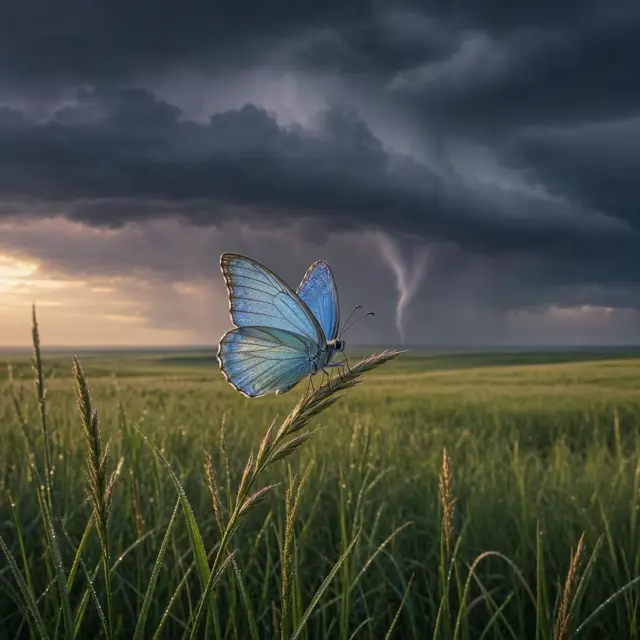
The butterfly does not create the tornado or power it. The point is that the flap is part of the starting conditions of a hugely connected system. One set of conditions might lead to a tornado, while another might not.
The idea is older than Lorenz. In 1950, Alan Turing wrote that moving a single electron by a billionth of a centimetre could decide whether a man was killed by an avalanche a year later. And in 1952, Ray Bradbury wrote a story about a time traveller who changes the future by stepping on a butterfly.
Why Weather Forecasts Run Out
The butterfly effect is a key idea in chaos theory, the study of systems where tiny differences can grow into huge ones. A chaotic system is still deterministic, meaning it follows fixed rules with no randomness. Yet in practice it can become impossible to predict.
That is because we can never measure the starting conditions of something like the weather perfectly. Every small error grows over time.
This is why weather forecasts have a limit. In the 1960s, scientists estimated that the weather can only be predicted about two weeks ahead, and that estimate became widely accepted. To deal with the uncertainty, forecasters now use ensemble forecasting: they run many forecasts, each starting from slightly different conditions, and compare the results.
Lorenz later went further. He showed that in some systems, beyond a certain point in the future, making the starting measurements more accurate would not improve the forecast at all, unless the error was exactly zero.
Does a Butterfly Really Cause Tornadoes?
Probably not, at least not in any way anyone has shown. Scientists now separate different kinds of butterfly effect. The first kind, the sensitivity to starting conditions that Lorenz found, is widely accepted and easy to show in computer models.
The second kind, the literal idea that a butterfly's flap could set off a distant tornado, has never been properly confirmed using a realistic weather model. Recent studies suggest it is unlikely in the real atmosphere.
Some scientists also argue that the weather is less sensitive than once thought, and that flaws in forecasting models matter more than tiny changes at the start. Climate scientists have pointed out that an unknown butterfly would take far too long to affect any real forecast.
But the idea has spread far beyond science. It is now used for any situation where a small change leads to big consequences, and it appears in books, films, TV shows such as The Simpsons, video games and songs.