A Picture Made of Pure Light
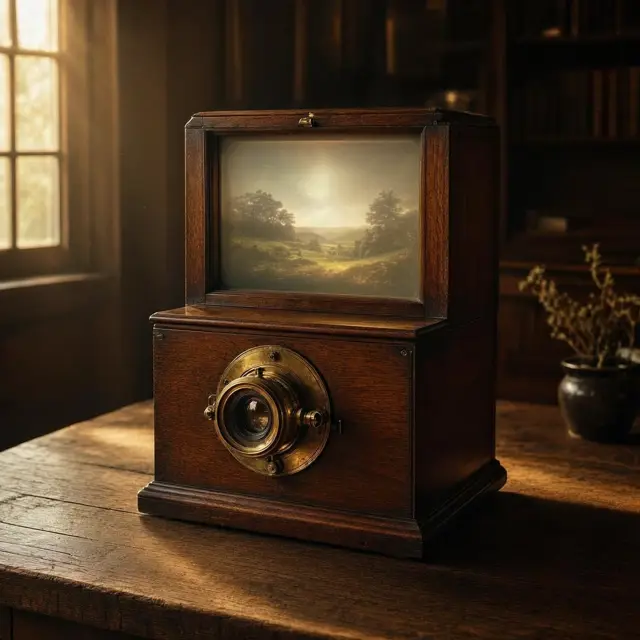
Light travels in straight lines. That simple fact is the whole secret of the camera obscura, Latin for dark chamber. Every lit object bounces light in all directions. A tiny hole in a wall lets through only the rays coming straight from each point outside. Those rays land on the opposite wall and paint a picture of the scene, upside down and reversed left to right, but with color and perspective intact.
The hole, or aperture, needs a careful balance. Make it smaller and the image gets sharper but dimmer. Make it too small and the sharpness is lost again, because light starts to spread out through diffraction. A good rule is a hole smaller than one hundredth of the distance to the screen.
That is why most camera obscuras use a lens instead. A lens lets a bigger opening stay in focus while letting in enough light. Add mirrors, and you can even flip the picture right side up.
Your Eye Works the Same Way
Here is the strange part. Your own eye works much like a camera obscura. Light enters through the pupil, passes through a lens and a dark chamber, and forms an upside-down image on the retina at the back.
The German astronomer Johannes Kepler was the first known to use the term camera obscura, in a book from 1604. To work out how it functioned, he did a clever experiment. He used a book in place of a glowing object and ran threads from its edges through a many-cornered hole in a table down to the floor. The threads traced out the shape of the book.
Kepler also realized that images land upside down and reversed on the retina, and he figured the brain somehow corrects them. In 1607 he studied the Sun with his camera obscura and spotted a sunspot. He thought it was the planet Mercury passing in front of the Sun.
Eclipses Through a Sieve and Leaves
People noticed pinhole images long before anyone built a camera. One of the earliest written records comes from the Chinese text Mozi, dated to the 4th century BC. Writings linked to Aristotle asked a puzzling question. Why does sunlight through square gaps in wickerwork make round spots? And why, during a solar eclipse, does light through a sieve or tree leaves make crescent shapes on the ground?
The answer, accepted much later, is that each spot is a tiny pinhole image of the Sun itself. In the early 11th century, the scientist Ibn al-Haytham studied this deeply. In one test, he placed several candles facing a hole into a dark room. Each candle made its own spot of light on the wall. Block one candle, and only its spot vanished.
In 1088, the Chinese scientist Shen Kuo heard a claim that a tower's upside-down image came from the sea reflecting it. His reply was blunt: This is nonsense.
Leonardo's 270 Drawings and Living Picture Shows
Leonardo da Vinci was hooked. In 1502 he wrote the oldest known clear description of the camera obscura. He explained how a sunlit building would appear upside down, in its true colors, on thin white paper inside a dark room. Over the years he drew about 270 diagrams of it. Yet his notes stayed unknown until they were decoded and published in 1797.
In 1558, Giambattista della Porta suggested using a convex lens to project the image onto paper for drawing. Later he went further and staged shows. Outside a dark room, scenes were set up in the sunshine with trees, mountains, handmade animals and performers. Inside, viewers watched it all play out on a white sheet. He claimed his friends could hardly believe it was just an optical trick.
In 1642, Mario Bettini described a camera with twelve holes. One soldier standing in front would appear as a squad of twelve, all moving in perfect sync.
From Drawing Box to the First Photographs
By the 18th century, portable camera obscura boxes were popular. Amateur artists took them on their travels, and so did professionals like the painter Joshua Reynolds. His camera was disguised as a book and now sits in the Science Museum in London. In 1694, Robert Hooke even described a cone-shaped box that fit over the user's head and shoulders.
In 1685, Johann Zahn proposed a handheld box with a mirror-reflex mechanism, a design later used in photographic cameras. Meanwhile, the magic lantern arrived by 1659 and partly took over as a projection device, showing pictures instead of real scenes.
The big leap came in the 19th century. Joseph Nicephore Niepce, Louis Daguerre and William Fox Talbot adapted these boxes to create the first photographs, catching the image on light-sensitive material. Today you can still build a camera obscura with a box, tracing paper, foil, tape and a blanket, and it remains a popular school science project.