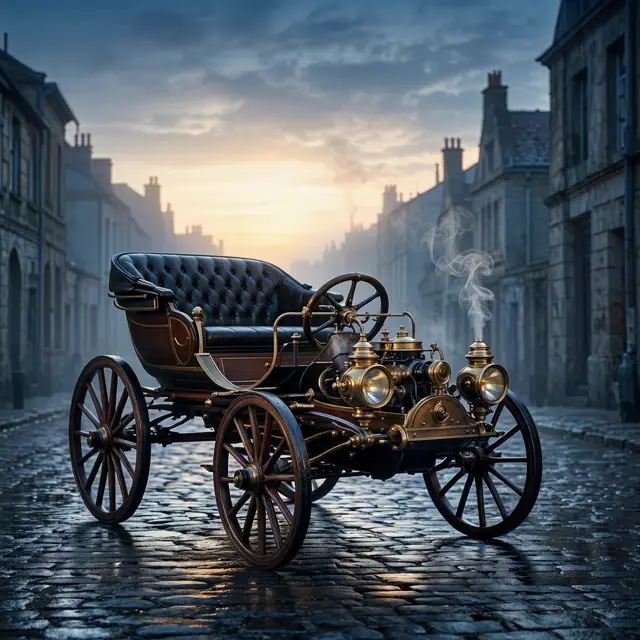
It Started With Steam, Not Petrol
The first full-scale, self-propelled mechanical vehicle ran on steam. Around 1769 the French inventor Nicolas-Joseph Cugnot built a steam-powered tricycle, then two steam tractors for the French Army. One of them still survives in the French National Conservatory of Arts and Crafts.
They did not work well. Cugnot's machines were limited by problems with water supply and with keeping up steam pressure. In 1801 Richard Trevithick demonstrated his Puffing Devil road locomotive in Britain, and it hit the same wall: it could not hold enough steam pressure for long.
The dream is even older. In 1649 Hans Hautsch of Nuremberg built a clockwork-driven carriage. Around 1672 a Flemish Jesuit, Ferdinand Verbiest, designed a steam vehicle in China as a 65-centimetre toy for the Kangxi Emperor. It could not carry a driver, and nobody knows for certain if it ever ran.
1886: The Patent That Made the Modern Car
Engines that burn fuel inside themselves came next. In 1807 the brothers Nicephore and Claude Niepce created what was probably the world's first internal combustion engine. In 1808 the Swiss inventor Francois Isaac de Rivaz designed and built the first automobile powered by one.
The practical, marketable car for everyday use arrived in 1886, when the German inventor Carl Benz patented his Benz Patent-Motorwagen. That is the moment generally counted as the invention of the modern car.
Then came scale. The 1901 Oldsmobile Curved Dash is widely considered the first mass-produced car, and the 1908 Ford Model T the first mass-affordable one. Cars were adopted rapidly in the United States, replacing horse-drawn carriages. In Europe, demand did not really take off until after World War II. In the 21st century, car use is still climbing fast, especially in China and India.
From Chariot to Automobile
The word car has deep roots. It is believed to come from the Latin *carrus* or *carrum*, meaning wheeled vehicle, which in turn came from the Gaulish *karros*, a chariot. For centuries it referred to any wheeled horse-drawn vehicle, from a cart to a wagon.
When engines arrived, English scrambled for names. "Motor car", "autocar" and "horseless carriage" are all recorded from 1895. Motor car remains the usual formal term in British English, while autocar is now considered archaic.
"Automobile" blends the Ancient Greek *autos*, meaning self, with the Latin *mobilis*, meaning movable. It came into English from French and was first adopted by the Automobile Club of Great Britain in 1897. It later fell out of favour in Britain and survives mainly in North America, where "auto" shows up in phrases like auto industry and auto mechanic.
The Price of Going Anywhere
There are over 1.6 billion cars in use worldwide as of 2025, and they have grown steadily more complex. Seat belts, airbags, rear cameras, air conditioning, navigation and in-car entertainment were all added over the decades.
Most cars in the early 2020s still run on internal combustion engines burning fossil fuels. Electric cars are not new, though: they were invented early in the car's history, became commercially available in the 2000s, and spread widely in the 2020s.
The benefits are obvious: on-demand travel, independence, convenience, and jobs across the automotive industry. The costs are real too. Traffic collisions are the largest cause of injury-related deaths worldwide. As of 2024, cars produce 10% of global carbon dioxide emissions. Heavy car use also brings congestion and urban sprawl, which raise infrastructure costs and limit mobility for people who cannot drive, including children, disabled people and the elderly.