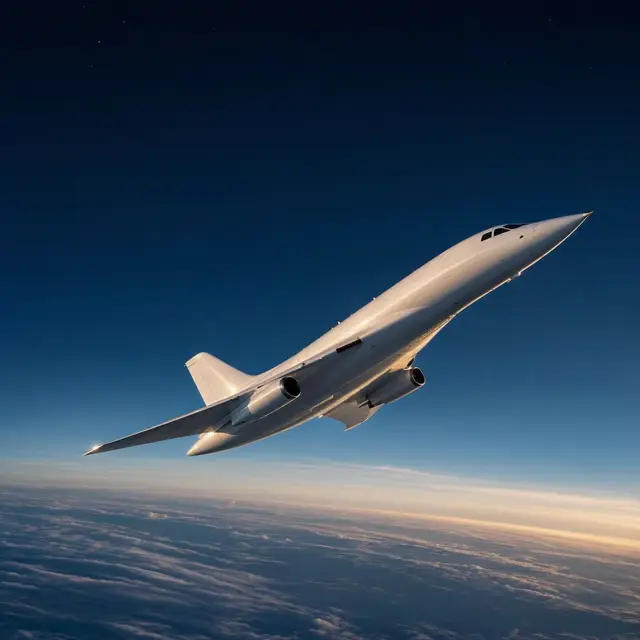
Across the Atlantic in Under Three Hours
Imagine crossing the Atlantic in less time than a long film. For 27 years, that was possible. Concorde cruised at twice the speed of sound and more than halved the time of a transatlantic flight.
Its record run came on 7 February 1996. Helped by a strong tailwind, a British Airways Concorde flew from New York to London in 2 hours, 52 minutes and 59 seconds.
The plane was built by Britain and France together, under a treaty signed in 1962. It first flew from Toulouse on 2 March 1969 and entered service on 21 January 1976, with Air France flying from Paris and British Airways from London.
A Plane That Stretched in the Sky
Flying that fast creates a lot of heat. Air rubbing against the plane at supersonic speed warmed the whole skin, so windows and panels were warm to the touch by the end of a flight.
The heat made the body of the plane expand by as much as 300 millimetres. A gap opened up on the flight deck between the engineer's desk and the wall. On some final flights, engineers slipped their caps into that gap and left them stuck there when the plane cooled and shrank again.
To cope, Concorde used its own fuel to soak up heat from the cabin air. It was also painted a bright, reflective white, which kept the skin 6 to 11 °C cooler.
The Nose That Bowed for Landing
Concorde's long, pointed nose was great for cutting through the air. But during take-off and landing, the plane tilted up so steeply that the pilots could not see the runway past it.
The fix was the famous droop nose. For take-off, the nose tilted down 5 degrees. Before landing, it dropped 12.5 degrees to give the pilots a clear view. In the air, it lifted back up, and a glass visor slid in front of the windscreen to keep the shape smooth.
Concorde was also the first airliner with analogue fly-by-wire controls. It flew so high that, if solar activity sent radiation levels too high, the crew would take it down below 47,000 feet.
Why Only 20 Were Ever Built
At first, the future looked bright. Planners expected to sell 350 aircraft, and airlines placed up to 100 options. In the end, only Air France and British Airways bought any, seven each, for a total of 20 planes.
One big problem was the sonic boom. The loud bang from breaking the sound barrier meant Concorde could only fly fast over oceans, not over land. Costs also ran far over budget, rising from an early estimate of £70 million to between £1.5 and £2.1 billion by 1976.
In 2000, Air France Flight 4590 crashed just after take-off, the only fatal accident in Concorde's history. Service resumed in 2001, but fewer passengers, rising repair costs and a slump in air travel led to retirement in 2003.
Still Loved, Years After Landing
When the last commercial flights landed in 2003, the crowds were so big that grandstands were built at Heathrow Airport to hold them.
The love never really faded. In 2006, the public voted Concorde the winner of the Great British Design Quest, beating the Mini, the London Tube map, the red telephone box and the World Wide Web.
Even its name had a story. "Concorde" means agreement or harmony, fitting for a joint British and French project. When Britain insisted on the English spelling "Concord", a minister later brought back the "e" and said it stood for Excellence, England, Europe and Entente. Today, 18 of the 20 planes are preserved and on display in Europe and North America.