A Plank, a Rope and a Baseball Cap
In 1991, two English pranksters named Doug Bower and Dave Chorley made headlines. They said they had started the whole crop circle craze back in 1978. Their kit was very simple: a wooden plank, some rope, and a baseball cap fitted with a loop of wire to help them walk in straight lines.
To prove it, they made a circle in front of journalists. A cereologist, a researcher who favored paranormal explanations, examined it and declared it genuine before the hoax was revealed. The pair said they had made more than 200 circles between 1978 and 1991, and that the idea came from a 1966 case in Australia.
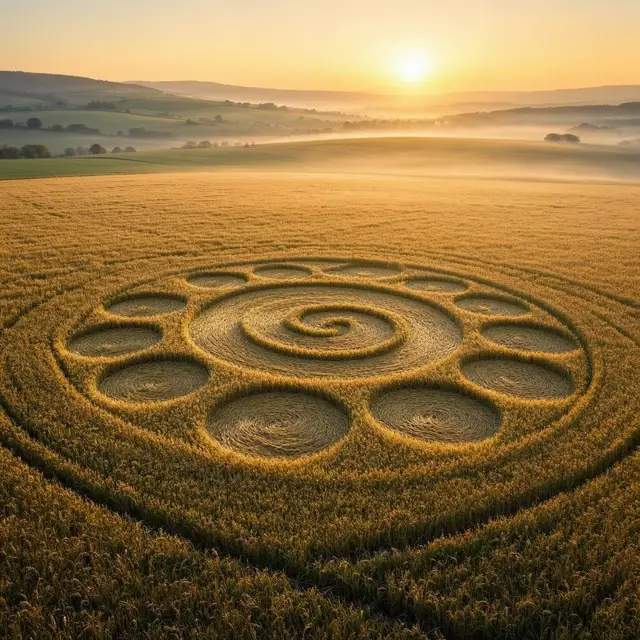
You might think the confession would end the craze. It did the opposite. Reports of crop circles rose sharply after their interviews, and circles began appearing all over the world in a copycat effect. By 2001, about 10,000 had been reported, from the United Kingdom and Japan to the United States, Canada and the former Soviet Union.
Flattened Fields Through the Centuries
The term crop circle only appeared in the early 1980s, but odd patterns in fields go back much further. A 1678 news pamphlet described a crop whose stalks had been cut rather than bent. In 1880, amateur scientist John Rand Capron wrote to the journal Nature about circles of flattened crops. He blamed a recent storm and "cyclonic wind action".
The case that inspired Bower and Chorley came in 1966 in Tully, Australia. A farmer said he saw a saucer-shaped craft rise from a swamp. He then found a roughly circular patch of reeds flattened in clockwise curves. The local police, the Royal Australian Air Force and the University of Queensland decided it was most likely natural, such as a down draught or a willy-willy.
Pop culture played a part too. The first film to show a geometric crop circle was the 1974 science fiction movie Phase IV. In it, the circles were made by super-intelligent ants.
How to Flatten a Field Overnight
The best-known method is simple. Tie one end of a rope to a fixed point and the other end to a board, then use the board to crush the plants as you walk around. If it has just rained, you can even bend the stalks without breaking them. When some people refused to believe Bower and Chorley, the pair began adding straight lines and squares to prove the shapes could not be natural.
In July 1992, a crop-circle-making contest was held in Berkshire, with a £3,000 prize. The winners were three helicopter engineers using rope, PVC pipe, a plank, string, a telescopic device and two stepladders. Eleven of the twelve teams made fairly impressive designs.
Since 2000, formations have grown larger and more complex, some with as many as 2,000 different shapes. Physicists suggest the most complex ones may be laid out with GPS and lasers. The scientific view is clear: crop circles are made by people, as hoaxes, advertising or art.
Why They Pop Up Where They Do
Crop circles in the UK are not scattered at random. Researcher Jeremy Northcote found they tend to appear near roads, near towns, and near famous ancient sites such as Stonehenge and Avebury, always in places that are easy to reach. In 2003, nearly half of all UK crop circles were found within 15 km of the Avebury stone circles. They usually show up overnight.
They are also different from a cropmark, which is a shape caused by old buried remains. Cropmarks do not appear overnight and show up in the same spot every year.
Weather was once a popular explanation. Meteorologist Terence Meaden blamed whirlwinds shaped by hills, and even Stephen Hawking said circles were "either hoaxes or formed by vortex movement of air". By the end of 1991, Meaden agreed the complex ones were made by people. One animal case is real, though: in 2009, Tasmanian officials said wallabies had flattened circles in poppy fields after nibbling the plants and running around in circles.
Tourists, Art and a Surprising Lawsuit
Farmers worried about damaged crops, but many locals welcomed the visitors. The interest created bus and helicopter tours, walking tours, T-shirts and books. Some artists now make circles for paying clients, like the UK art group Circlemakers. In 2009, The Guardian reported that makers around Wiltshire were busy with well-paid promotional work instead.
The circles have become part of pop culture. A crop circle from Wiltshire appears on Led Zeppelin boxed sets. During the 2012 London Olympics, one shaped like the Olympic rings was visible to passengers landing at Heathrow. In 2017, a father and his 11-year-old son made a 3 hectare circle in California, shaped like the Star Wars Rebel Alliance emblem, as a spaceport for X-wing fighters.
The law got involved too. In 1992, two Hungarian teens were sued over their circle. The judge ruled that 99% of the crop damage was caused by the thousands of visitors, not by them. A TV show paid their fine.