The Lowest Place You Can Stand
The Dead Sea is a landlocked salt lake bordered by Jordan to the east, the West Bank to the west and Israel to the southwest. It sits in the endorheic basin of the Jordan Rift Valley — a basin with no outflow to the sea — and its main tributary is the Jordan River.
As of 2025, its surface lies 439.78 metres below sea level, which makes its shores the lowest land-based elevation on Earth. Standing at the water's edge, there is nowhere on dry land you could go that would be lower.
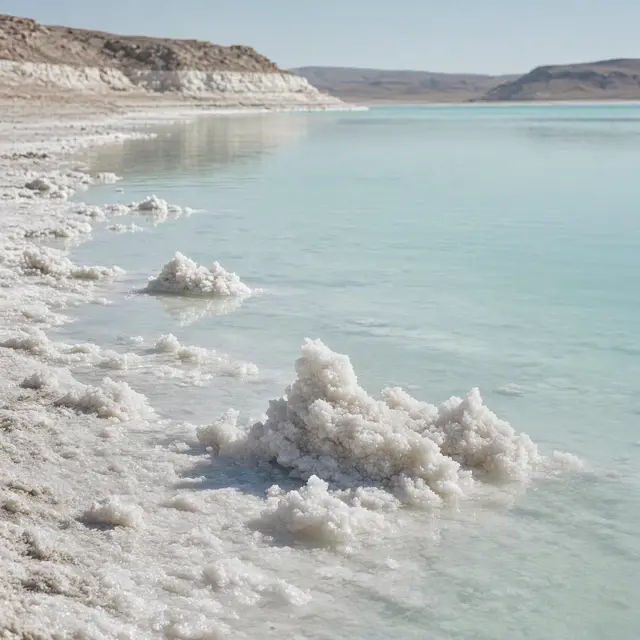
It is also deep for a lake in such a place: 304 metres, making it the deepest hypersaline lake in the world. The main northern basin runs 50 km long and 15 km wide at its widest point. The name is not poetic exaggeration but a description of what the water does to living things.
Why You Float and Fish Cannot
With a salinity of 342 grams per kilogram — 34.2%, measured in 2011 — the Dead Sea is one of the saltiest bodies of water on the planet, 9.6 times as salty as the ocean.
All that dissolved salt raises the water's density to 1.24 kilograms per litre. Human bodies are less dense than that, so a swimmer simply does not sink. Floating there is not a skill; it is unavoidable physics.
The same chemistry that holds you up excludes almost everything else. The salinity prevents macroscopic aquatic organisms — fish, aquatic plants — from living in it at all. But "dead" is not quite absolute. During rainy periods, when salinity drops to around 30%, microscopic life appears: Dunaliella algae and halobacteria containing carotenoid pigments. In 1980, a bloom of them turned the sea red.
Asphalt for Mummies, Potash for Fields
The Dead Sea has been an industrial resource for thousands of years, long before anyone used that phrase. It has drawn visitors from around the Mediterranean basin for millennia and was one of the world's first health resorts.
Its natural asphalt deposits were used in Egyptian mummification — a lake in the Jordan Valley supplying the embalming trade of another civilisation entirely.
Today the extraction is chemical and enormous. Potash, used in fertilisers, is the main product: Israel produces 1.77 million tons annually, and Jordan's Arab Potash generates around $1.2 billion in sales. The region also carries deep historical weight — the sea is associated with Sodom and Gomorrah, and the Dead Sea Scrolls, dated between 150 BCE and 70 CE, were found near Qumran on its northwestern shore in the 1940s and 50s.
A Lake Draining in Real Time
The Dead Sea is receding at a swift rate, and the numbers are stark. Its surface area was 1,050 km² in 1930. Today it is 605 km² — it has lost more than 40% of its surface in under a century. The level has fallen from around −390 m in 1930 to −439 m now, dropping roughly a metre per year in recent times.
The cause is upstream. The National Water Carrier, completed in 1964, diverted the flow of the Jordan River. Inflow is now less than 100 million cubic metres a year, against historical flows of 1.2 to 1.3 billion cubic metres. The lake is not evaporating faster; it is simply no longer being refilled.
The consequences are visible on the ground. Retreat has opened sinkholes along the shore and exposed old sediments, while evaporation ponds now dominate the southern basin. Canal and pipeline schemes have been proposed to slow it, including the Red Sea–Dead Sea Water Conveyance project, which was scrapped.