Something Was Stuck, and Then It Wasn't
An earthquake is the shaking of Earth's surface caused by a sudden release of energy in the lithosphere, which sends out seismic waves. The interesting part is why the energy was stored up in the first place.
Two sides of a fault would slide past each other quietly if the surfaces were smooth. They almost never are. Rough patches, called asperities, increase the friction and cause the fault to lock. The plates keep moving anyway, so stress builds in the rock around the locked section, and strain energy piles up with nowhere to go.
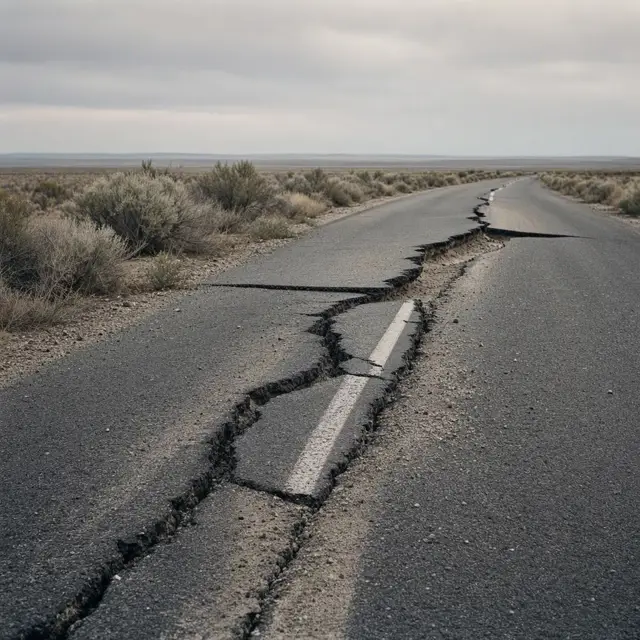
Eventually the stress becomes great enough to break through the rough patch, and the fault slides all at once, releasing what it has been holding. Geologists call this build-and-snap cycle the elastic-rebound theory. Only about 10% or less of the energy actually radiates as seismic waves. Most goes into cracking rock and frictional heat.
Where the Word Points, and Where the Break Starts
Two terms get mixed up constantly, and the difference matters when you read the news.
The hypocenter, also called the focus, is the point underground where the rupture actually begins. The epicenter is simply the spot on the surface directly above it. The epicenter is a map convenience. The earthquake starts below.
There are three main fault types that can produce one: normal, reverse (also called thrust), and strike-slip. Normal and reverse faults involve vertical movement, while strike-slip faults slide sideways, and plenty of real earthquakes combine both.
There is also a depth limit to all of this. Only the brittle upper crust and the cool slabs of plate descending into the mantle can store elastic energy and release it in a rupture. Rock hotter than about 300 °C flows under stress instead of breaking, so it does not produce earthquakes at all.
The Big Ones, and Why Size Is Not the Story
The largest earthquake ever measured on a seismograph was the Chilean earthquake of 22 May 1960, at magnitude 9.5. It released roughly twice the energy of the next most powerful, the Good Friday earthquake that struck Prince William Sound in Alaska in 1964.
The ten largest recorded earthquakes have all been megathrust events, and the longest ruptures ever mapped run to around 1,000 km, in places like Alaska, Chile and Sumatra.
But raw magnitude is a poor predictor of harm, and this is the point most coverage misses. Of those ten largest, only the 2004 Indian Ocean earthquake is also among the deadliest. What makes an earthquake catastrophic is where it happens: close to dense population, or offshore where the seabed can be shoved far enough to launch a tsunami that reaches communities thousands of kilometres away.
It Is the Buildings
The regions most at risk of heavy loss of life are not simply the shakiest ones. They are places where powerful earthquakes are relatively rare, so nobody prepares, and poorer places where seismic building codes are lax, unenforced or absent.
The 1556 Shaanxi earthquake in China illustrates it grimly. Most homes in the area were yaodongs, dwellings carved into soft hillsides, and the great majority of victims died when those collapsed. The building type, not the magnitude, decided the outcome.
Shaking is not the only mechanism either. Ground can undergo soil liquefaction, where saturated soil briefly behaves like a liquid and structures sink or tilt, and earthquakes commonly set off landslides.
Which is why the practical response is engineering rather than prophecy. Managing earthquake risk means forecasting, preparedness, seismic retrofitting of existing buildings, and designing new ones to survive shaking. Similar quakes have been detected on other worlds too, as marsquakes and moonquakes.