A Nation Packed Onto a Riverbank
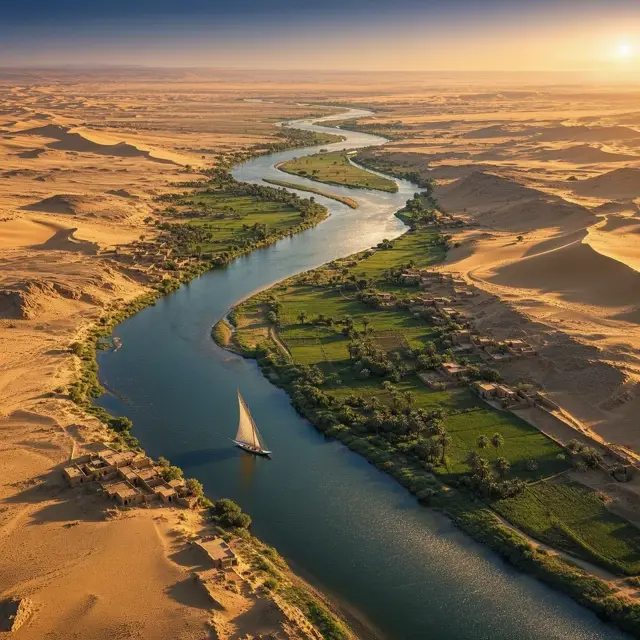
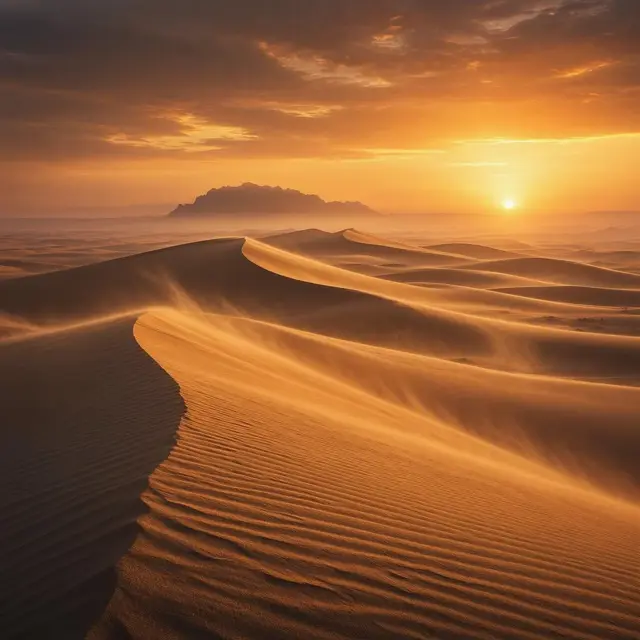
About 99% of Egypt's population uses about 5.5% of its total land. The reason is the climate: Egypt is extremely dry, so life crowds along the narrow Nile Valley and Delta. Away from the river, most of the landscape is desert, part of the Sahara and the Libyan Desert, with a few scattered oases.
Egypt spans the northeast corner of Africa and reaches into the southwest corner of Asia through the Sinai Peninsula. It borders the Mediterranean Sea to the north and the Red Sea to the east.
Cairo is the capital, largest city and leading cultural centre. Alexandria is the second-largest city and a hub of industry and tourism. With over 107 million people, Egypt is the most populous country in the Arab world, the third most populous in Africa, and the 15th most populous on Earth.
Black Land and Red Land
The ancient Egyptians named their country after its soil. One of its names, commonly written *Kemet*, comes from the word for black. It most likely refers to the fertile black soil of the Nile floodplain, set against *deshret*, the "red land" of the desert.
Ancient Egypt was also called "The Two Lands", meaning Upper and Lower Egypt after they were unified. Another name meant "land of the riverbank".
The English word Egypt comes from the Ancient Greek *Aigyptos*. Its likely source is *Hutkaptah*, "temple of the Ka of Ptah", a name for the ancient city of Memphis. The Arabic name, *Misr*, is the Classical and modern official name, and it stems from an ancient Semitic name for the land. Egyptians pronounce it locally as *Masr*.
Where Civilisation Practised Its Firsts
Egypt has one of the longest histories of any country. By about 6000 BCE, a Neolithic culture had taken root in the Nile Valley, as early peoples settled by the river and built an agricultural economy.
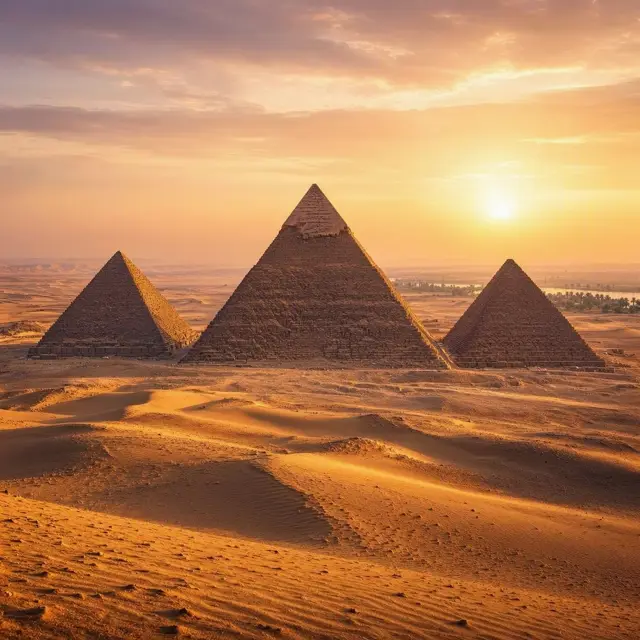
It is considered a cradle of civilisation. Ancient Egypt saw some of the earliest developments of writing, agriculture, urbanisation, organised religion and central government. Between about 2700 and 2200 BCE came the age of the pyramids, including the famous ones at Giza.
After nearly three thousand years of pharaonic rule, Egypt came under foreign rule from the 6th century BC. It became an early and important centre of Christianity, then adopted Islam from the seventh century onward. Alexandria, once the capital, was a hub of world knowledge through its famous Library.
Caliphs, a Canal and a Modern State
Cairo rose to the top in the Middle Ages. It became the capital of the Fatimid Caliphate in the tenth century, and of the Mamluk Sultanate in the 13th century. In 1517 Egypt became part of the Ottoman Empire.
The modern country took shape in the 19th century. Its ruler Muhammad Ali established modern Egypt, which became an autonomous Khedivate in 1867. The Suez Canal, completed in 1869 with French assistance, turned Egypt into a key strategic and commercial asset.
Egypt was later occupied by the British Empire and gained independence in 1922 as a monarchy. After the 1952 revolution it declared itself a republic. Today it has the second-largest economy in Africa, is regarded as a regional power in the Middle East, North Africa and the Muslim world, and is a founding member of the United Nations, the Arab League and the African Union.