Nothing to Do With Emotion
Almost everyone assumes emoji is related to the English word *emotion*. It is not. The resemblance is purely coincidental.
The word is Japanese: *e* (絵, "picture") plus *moji* (文字, "character"). Put together it originally meant simply pictograph. The overlap with "emotion" and "emoticon" is one of the great linguistic accidents — two unrelated words from opposite sides of the planet that happen to look like relatives and happen to mean roughly compatible things.
An emoji is a pictogram, logogram or ideogram embedded in text. Its primary job is to supply the emotional cues that typed conversation strips out — tone, warmth, sarcasm, the difference between "fine" and "fine" — and to replace words outright as part of a logographic system. Which is to say: after several thousand years of moving away from picture-writing, we quietly went back.
One Hundred and Seventy-Six Squares
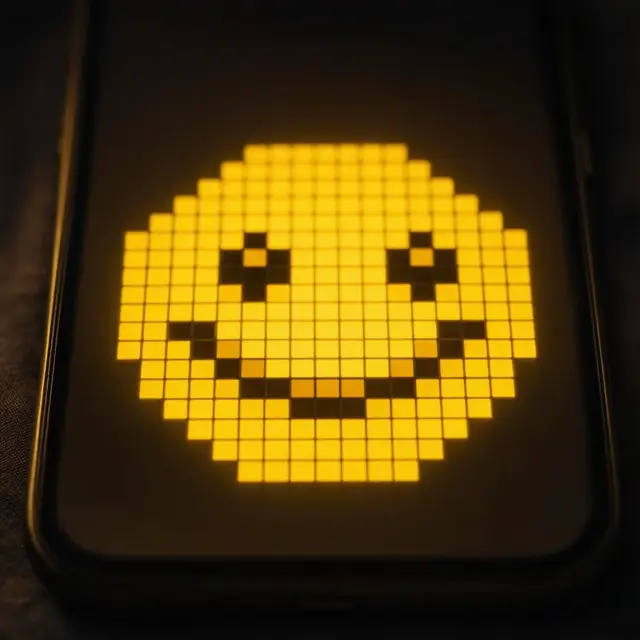
The most famous early emoji set was created by Shigetaka Kurita in 1999 for NTT DoCoMo's i-mode platform. It contained 176 brightly coloured emoji, each drawn at 12 by 12 pixels.
That is a grid of 144 dots. Every idea — love, weather, anger, a telephone, a bowl of ramen — had to be legible inside 144 squares. The constraint is severe enough that the results are less illustration than iconography, closer to a road sign than a drawing.
Kurita was not quite first. SoftBank had released 90 monochrome emoji in 1997 on the SkyWalker DP-211SW, though it saw limited adoption. But Kurita's set is the one that mattered and the one that endured — so much so that the Museum of Modern Art acquired the original collection in October 2016. A set of 12-pixel phone graphics is now a museum piece.
How a Picture Becomes Official
Emoji stayed a mostly Japanese phenomenon until they were given an address in the world's text system. The Unicode Consortium officially adopted emoji in 2010, following proposals from Google and Apple that began in 2007.
That step is why an emoji sent from one phone arrives on a completely different phone as the same idea. Unicode assigns each one a permanent code point, so it travels as a character rather than as an image. Today, Unicode 17.0 specifies 3,953 emoji using 1,438 characters across 24 blocks.
This is also the difference between an emoji and an emoticon. An emoticon is improvised out of ordinary punctuation — `:-)` is a colon, a hyphen and a bracket that you are choosing to read as a face. An emoji is a standardised character in its own right. One is a clever hack; the other is officially part of written language.
The Year a Face Was a Word
In 2015, Oxford Dictionaries named the emoji U+1F602 FACE WITH TEARS OF JOY its word of the year — noting that emoji "fill gaps" in digital communication. Not a word about emoji. An emoji, as the word.
It was a defensible choice. Research indicates Face With Tears Of Joy remains among the most widely used emoji globally, and emoji became increasingly popular worldwide through the 2010s until they were considered a large part of popular culture in the West and around the world.
The same year brought a quieter but more consequential change. The Unicode Emoji Technical Standard introduced five skin tone modifiers (U+1F3FB–U+1F3FF), based on the Fitzpatrick scale, allowing a single emoji to represent a range of skin tones. A system that began as 176 identical yellow squares had to grow up and account for the fact that the entire planet was now using it.