The World's Least Sunny Capital
Tórshavn, the capital of the Faroe Islands, holds an odd world record. It gets just 840 hours of sunshine a year, the fewest ever recorded for any city. Sunny days are rare here, and grey skies are normal. On average, rain or snow falls on 210 days of the year.
Still, the weather is gentler than you might expect. The islands sit close to the Arctic Circle, but the warm North Atlantic Current keeps temperatures mild all year. Winters average 3 to 4 °C, and summers stay cool at about 9.5 to 11.2 °C. This is called a subpolar oceanic climate. The warmest winter on record was 2016-17, at an average of 6.1 °C.
Being so far north brings strange light. On summer nights the sky stays in a constant twilight, while winter days are very short. Storms are common too. In September 1966, Hurricane Faith hit the islands with winds over 160 km/h, and only then did it stop being a tropical storm.
Islands Built From Ancient Lava
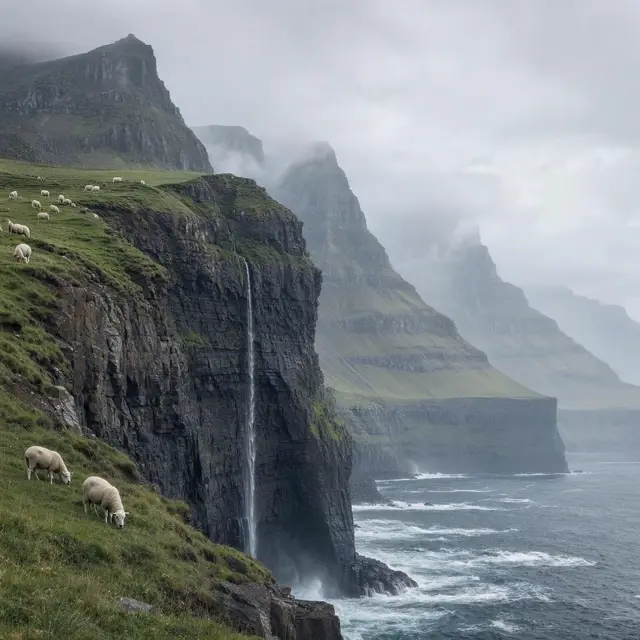
The Faroes are made of lava, piled up in a stack about six kilometres thick. These lavas poured out around 60 million years ago, when the North Atlantic Ocean was first opening. Back then, the land that became the Faroe Islands was still attached to Greenland.
The rock is mostly basalt, a hard volcanic stone. It lies in layers, with thin bands of soft volcanic ash in between. The ash wears away faster, so chunks of basalt above it break off. That is why many mountainsides look like giant steps. On northern Mykines, the basalt forms very regular upright columns up to 30 metres tall.
Today there are 18 major islands, and 779 islands, islets and sea rocks in total. They sit about 655 kilometres off northern Europe, roughly halfway between Iceland and Norway. The coasts are mostly cliffs, with 1,117 kilometres of coastline. The highest point, Slættaratindur, rises 882 metres above the sea.
The Sheep Islands
The most popular theory says the name Faroe means "sheep islands", from old Norse words for sheep and islands. Not everyone agrees. Some scholars argued that the first settlers used a different word for sheep, and others suggested Irish roots. But sheep clearly matter here. A Faroe sheep even appears on the coat of arms.
The islands' farm animals are the result of 1,200 years of breeding in isolation. Many of them exist nowhere else in the world. Local breeds include the Faroe pony, Faroe cow, Faroe sheep, Faroese goose and Faroese duck. A wild variety of sheep once lived on the tiny island of Lítla Dímun, until the mid-1800s.
Sheep shape daily life too. A favourite treat is skerpikjøt, mutton that is aged and dried in the wind until it is chewy. Many homes have a drying shed just for it. Local wool becomes sweaters, with patterns that change from village to village. And grazing probably helped wipe out the willows, junipers and birches that grew after the Ice Age.
Tunnels, Ferries and Helicopters
There are no railways in the Faroe Islands. Instead, the main islands are tied together by roads, bridges, causeways and tunnels. The tunnels run through mountains and between islands, and they connect almost every settlement.
The government has pushed hard on these links since 2014. In 2020, the Eysturoyartunnilin opened and greatly cut travel time between the island of Eysturoy and the capital. In 2023, the islands' longest single tunnel, the Sandoyartunnilin, linked the island of Sandoy to the main road network. Suðuroy is now the only major island with no fixed link.
Where the roads stop, boats and aircraft take over. Public buses and ferries serve the main towns and villages. The islands have just one airport, on Vágar, and the government-owned Atlantic Airways also flies helicopters to each of the islands. Two small islands, Koltur and Stóra Dímun, have no ferry at all, so a helicopter is their only regular service.
Own Language, Own Team
The official language is Faroese, which comes from Old Norse and is closest to Icelandic. Because the islands are so remote, it kept old grammar features that Danish, Norwegian and Swedish lost. It also keeps the letter Ð, but oddly, Faroese speakers do not pronounce it. Faroese sign language became a national language in 2017.
The islands are a self-governing territory within the Kingdom of Denmark. They run their own affairs, apart from defence, policing, justice and currency. They are not in the European Union, mainly so they can keep control of their own fishing waters. That matters, because fishing makes up around 90% of exports.
Football is by far the biggest sport, with about 7,000 registered players. In 2014, the national team beat Greece 1-0. The two teams were 169 places apart in the world rankings, and the result was called "the biggest shock of all time" in football. After that win, the Faroes jumped 82 places in the rankings.