Bamboo That Banged
The first version needed no chemistry. During the Han dynasty, between 202 BC and 220 AD, people threw bamboo stems onto a fire so the sealed segments would burst with a loud crack.
Gunpowder came later and was used at first to copy that sound, packed into small containers. Under the Song dynasty, between 960 and 1279, the first real firecracker appeared: a tube of rolled paper holding gunpowder with a fuse. People strung them together in long clusters so they would go off one after another, an arrangement whose name meant whip.
By then fireworks were both public and commercial. Ordinary people could buy firecrackers from market vendors, and in 1110 the military mounted a large display to entertain Emperor Huizong. One record from 1264 describes a rocket propelled firework called an earth rat that shot off in the wrong direction and startled the empress dowager at a feast held in her honour. It was one of the earliest examples of rocket propulsion.
A Secret Europe Could Not Crack
Fireworks were being made in Europe by the 14th century and were popular by the 17th, but the colours were another matter.
Chinese makers had been tinting flame and smoke since at least the Han period, and later manuals set the recipes down. A 1753 text lists compounds for specific colours: a sulphide of arsenic for yellow, verdigris for green, lead carbonate for a lilac white, and calomel for white.
European visitors were baffled and said so. An ambassador of Peter the Great reported from China that they made fireworks no one in Europe had ever seen. In 1818 a French writer called the variety of colours the greatest mystery of Chinese fireworks, and an English geographer had written much the same thing twenty years earlier.
Chemistry caught up eventually. In 1786 Berthollet found that potassium chlorate produced a violet emission, and chlorates of barium, strontium, copper and sodium turned out to give intense, bright colours.
What Is Actually Inside
The colour comes from small pellets, each one a pyrotechnic star, and each is built from four kinds of ingredient: a fuel, an oxidiser that combines with the fuel to make intense heat, colour-producing salts, and a binder to hold the pellet together.
The colour a compound gives in a firework is the same colour it gives in a laboratory flame test, though not every compound that burns with a colour is suitable. A good one produces a pure, intense colour at a moderate concentration.
Sparks are a different matter, and they are stuck in a narrow range: red and orange, yellow and gold, white and silver. That is because the light comes from a glowing solid particle rather than from a vapour, and glowing solids do not pick colours the way vapours do.
The brightest stars are fuelled by aluminium. Magnesium burns brilliantly but does not form a protective oxide layer, so makers often use magnalium, an alloy of the two.
Shapes With Names
An aerial shell is the backbone of a modern display. It holds the compounds, is fired upward by a mortar and bursts high overhead.
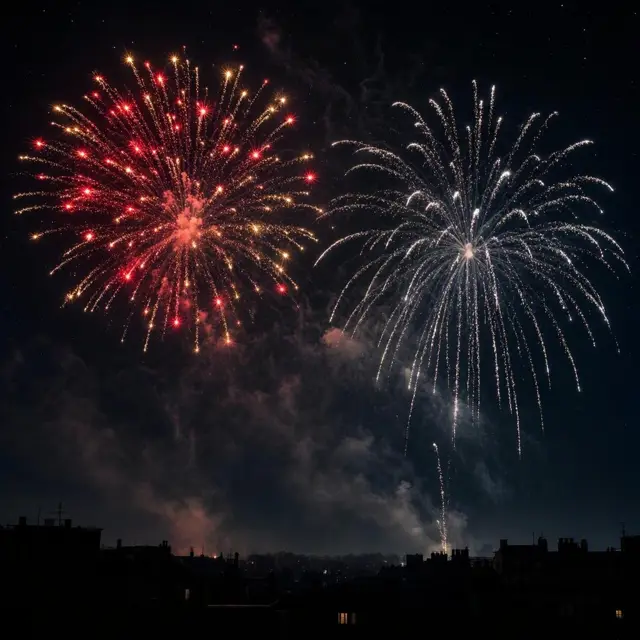
The patterns have names borrowed from flowers and trees. A peony, the most common of all, is a round burst of coloured stars that burn without trails. A chrysanthemum is the same shape but leaves a visible trail of sparks. A willow uses long burning silver or gold stars to droop into a soft dome. A palm sends out a few thick arms from a bright rising tail that acts as the trunk, sometimes with a small burst inside to suggest coconuts. A crossette breaks into large stars that split again, ideally into four pieces flying off symmetrically to make a grid of crosses.
The pleasure comes with costs. Fireworks frighten domestic and wild animals into running into danger, the noise can distress people with sound sensitivity or trauma, and hearing protection is recommended for spectators, especially children.