A Lens Sliced Into Rings
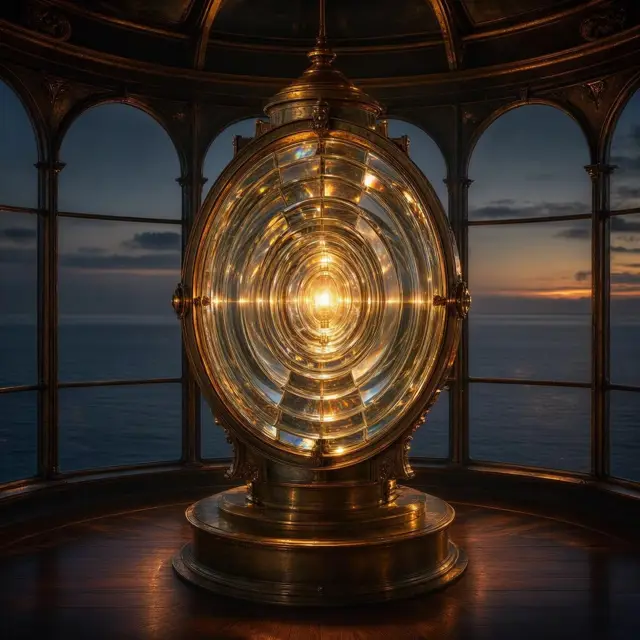
A regular lens that is both wide and strong needs a big, heavy chunk of glass. A Fresnel lens gets around this by splitting the lens into a set of thin rings. Each ring keeps the curve of the original surface, but most of the glass in between is gone. The result can be so thin that it is a flat sheet.
Many modern Fresnel lenses are just 1 to 5 mm thick, almost flexible. That lets designers build a lens with a wide opening and a short focal length without a huge lump of glass. A perfect version would have an endless number of rings.
There is a catch. The trick makes images a little less sharp, which is why cameras still use regular lenses for photos. But for sending light a long way, it is brilliant. Because of its use in lighthouses, it has been called "the invention that saved a million ships".
An Awkward Start and Fish Glue
The idea was not totally new. In 1748, Buffon cut a lens into steps from a single piece of glass, but it was meant for burning glasses, not lighthouses. In 1819, the French physicist Augustin-Jean Fresnel joined a lighthouse commission. Unaware of the earlier work, he proposed "lenses by steps". Much to his embarrassment, one commissioner remembered Buffon's idea.
Fresnel's design was different. It was flat on one side and built from many separate prisms, which made it easier to make. With a budget of just 500 francs, he found a glassmaker who could remove flaws by reheating and remolding the glass. His colleague Arago discovered by accident that fish glue could stand the heat, so it could be used in the lens.
The first model, finished in March 1820, held 97 prisms. On the evening of 13 April 1821, a bigger version was shown in public next to the newest mirrors of the day. It suddenly made them obsolete.
A King Watching From Far Away
Fresnel's next lens turned, sending out eight beams that sailors would see as regular flashes. Its official test took place on the unfinished Arc de Triomphe on 20 August 1822. King Louis XVIII and his group watched it from 32 km away. The lens was then rebuilt at Cordouan Lighthouse, partly by Fresnel's own hands. On 25 July 1823, the world's first lighthouse Fresnel lens was lit.
Fresnel kept improving it. He swapped mirrors for catadioptric prisms, which bend light and also bounce it inside the glass using total internal reflection. This lost far less light than silvered mirrors. He also planned 51 lighthouses, with lenses sorted into sizes called "orders".
He died in 1827, at 39, before a full-sized version of that last design was built. A first-order lens stands about 2.59 m tall. One giant used at Makapuu Point in Hawaii is 3.7 m tall, with over a thousand prisms.
Flashes With a Signature
As lighthouses spread, sailors struggled to tell them apart. Colored filters helped, but they wasted light. Then John Hopkinson invented the "group-flashing" lens, which split the panels to give several flashes in a row. Now a lighthouse could be known by how many flashes it gave, not just how often.
Then came a cheaper way to make them. In 1852, John L. Gilliland patented a method of making lenses from pressed and molded glass. His company made a small version, the bull's-eye lens, for railroads, steamboats and docks, and these were common in the United States by the 1870s. By the 1950s, plastic had replaced glass, which made Fresnel lenses cheap enough for overhead projectors.
Today most lighthouses have swapped their great glass lenses for cheaper, tougher lights, sometimes LEDs placed inside the original lens. Some keep their old lenses, while others use copies made with acrylic prisms.
From Stage Lights to VR Headsets
Fresnel lenses are hiding everywhere. Theater and film lights, often just called "Fresnels", can make a soft-edged beam as narrow as 7° or as wide as 70°. Car tail lights and reversing lights still use them. Aircraft carriers use them in landing lights that show pilots if they are coming in too high or too low.
Some uses are just fun. The rock artist Peter Gabriel used them on stage to make his head look huge next to his body. In the Pixar film Wall-E, the hero watches a musical on an iPod made bigger by one. Virtual reality headsets like the Meta Quest 2 use them because they are thin and light.
They can tame sunlight too. Plastic Fresnel lenses heat solar cookers and can squeeze sunlight onto solar cells almost 500 times over. They can even sinter sand, which allows 3D printing in glass.