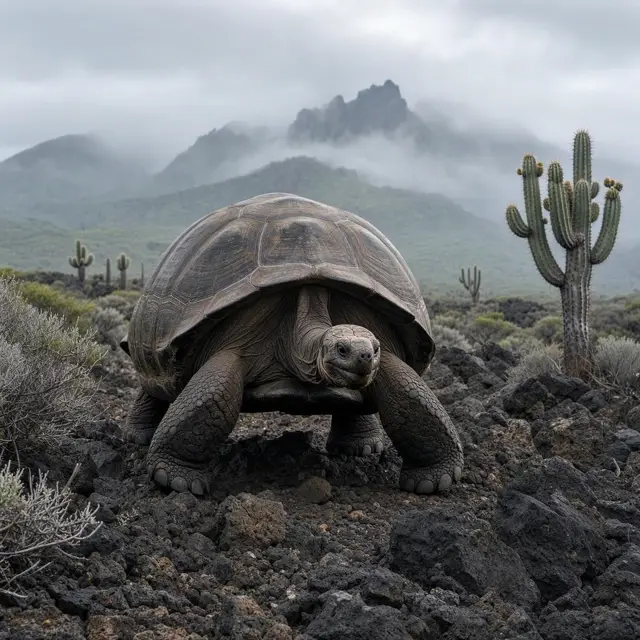
Islands Named After Tortoises
The Galápagos Islands are a group of volcanic islands in the Pacific Ocean, sitting around the equator about 900 kilometres west of South America. They belong to Ecuador, and just over 33,000 people lived there in 2020.
The name comes from their giant tortoises. In Spanish these are called galápagos, from an old Iberian word meaning turtle or tortoise. Early sailors had another name for the islands: the Enchanted Isles, because the winds and currents made them so hard to steer around.
The islands were found by accident in 1535, when a Spanish bishop, Tomás de Berlanga, came across them. There is no firm evidence that anyone reached them earlier, and a lack of fresh water may have kept people from settling.
Despite sitting on the equator, the islands are often cool and misty. A cold ocean current, the Humboldt Current, brings chilly water that causes frequent drizzle for much of the year.
Built by a Hotspot
The islands are still being made. They sit on top of a hotspot, a place where rock deep below the Earth's crust melts and pushes up, creating volcanoes.
At the same time, the sea floor they rest on is slowly moving east. As older islands drift away from the hotspot, they wear down and eventually sink below the waves, while new ones form in their place. The youngest islands, Isabela and Fernandina, are still being built. Fernandina is only about 50,000 years old, while San Cristóbal in the east is about 3.2 million years old.
The volcanoes are very much alive. The nine active ones erupted 24 times between 1961 and 2011. In 2018, lava from Sierra Negra on Isabela reached the coast, and about fifty people had to leave their homes.
When Charles Darwin visited, he was so struck by all the volcanic features that he called the islands that land of craters.
What Darwin Noticed
The famous visit came in 1835. HMS Beagle, a British ship surveying the coasts of South America, reached the islands on 15 September. On board was a young naturalist, Charles Darwin, who spent about five weeks there.
At first he was mainly interested in the rocks. But he noticed that the mockingbirds were different from one island to the next. Nicholas Lawson, the acting governor, mentioned in passing that he could tell which island a tortoise came from just by its shell. Darwin did not even bother labelling the finches he collected by island, thinking they were unrelated.
Back in England, experts studied his bird specimens. What looked like many different kinds of birds turned out to be finches, each with features unique to the islands. Today they are known as Darwin's finches.
By the end of his voyage, Darwin had begun to wonder whether species could change. The Galápagos visit became crucial to his theory of natural selection, published in On the Origin of Species in 1859.
Tortoises, Penguins and Pirates' Goats
The islands are full of animals found nowhere else. The Galápagos penguin is the only penguin that lives in the tropics. The marine iguana is the only iguana that feeds in the sea. There is a cormorant that cannot fly, and a finch nicknamed the vampire finch for its habit of drinking blood.
People have not always been kind to them. Pirates used the islands as a hideout to raid Spanish treasure ships. Later, whalers took thousands of giant tortoises on board as fresh food, because the tortoises could survive for months without food or water. Some kinds were wiped out.
Animals brought in by people did even more damage. In 1959, fishermen left three goats on Pinta island. By 1973 there were more than 30,000. Programmes have since cleared goats, pigs and donkeys from the largest islands.
In 1959, Ecuador made 97.5 percent of the land a national park, and in 1986 the waters around the islands became a marine reserve. Today, about 300,000 visitors come each year.