A Mile Straight Down
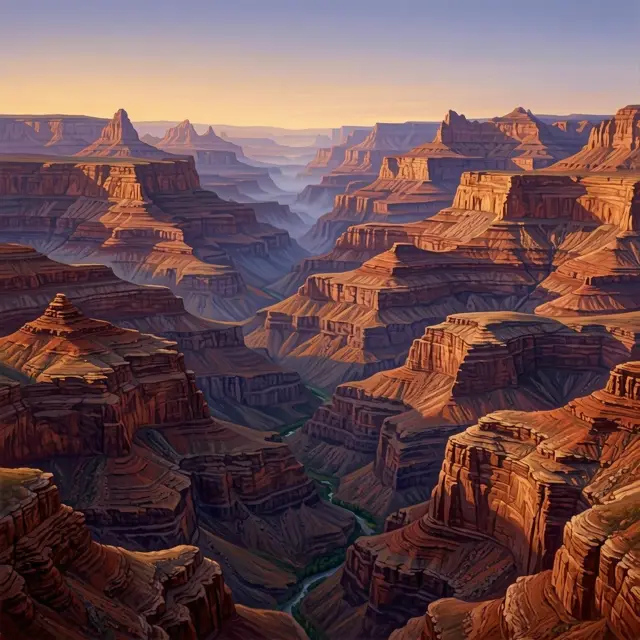
The Grand Canyon is a steep-sided canyon carved by the Colorado River in Arizona. The numbers are what make it difficult to photograph honestly: 277 miles (446 km) long, up to 18 miles (29 km) wide, and over a mile deep — 6,093 feet, or 1,857 metres.
A mile of vertical drop means the top and the bottom are effectively different places. Weather, temperature and vegetation all change as you descend, because you are travelling through as much altitude as many mountain ranges provide going up.
The canyon and its adjacent rim are spread across a remarkable patchwork of jurisdictions: Grand Canyon National Park, the Kaibab National Forest, the Grand Canyon–Parashant National Monument, the Hualapai Indian Reservation, the Havasupai Indian Reservation, and the Navajo Nation.
Two Billion Years, Exposed
The canyon's real subject is time. Nearly two billion years of Earth's geological history have been exposed as the Colorado River and its tributaries cut down through layer after layer of rock.
The cutting was possible because the land was rising. As the Colorado Plateau was uplifted, the river kept pace by carving downward through it — a slow race between rock going up and water going down.
Some aspects of how the incision happened are still debated among geologists, but several recent studies support the view that the Colorado River established its course through the area about 5 to 6 million years ago. Since then the river has driven the down-cutting of tributaries and the retreat of the cliffs, deepening and widening the canyon at the same time. Every band of colour in the wall is a different world, stacked in order.
Inhabited Long Before It Was 'Discovered'
The canyon has been continuously inhabited by Native Americans for thousands of years, who built settlements within it and in its many caves.
It was not merely occupied but revered. The Pueblo people considered the Grand Canyon a holy site and made pilgrimages to it — a place of religious significance long before it became a scenic destination.
The first European known to have viewed it was García López de Cárdenas of Spain, who arrived in 1540. That date is worth holding next to the previous paragraph: a landscape that had been lived in, named and worshipped for millennia entered European records less than five hundred years ago, and is often still described as though that arrival were its beginning.
The President Who Kept Coming Back
Among the canyon's most consequential advocates was President Theodore Roosevelt, a major proponent of preserving the area.
His interest was not remote or administrative. He visited on numerous occasions — to hunt, and simply to enjoy the scenery — which is a different kind of political support from signing a document about a place you have never stood in.
That advocacy is a large part of why the canyon sits inside a national park today rather than under private development. The layered protections now covering it — national park, national forest, national monument, and three sovereign tribal nations — mean the Grand Canyon is not governed as one place but as an overlapping set of claims, histories and responsibilities, which is arguably the most accurate reflection of what it actually is.