Built by Billions of Animals
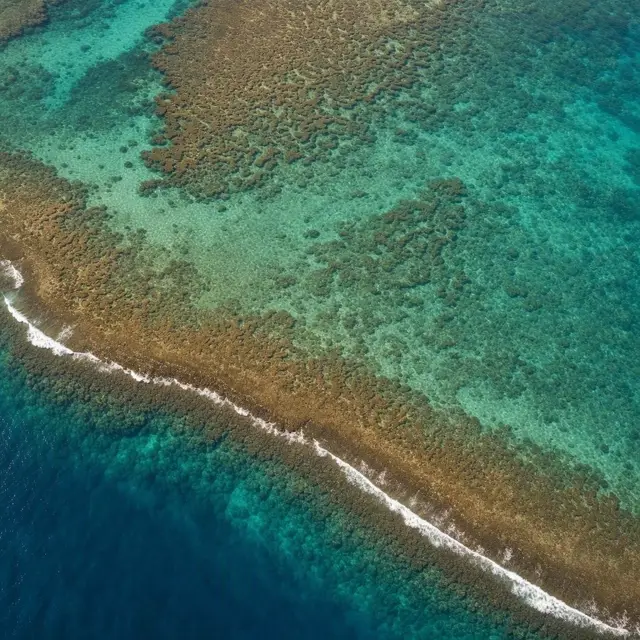
The Great Barrier Reef is the world's largest coral reef system: over 2,900 individual reefs and 900 islands, stretching more than 2,300 kilometres across roughly 344,400 square kilometres.
It sits in the Coral Sea off the coast of Queensland, Australia, separated from the coast by a channel 160 km wide in places and over 61 metres deep.
The extraordinary part is what built it. The Great Barrier Reef is the world's biggest single structure made by living organisms, and it can be seen from outer space. It was constructed by billions of tiny animals called coral polyps — creatures a few millimetres across, each laying down a skeleton of calcium carbonate, accumulating over thousands of years into something with its own weather patterns. Nothing humans have ever built comes close, and it was made without a plan.
Protected, Named, Listed
The reef's status is about as decorated as a natural feature can be. It was selected as a World Heritage Site in 1981. CNN labelled it one of the Seven Natural Wonders of the World in 1997. Australian World Heritage places added it to their list in 2007, and the Queensland National Trust named it a state icon of Queensland in 2006.
A large part of it is protected by the Great Barrier Reef Marine Park, which limits the impact of human uses such as fishing and tourism.
It has also long been known to and used by Aboriginal Australian and Torres Strait Islander peoples, and remains an important part of local groups' cultures and spirituality. Tourism is now a major economic activity for the region — especially around the Whitsunday Islands and Cairns — generating over AUD$3 billion a year. In November 2014, Google launched an underwater Street View of the reef in 3D.
Half the Coral, Gone
The losses are severe and repeatedly measured. A study published in October 2012 in the *Proceedings of the National Academy of Sciences* found the reef had lost more than half its coral cover since 1985. A 2020 study reaffirmed it, finding over half the coral cover lost between 1995 and 2017.
The pressures stack: runoff of manmade pollutants, climate change with mass coral bleaching, dumping of dredging sludge, and cyclic population outbreaks of the crown-of-thorns starfish.
Bleaching events have come in waves. A March 2016 report found bleaching more widespread than previously thought, badly affecting the northern reef as ocean temperatures rose. In March 2017, *Nature* published a paper showing huge sections of an 800-kilometre stretch of the northern reef had died during 2016 from high water temperatures, which the authors attributed to global climate change. Another mass bleaching event was confirmed in March 2022.
An Obituary, Then a Recovery
In October 2016, *Outside* published an obituary for the Great Barrier Reef. The article was criticised for being premature and for hindering efforts to build the reef's resilience — declaring something dead is not a neutral act when people are still working to save it.
The damage since has been real but the story is not finished. The percentage of baby corals being born dropped drastically in 2018, and scientists described it as the early stage of a "huge natural selection event unfolding": many mature breeding adults died in the 2016–17 bleaching, cutting birth rates, and the types of coral reproducing changed — pointing toward a long-term reorganisation of the ecosystem if the trend continues.
Then came the counterpoint. The Australian Institute of Marine Science surveys the reef annually, and its 2022 report showed the greatest recovery in 36 years, driven mainly by regrowth across two-thirds of the reef by fast-growing Acropora coral. Under the Great Barrier Reef Marine Park Act 1975, an Outlook Report on the reef's health is required every five years; the last was published in 2019.