A Name Chosen to Lure Settlers
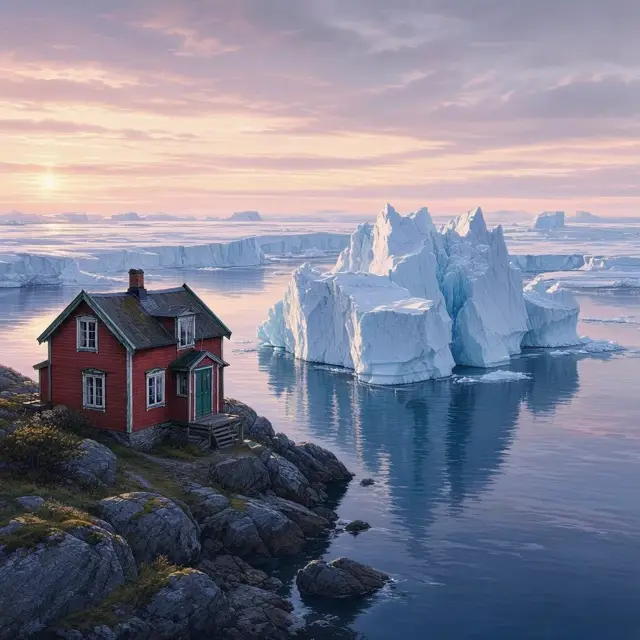
About 81% of Greenland is covered in ice, yet its name promises green fields. That was on purpose. According to the Icelandic sagas, Erik the Red settled there and named it Greenland because, as he put it, people would be attracted there if it had a favourable name. From 986, a group of 14 boats led by him brought settlers to the west coast.
The people who live there today use their own name: Kalaallit Nunaat, meaning 'land of the Kalaallit', the main group of Greenlandic Inuit. A neat detail: the word Nunaat does not include waters and ice, so the name only covers the land itself.
And there is plenty of land. Greenland is the world's largest island, covering 2,166,086 square kilometres. More than 80% of it lies north of the Arctic Circle, between the Arctic and Atlantic oceans. It is part of North America, but it is an autonomous territory of the Kingdom of Denmark.
A Giant Lid of Ice With Secrets Underneath
The ice sheet that covers Greenland spans 1,755,637 square kilometres and holds roughly 2,850,000 cubic kilometres of ice. If all of it melted, global sea level would rise by about 7.5 metres from that alone. Research suggests this would take at least 1,000 years, even with very fast warming.
Under the ice sits a hidden landscape. There is a series of canyons, the biggest known as Greenland's Grand Canyon, carved by flowing meltwater. A 1951 survey led by French scientist Paul-Emile Victor even concluded that under the ice, Greenland is really three large islands. That idea is disputed.
The far north, Peary Land, has no ice sheet at all. The air there is too dry to make snow, and without snow an ice sheet cannot form. Meanwhile, near the top of the ice, the thermometer dropped to minus 69.6 °C on 22 December 1991. That is the lowest temperature ever recorded in the Northern Hemisphere.
The Day It Rained on the Summit
The ice sheet always loses big chunks at its edges through ice calving. For a long time, snowfall balanced that out. Since the 1980s, the losses have been larger than the gains. After 1996, Greenland has not had a single year without losing ice mass on average. In the 2010s, it melted at its fastest rate in at least 12,000 years.
Then, in 2021, something strange happened. Rain fell at Greenland's highest point for the first time in recorded history. It was so unexpected that the research station at the summit had no rain gauges for the occasion.
The melting has even redrawn the map. A piece of land off the east coast was thought to be a peninsula, because a glacier covered the water around it. By 2007 the glacier had melted away and revealed an island. It was named Uunartoq Qeqertaq, which means 'warming island', and an atlas crowned it 'Place of the Year'.
4,500 Years of Newcomers
People have lived in Greenland on and off for at least 4,500 years. The first arrivals, known as Palaeo-Inuit, came around 2500 BC from what is now Canada. One group, the Saqqaq culture, lived in the south and west until about 800 BC.
The Norse arrived in the 10th century, during a mild spell. Around their southern fjords, the weather was several degrees warmer than usual, and barley was grown as far north as the 70th parallel. The Norse never numbered more than about 2,500. Their settlements vanished in the 15th century. Colder weather may have played a part, and so may a falling price for walrus ivory, their most valuable export.
The Thule people, ancestors of today's Greenlanders, reached the island around 1300. They were the first to bring dog sleds and toggling harpoons to Greenland. A 2015 genetic study found that modern Greenlandic Inuit descend directly from these Thule pioneers.
Running Its Own Affairs
Greenland's colonial status ended with the 1953 Danish constitution. In 1979, a referendum brought home rule, giving Greenland its own legislature for many internal matters. In 1985, Greenland left the European Economic Community, as it disagreed with its fishing rules and its ban on sealskin products. Self-rule followed in 2009, and Greenlandic became the sole official language that same year. Denmark still handles foreign affairs and defence.
With 56,542 people in 2025, Greenland is the least densely populated country in the world. Nearly everyone lives along the fjords of the south-west coast, and 19,905 people live in the capital, Nuuk.
Getting around is an adventure. There are virtually no roads between towns, because the coast is cut by so many inlets. The weekly coastal ferry takes 80 hours each way. For fun, handball is often called the national sport, and there is even a golf course in Nuuk.