Cut It in Half, Still See It All
Tear a photograph in two and each piece shows half the scene. Cut a hologram in two and something odd happens: each piece still shows the whole scene. That is because every point on a hologram holds light from every point of the scene it recorded.
The article offers a nice way to picture it. Imagine looking at a street through a big window, then through a small one. Through the small window you can still see everything, but you have to move your head to take it all in.
A hologram records a wavefront, the shape of the light coming off an object, not just a flat image. When lit the right way, it rebuilds that light. So the picture has real depth and parallax: move your head, and you see the object from a new angle, just as if it were sitting there.
Born From a Better Microscope
Holography was invented by accident. In 1948 the Hungarian-British physicist Dennis Gabor was trying to sharpen the images in electron microscopes at a company in Rugby, England. His side discovery earned him the Nobel Prize in Physics in 1971. The name comes from Greek words meaning whole and writing.
There was a catch. Holography with ordinary light did not really advance until the laser arrived in 1960. In 1962, Yuri Denisyuk in the Soviet Union and Emmett Leith and Juris Upatnieks in the United States made the first practical holograms of 3D objects.
Later, Stephen Benton found a way to make holograms you can view in ordinary light instead of laser light. These are called rainbow holograms. Today, cheap laser diodes have put holography within reach of artists and hobbyists.
Two Beams and a Secret Key
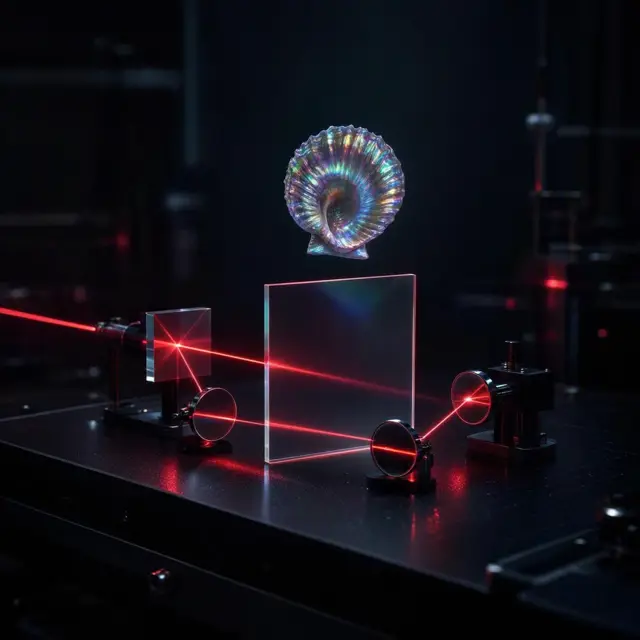
Making a classic hologram starts with splitting one laser beam into two. One beam, the object beam, is spread out and bounced off the subject. The other, the reference beam, shines straight onto the recording plate. Where the two meet, their light waves overlap and form an interference pattern.
That pattern looks like random swirls with no link to the scene at all. Think of it as a locked code. The key is the original light. Shine the same kind of laser on the developed plate and diffraction bends the light back into an exact copy of the scene.
The process is incredibly fussy. During the exposure, everything must stay still to within about a quarter of the wavelength of light. Otherwise the pattern blurs and the hologram is ruined. Living subjects need a very intense, very brief laser pulse, which is hazardous and rarely done outside labs.
A Sandbox on Old Tires
Holography was long thought to need a costly metal table to kill every tiny vibration. In 1971, Lloyd Cross opened the San Francisco School of Holography and proved otherwise. His students used a small laser and a homemade sandbox made of cinder blocks on plywood, resting on stacks of old tires.
Mirrors and lenses sat on short lengths of plastic pipe stuck into washed sand. The holographer would load the plate in the dark, leave the room, wait a few minutes for everything to settle, then fire the laser by remote control.
Things got cheaper still. People once assumed a laser diode was useless for holograms. When tested, some worked better than the old gas lasers. Red laser diodes dropped from hundreds of dollars in the early 1980s to about 5 dollars, thanks to CD and DVD players. By 2005, home holography kits were popular gifts.
From Banknotes to Sci-Fi
You probably carry holograms right now. They are hard to forge, because copies come from a master hologram made with expensive, advanced equipment. That is why they appear on banknotes such as British pounds and all current euro notes, plus credit cards, passports and ID cards. Parts of India even require holographic license plates.
Holograms were also tipped as the future of data storage, since they use the whole depth of a material, not just its surface. In 2005, companies built a 120 mm disc that could hold up to 3.9 TB. As of 2014, no commercial product had been released.
Movies set our hopes high. The Princess Leia message in Star Wars and the Holodeck in Star Trek show solid-looking 3D projections that real holograms cannot do. Still, those fictional versions inspired real advances in other fields, such as augmented reality.