A Dance That Gives Directions
When a worker honey bee finds a good source of food, she does not keep it to herself. Back at the hive, she performs a pattern of movements known as the waggle dance. It tells other workers the distance and the direction to the spot, usually flowers or water. All living honey bee species do some form of this dance, though the details differ from species to species.
If the food is very close to the hive, bees may use a less exact version called the round dance. There is also the tremble dance, which recruits bees to collect nectar from foragers coming home. On top of all this, bees also talk through many different chemicals and smells.
The two smallest species, Apis andreniformis and Apis florea, add a clever twist. They dance on the flat top surface of the comb instead of a vertical one, and they point the dance in the actual compass direction of the food. Dances are also used when a colony splits, as scouts report the location and quality of possible new homes.
One Queen, Thousands of Workers
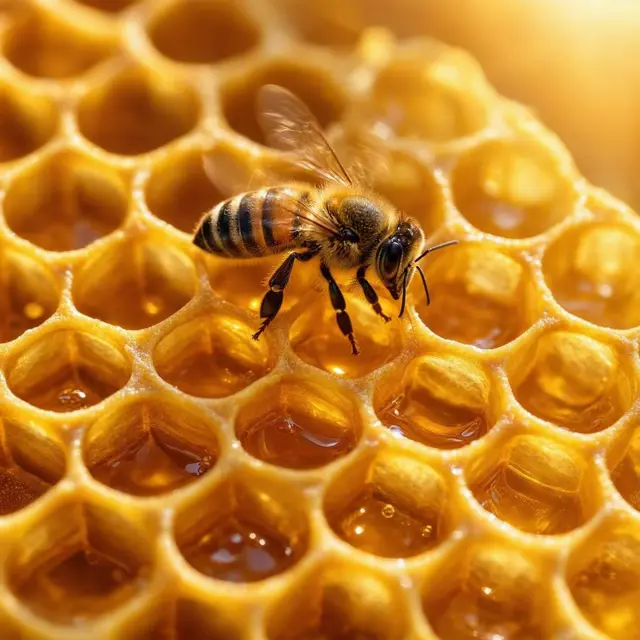
Honey bees are eusocial insects. A colony usually has one queen, tens of thousands of female workers and, in season, up to a few thousand males, each one called a drone. A typical colony may hold as many as 60,000 workers. Drones come from unfertilised eggs, while queens and workers come from fertilised ones.
What a larva eats decides its future. Young larvae are fed royal jelly made by worker bees, then switch to honey and pollen. A larva fed only royal jelly grows into a queen. A queen develops in just 16 days, compared with 21 for a worker and 24 for a drone. Once mated, she can lay up to 2,000 eggs a day.
Workers change jobs as they get older. Young ones, often called nurse bees, clean the hive and feed the larvae. Later they build comb, receive nectar and pollen, and guard the hive. Finally they fly out and spend the rest of their lives gathering food. Drones have no sting, and in winter they are pushed out of the hive to save warmth and food.
Living Heaters and Hornet Balls
Honey bees stop flying when it gets colder than about 10 °C. Instead they crowd into a tight winter cluster around the queen. Workers shiver to make heat, keeping the center between 27 °C and 34 °C. They take turns moving from the chilly outside edge, which stays around 8 to 9 °C, to the warm inside, so that no bee gets too cold.
All this heat needs fuel. The bees burn their stored honey to make body heat, and in temperate climates a colony can eat between 15 and 50 kilograms of it over one winter. The colder the weather, the tighter the cluster. In summer the bees do the opposite and cool the hive by fanning and letting water evaporate.
Heat is also a weapon. Japanese honey bees defend against large wasps such as the Asian giant hornet by surrounding the intruder in a tight ball of bees. They vibrate their muscles hard and raise the temperature until the hornet dies. Scientists once thought heat alone did the job, but experiments show the extra carbon dioxide inside the ball matters too.
Great Pollinators, With Some Myths
Of all the honey bee species, only the western honey bee is widely used to pollinate crops as a business. This pollination work is measured in billions of dollars and is credited with adding about 9 percent to the value of crops around the world. Apples, blueberries and cherries, for example, are 90 percent dependent on honey bee pollination.
Still, the idea that people would starve without honey bees goes too far. Albert Einstein is sometimes misquoted as saying humans would have only four years left if bees disappeared. He never said it, and no science backs it up. The ten most important crops, making up 60 percent of all human food energy, need no insect pollination at all. Rice, wheat and maize are pollinated by the wind, and potatoes grow from tubers.
No crops that first came from the Americas depend on the western honey bee, which arrived with colonists. Honey bees are also generalists that often pollinate poorly. They are the most commonly recorded pollen thieves, and where they are brought in, they can push out native pollinators.
Old Fossils and Modern Troubles
Even the name has rules. The insect expert Robert Snodgrass argued it should be written as two words, honey bee, because it is a real kind of bee. Dragonfly and butterfly are written as one word because those insects are not flies. The genus name, Apis, is simply Latin for bee.
The first Apis bees appear in the fossil record about 34 million years ago, in European deposits. Yet honey bees seem to have their origin in South and Southeast Asia, where every living species except the western honey bee is native. The Americas had no honey bees in human times until Europeans brought them. Only one fossil species is known there, from a single 14 million-year-old specimen found in Nevada.
Today's hives face serious threats. In the first decade of the 21st century, North America saw sudden die-offs of 30 to 70 percent of hives, a problem named colony collapse disorder. Varroa mites are another big danger. People long believed these mites drank bees' blood, but a 2018 study showed they actually feed on fat body tissue.