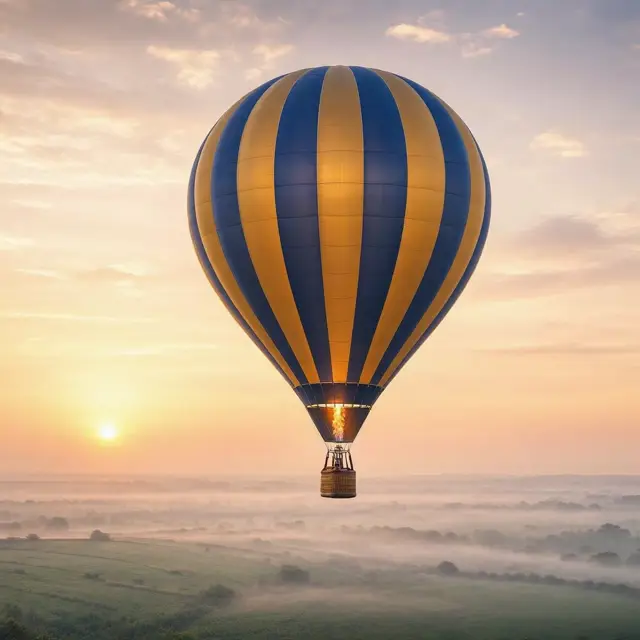
The Day Two Men Floated Over Paris
On 21 November 1783, two men rose over Paris in a balloon lifted by nothing but hot air. Jean-François Pilâtre de Rozier and François Laurent d'Arlandes made the world's first free, untethered flight with people on board. Their balloon was built by the Montgolfier brothers, Joseph-Michel and Jacques-Étienne. The hot air balloon became the first successful technology to carry humans into the sky.
It almost went differently. King Louis XVI had first decided that condemned criminals should be the first pilots. De Rozier and d'Arlandes asked for the honor instead, and won. By then the brothers had already tested balloons with no one aboard and with animals as passengers.
A few weeks earlier, on or around 15 October 1783, de Rozier had gone up in a balloon tied to the ground, rising 26 metres, the full length of the rope. About ten years later, on 26 June 1794, the French used a balloon in war for the first time, to watch the battle of Fleurus from above.
Lanterns, a Priest, and Desert Lines
Hot air was lifting things long before the Montgolfiers. The sky lantern was an early relative of the balloon. During China's Three Kingdoms era, between 220 and 280 CE, Zhuge Liang used these floating lanterns to send military signals. In the 13th century, the Mongol army used them at the Battle of Legnica in Poland, the first time ballooning was known in the western world.
In 1709, a Portuguese Jesuit priest named Bartolomeu de Gusmão won funding from King John V for a flying machine called the Passarola. He staged an unmanned demonstration for the king and queen. The same year he wrote a short manifesto arguing that people could sail through the air, and he left designs for a craft that could carry a person.
One modern balloonist looked back even further. In the 1970s, Julian Nott suggested that the Nazca Lines, made about two thousand years ago, might have been guided from a balloon. In 1975 he built and flew the Nazca Prehistoric Balloon, saying he used only methods and materials that ancient Peruvians had.
Why Warm Air Can Lift a Basket
A hot air balloon has three main parts. The envelope is the big fabric bag, usually made of nylon. Below it hangs a basket, commonly woven from wicker or rattan, which are light, strong, and tough. Between them sits the burner, which sends a propane flame up into the envelope. A single burner can put out 2 to 3 megawatts of heat.
Heating the air makes it less dense than the cooler air outside. The balloon rises thanks to buoyancy, the same upward push that acts on objects in water. The bigger the temperature gap between inside and outside, the more lift you get. In typical weather, air heated to 99 °C needs about 3.91 cubic metres of envelope to lift one kilogram.
There is a limit, though. Nylon melts at about 230 °C, but pilots keep the inside below about 120 °C, because hotter air weakens the fabric faster. At that level, an envelope lasts roughly 400 to 500 flying hours. On a warm day a balloon lifts less, and lift also drops about 3% for every 1,000 metres climbed.
Steering by Riding the Wind
You cannot really steer a hot air balloon. It simply drifts with the wind. Instead, pilots climb or sink to catch winds blowing in different directions at different heights. In the northern hemisphere, the wind tends to turn east as you go higher.
To come down, the pilot lets hot air out. Most balloons have a parachute vent at the top, a round flap of fabric invented by Tracy Barnes. Pulling a control line opens it, and letting go allows the remaining hot air to push it back into place. Opening it briefly starts a fast descent. After landing, the pilot pulls it fully open to empty the balloon.
Burners have clever tricks too. A whisper burner releases propane more slowly and makes a different sound, so pilots use it over farm animals to avoid scaring them. It also gives a yellower flame that lights up the inside of the envelope, which is why it is used for night glows. For safety, many passenger balloons carry two full sets of fuel tanks and burners.
Higher, Faster, and Around the World
Modern balloons with an onboard heater came from Ed Yost and Jim Winker, whose work led to a first successful flight on 22 October 1960. Since then, pilots have pushed them to extremes. On 26 November 2005, Vijaypat Singhania took off from Mumbai and climbed to 21,027 metres, the world altitude record for a hot air balloon.
In 1991, Per Lindstrand and Richard Branson flew about 7,672 kilometres from Japan to northern Canada in the Virgin Pacific Flyer. Its envelope held 74,000 cubic metres, the largest ever built for a hot air craft. Riding the jet stream, it reached 394 km/h, the fastest ground speed for a balloon with people aboard.
In 1999, Bertrand Piccard and Brian Jones made the first nonstop trip around the world by balloon in the Breitling Orbiter 3. They left Switzerland on 1 March and landed in the Egyptian desert after 19 days, 21 hours, and 55 minutes. In 2002, Steve Fossett flew around the world alone on his sixth try, in 320 hours and 33 minutes.