A Hairdryer and Two Tin Cans
The modern hovercraft started on a kitchen-table scale. British engineer Christopher Cockerell put one tin can inside another, one from coffee and one from cat food, and blew air between them with a hairdryer. He expected a ring of moving air. What surprised him was that this fast sheet of air acted like a wall.
He called it the momentum curtain. It could trap higher-pressure air inside it, so a craft needed far less airflow to lift itself. In terms of power, a hovercraft would need only a quarter to a half of what a helicopter needs.
Cockerell flew his models over government carpets in Whitehall, and the idea was put on the secret list. Yet no branch of the military wanted it. As he later joked, the Navy said it was a plane not a boat, the RAF said it was a boat not a plane, and the Army were plain not interested.
The Channel Crossing and the Royal Dent
With no military interest, there was no reason to keep the idea secret. Funding came through, and Saunders-Roe built the SR.N1. It made its first hover on 11 June 1959. On 25 July 1959, it crossed the English Channel with Cockerell on board. The date was the 50th anniversary of Louis Blériot's first flight across the Channel.
That December, the Duke of Edinburgh talked the chief test pilot into letting him take the controls. He drove it so fast that he was asked to slow down. The bow was dented from the speed, and the damage was never fixed. The craft was known from then on as the Royal Dent.
The SR.N1 had one big weakness. It floated only 23 cm above the surface, so even small waves hit the front. The fix was a flexible rubber skirt. A 1.2 m skirt let the craft climb over obstacles almost as tall as the skirt itself.
Flying Ferries With Flight Numbers
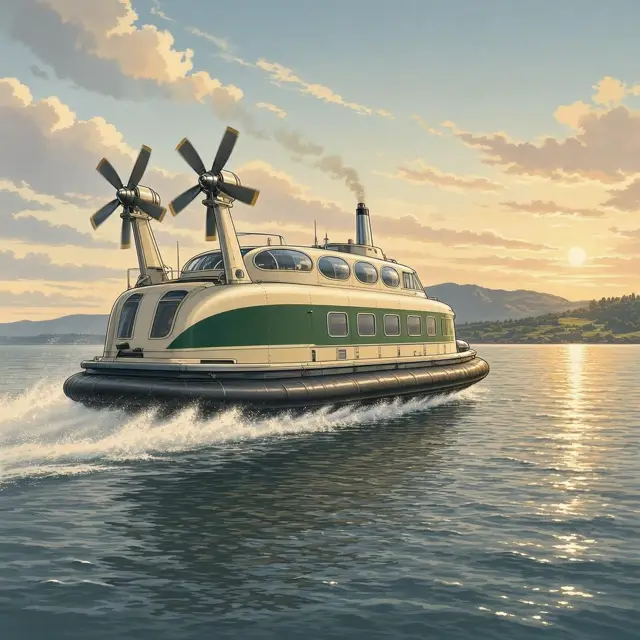
In 1968 came the giant SR.N4, the world's first car-carrying hovercraft. The first version carried 254 passengers and 30 cars at up to 83 knots. The Channel crossing took about 30 minutes and was run like an airline, complete with flight numbers. A later version carried 418 passengers and 60 cars, and on 14 September 1995 one made the crossing in just 22 minutes.
The Channel service finally ended on 1 October 2000 after 32 years. Ferries and catamarans offered stiff competition, duty-free shopping inside the EU had ended, the craft were ageing, and the Channel Tunnel had opened.
One route never stopped. Hovertravel began running between the Isle of Wight and Southsea on 24 July 1965 and had carried over 20 million passengers by 2004. As of 2025, it is one of only two year-round public hovercraft services left in the world. The other is in Oita, Japan, which restarted in July 2025.
Rescues on Mud, Ice and Rivers
A hovercraft rides on an air cushion, so it barely cares what is underneath. That makes it perfect for places boats and trucks cannot reach. In England, rescue teams use hovercraft to pull people out of thick mud. Fire departments around the Great Lakes use them to reach ice fishermen stranded when ice breaks away from shore. The Canadian Coast Guard even uses them to break light ice.
In Finland, small hovercraft link islands during the mud season. Since 2006, a charity called HoverAid has used them to reach remote places in Madagascar. From 1998, the US Postal Service used one to carry mail, freight and passengers between Bethel, Alaska, and eight small villages along the Kuskokwim River.
Floating also makes heavy things easy to pull. Moving a 200-ton load on an air cushion barge at 5 knots takes a pull of only 5 tons. In 1982, a helicopter towed one across snow, ice and water.
Hovering Vacuums and Floating Lawn Mowers
Once the idea took off, people put air cushions under all sorts of things. The Hoover Constellation was a round vacuum cleaner with no wheels that floated on air. It was not great at either job. The escaping air blew dust everywhere, and without a skirt it only hovered on smooth floors. Even so, originals are now wanted by collectors.
The Flymo lawn mower uses a fan on its blade to float, so it can glide in any direction. At Lord's Cricket Ground, a hover cover glides over the pitch. It is quick to move and has no pressure points, so it is less likely to damage the grass.
There are hovercraft races too, with a World Hovercraft Championships. The world speed record of 137.4 km/h was set by Bob Windt in Portugal in 1995. At the other extreme, a human-powered craft named Steamboat Willy could lift off from rest with almost any rider. The idea even reached railways, with France's experimental hovertrain, the Aérotrain.