An Island Pulling Apart
Iceland is an island country in the North Atlantic, just south of the Arctic Circle. It sits right on top of the Mid-Atlantic Ridge, where the Eurasian Plate and the North American Plate are moving away from each other.
Each of these giant slabs of Earth's crust is a tectonic plate, and Iceland is probably the only place in the world where you can easily see the effects of two of them drifting apart above sea level.
In geological terms, Iceland is young, only 16 to 18 million years old, and it is very active. There are hundreds of volcanoes and about 30 active volcanic systems. In 1783 and 1784, the eruption of Laki caused a famine that killed nearly a quarter of Iceland's people, and spread haze over most of Europe for months.
New land is still being made. Surtsey, one of the youngest islands in the world, rose out of the ocean in a series of eruptions between 1963 and 1968. Today, only scientists studying how new life arrives on it are allowed to visit.
Geysers, Glaciers and Free Heat
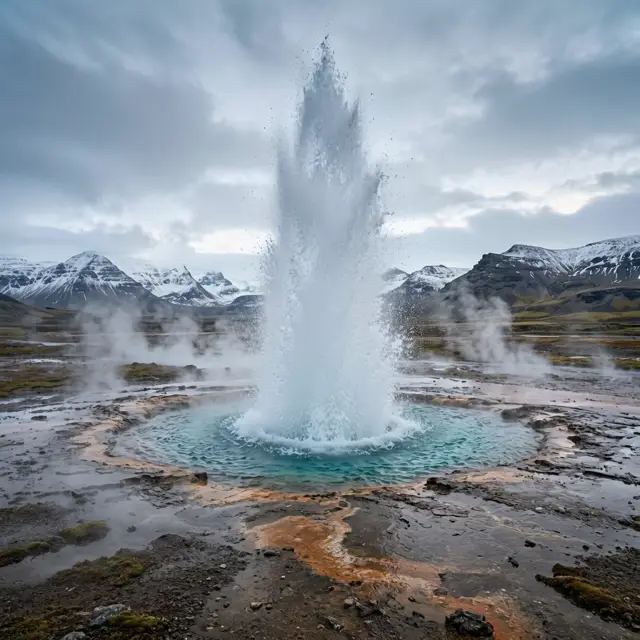
Iceland gave the English language a word. The geyser, a hot spring that shoots water high into the air, is named after Geysir, one of Iceland's hot springs. Its neighbour, Strokkur, erupts every eight to ten minutes.
The landscape is dramatic. The interior is a cold, empty mix of sand, mountains and lava fields, while lakes and glaciers cover about 14 percent of the land. Only about 23 percent of the country is covered in plants.
All that underground heat is put to good use. Hydropower and geothermal energy provide effectively all of Iceland's electricity, so most people have cheap hot water and heating. For a time, Iceland became the world's biggest producer of electricity per person.
Despite being so far north, its coasts stay free of ice through the winter, thanks to a warm ocean current. Still, climate change is making Iceland's glaciers melt faster.
Vikings and One of the Oldest Parliaments
People reached Iceland surprisingly late. Irish or Scottish monks may have lived there first, but according to an ancient Icelandic record, settlement began in 874, when the Norwegian chieftain Ingólfr Arnarson built his home in what is now Reykjavík.
More settlers followed, mostly from Scandinavia. By 930, most of the farmable land had been claimed, and they set up the Althing, an assembly to make laws and settle disputes. It is one of the world's oldest parliaments still in use.
When the settlers arrived, around a quarter of Iceland was covered in forest. Today, it is about 1 percent.
The only land mammal already living there was the Arctic fox, which walked over the frozen sea at the end of the last ice age. Polar bears occasionally drift over from Greenland on icebergs, but none live there. And remarkably, Iceland was essentially free of mosquitoes until October 2025.
A Phone Book Sorted by First Name
The Icelandic language has changed less from Old Norse, the language of the Vikings, than the other Nordic languages have. It is also the only living language that still uses the old runic letter Þ in its alphabet.
Names work differently too. Most Icelanders do not have a family surname. Instead, they use a patronymic, a last name based on their father's first name, such as Jónsdóttir, meaning Jón's daughter. Some use their mother's first name instead.
Because of this, Icelanders call each other by their first names, and the phone directory is sorted alphabetically by first name. All new names must be approved by the Icelandic Naming Committee.
Iceland has also led the way on equality. Vigdís Finnbogadóttir was the world's first democratically elected female head of state. In 1983, Iceland had the world's first political party formed and led entirely by women, and after the 2021 elections, 48 percent of its members of parliament were women.
About 35 percent of Iceland's roughly 395,000 people live in the capital, Reykjavík.