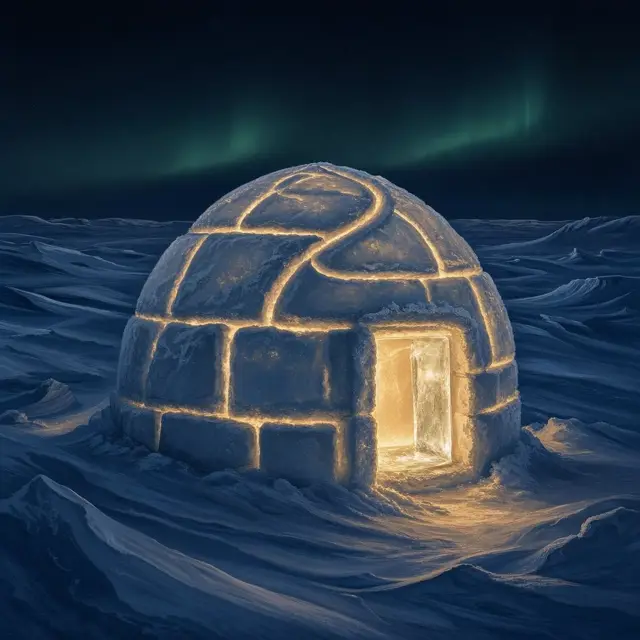
Sixty Degrees of Warmth From Nothing
An igloo — *iglu* or *illu* in the Inuit languages — is a shelter built from suitable snow. Which sounds like a description of a problem rather than a solution, until you look at the numbers.
Snow works because the air pockets trapped inside it make it an insulator. This is called the igloo effect, and its effect is dramatic: outside temperatures may be as low as −45 °C, while inside the temperature can range from −7 to 16 °C — warmed by body heat alone.
Read that again. No fire, no fuel, no heater. Up to sixty degrees of difference between the air outside and the air inside, produced by the people sitting in it. The material everyone associates with being frozen turns out to be a first-rate blanket, because what insulates is not the ice but the air held motionless within it.
A Dome Shaped Like a Hanging Chain
Igloos are commonly drawn as half-spheres. They are not. They are built as a catenary — a curved shape more closely resembling a paraboloid.
The reason is structural, and it is the same insight behind arch bridges and cathedral domes. In an inverted paraboloid, the forces in the structure are nearer to being exclusively compressive, so the walls press into each other rather than bending. Snow is decent at being squeezed and terrible at being bent, so the shape is chosen to give it only the job it can do. A hemisphere would buckle where the paraboloid holds.
The blocks are cut with saws and machete-like blades. They start four-sided, and are later cut into five- or six-sided shapes specifically to increase structural interlocking — each block wedged against its neighbours instead of merely stacked on them.
Cold Sinks, So Put the Door Below
The interior design is built entirely around one fact: warm air rises and cool air settles.
The sleeping platform is raised, so occupants rest in the warmest layer of air. The entrance sits lower, which turns it into a cold trap — the coldest air pools down there and stays, rather than mixing through the living space.
An entrance tunnel does further work, reducing wind and heat loss whenever the door is opened. And for daylight, a single block of clear freshwater ice is set into the wall as a window, letting light in without letting warmth out.
None of these are decorative touches. Each one is a specific answer to a specific thermal problem, arrived at without thermometers or thermodynamics — an architecture derived entirely from paying close attention over a very long time.
Three Sizes, and Who Actually Built Them
Igloos came in three traditional sizes, each for a different purpose:
- The smallest were temporary shelters, usually used for one or two nights on hunting trips out on the sea ice
- The intermediate size was a single-room family dwelling, holding one or two families, with several of them forming an Inuit village
- The largest were communal, built in groups of two, with up to five rooms housing 20 people, and used for feasts and traditional dances
That last category is the one that breaks the popular image. A five-room snow building hosting twenty people at a dance is not survival architecture; it is a venue.
One correction is worth making. Although igloos are often associated with all Inuit, they were traditionally used only by the people of Canada's Central Arctic and the Qaanaaq area of Greenland. Other Inuit built houses from whalebone and hides, and used snow to insulate them rather than to build them.