From 40 Shutdowns to Almost None
In the 1950s, a typical jetliner engine produced about 5,000 pounds of force. By the 1990s, the General Electric GE90 turbofan produced 115,000. Reliability jumped too. Engines went from 40 in-flight shutdowns per 100,000 flight hours to less than one by the late 1990s.
Those gains changed travel. Together with much lower fuel use, they made it routine for airliners with just two engines to cross the Atlantic by around the year 2000. Before that, the same trip would have needed several fuel stops and three or more engines.
The need for jets had shown up decades earlier. Before World War II, engineers saw that propeller engines were hitting a limit. As the tips of the blades neared the speed of sound, propellers lost efficiency. To fly faster, planes needed a whole new way of pushing forward.
Two Inventors Racing Without Knowing It
The idea of a gas turbine was old. John Barber got a patent for a stationary turbine in England in 1791, and the first one that could keep itself running was built by a Norwegian engineer in 1903. Making one light, safe and reliable enough to fly was the hard part.
In 1928, a young cadet at the Royal Air Force College named Frank Whittle sent his idea for a jet engine to his superiors. He filed his first patent in 1930 but could not get the government interested, so work moved slowly. In 1935, Hans von Ohain began a similar design in Germany, at first unaware of Whittle's work. His early engine even ran on hydrogen.
Von Ohain reached the sky first. On August 27, 1939, the He 178 flew with his engine, becoming the world's first jet plane. Britain's first jet, the Gloster E28/39, flew on 15 May 1941. By the 1960s, all large civilian aircraft were jet powered.
Squeeze, Burn, Spin, Blast
A basic jet engine, called a turbojet, does four jobs in a row. A compressor squeezes the incoming air. Fuel is mixed in and burned. The hot, high-pressure gas then rushes through a turbine, which spins and powers the compressor at the front. Finally, the gas shoots out of a nozzle, and that fast jet pushes the plane forward. This loop is known as the Brayton cycle.
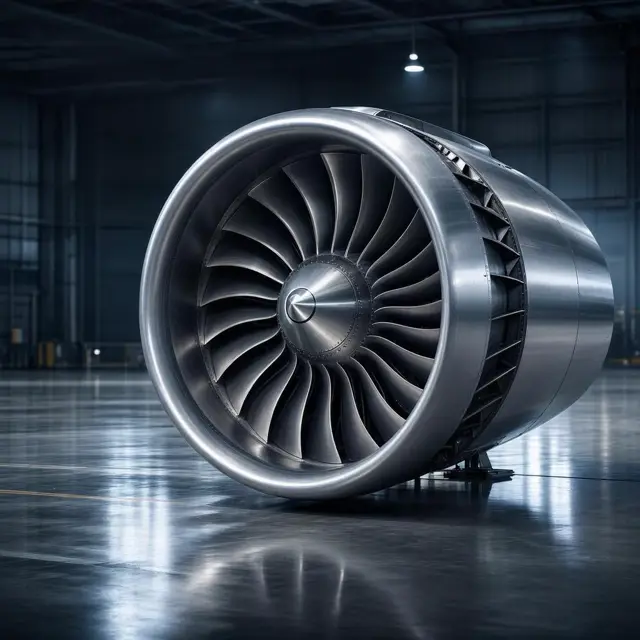
Most airliners today use a turbofan instead. It adds a big fan at the front that sends much of the air around the hot core rather than through it. At the speeds airliners fly, this is usually more efficient. By the 1970s, turbofans had made jets about as fuel-efficient as the best propeller engines.
The parts spin so fast that cockpit gauges do not show the real speed. Each section turns at many thousands of revolutions per minute, so the gauges show a percentage of a set speed instead, which is easier to read.
Why Modern Jets Sound Different
Jet noise comes from many parts, including the fan, the compressor and the turbine. A big source is the exhaust itself, as the fast jet violently mixes with the air around it. Up to about 600 meters per second, the sound power rises with the jet speed raised to the eighth power. A small increase in speed means far more noise.
That is why slower exhaust is quieter. High-bypass turbofans, with their gentler jets, are the quietest engines. Rockets, turbojets and ramjets, with the fastest exhaust, are the loudest. As airliners moved from turbojets to turbofans, their jet noise dropped.
Turbofans brought a new sound of their own, though. At takeoff, the tips of the big fan blades move faster than sound and create shockwaves. The result is a distinctive sound known as buzz saw noise, which replaced the very distinctive roar of the older jets.
Engines With No Moving Parts
The simplest jet engine of all is the ramjet. It has no moving parts in the engine itself. Instead of a compressor, it uses its own forward speed to ram air into the inlet and squeeze it. The catch is that it cannot start from a standstill. It needs a lot of speed before it works at all.
A scramjet goes one step further. It never slows the incoming air below the speed of sound and burns its fuel in a supersonic flow. In theory, scramjets might reach about Mach 15 or more and fly as high as 75 km. Very few have been built or flown. For most other jets, the speed limit is thought to be around Mach 5 to 8, because above about Mach 5.5 the nitrogen in the air starts to react from the heat.
Jet engines also work far from airports. Versions of them generate electricity, run pumps, and power ships and locomotives. A turbofan-powered car called ThrustSSC even holds the land speed record.