Thirty Seconds in the Air
The most famous jet packs can fly for only about 30 seconds. That is the price of carrying all your fuel on your back. To fly, a pack must push mass downward hard enough to lift the pilot, the pack and its fuel, and it has to keep doing that the whole time.
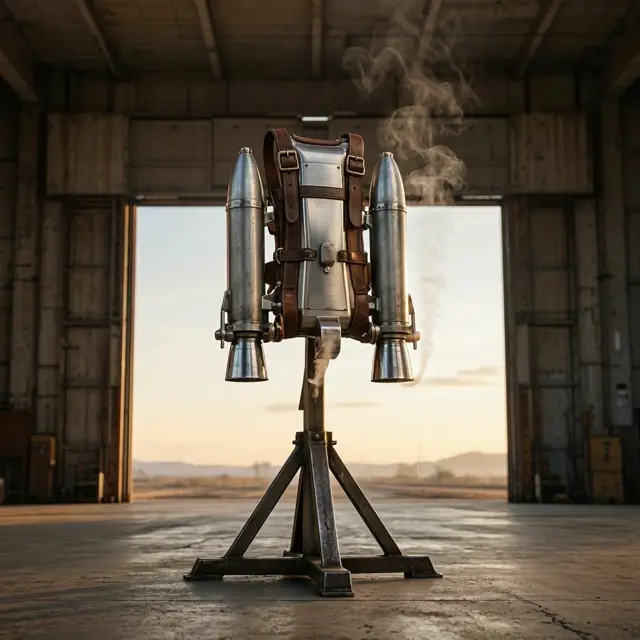
The classic rocket belt runs on nearly pure hydrogen peroxide. When it touches a catalyst such as silver, it breaks down into superheated steam and oxygen in less than a tenth of a millisecond, swelling 5,000 times in volume. That hot gas, at about 740 °C, blasts out of the nozzles.
The jet is strong but comes out fairly slowly, which gives it a poor specific impulse. Add expensive fuel, no training versions with dual controls, and flights too low for a parachute to help, and you get a machine used mostly for stunts. One famous example was a flight at the opening ceremony of the 1984 Summer Olympics in Los Angeles.
From Jump Belts to the Bell Rocket Belt
People dreamed of these devices long before they worked. A 1919 design by the Russian inventor Alexander Andreev was later patented but apparently never built. In 1958, two Thiokol engineers made a Jump Belt powered by compressed nitrogen. It tossed the wearer up to 7 meters, and by leaning forward he could run at 45 to 50 km/h.
The U.S. Army got interested. Its planners imagined personal jet devices for scouting, crossing rivers and reaching steep mountain slopes. In August 1960 it hired Bell Aerosystems, where the engineer Wendell Moore had been experimenting with a personal jet device for several years.
The Bell Rocket Belt was shown to the public in 1960, and its demonstration flights created huge public excitement. In 1965 one appeared in the James Bond film Thunderball, carrying Bond away from the villains before the opening titles. One Bell Rocket Belt now sits at the Smithsonian's Steven F. Udvar-Hazy Center near Dulles Airport. The rocket packs that enthusiasts build today are still largely based on Moore's work.
The Jet Belt That Lasted Minutes
Swapping the rocket for a turbojet changed the math. Instead of peroxide, the engine burns ordinary kerosene jet fuel, so flights can last many minutes. In 1965 Bell signed a contract with DARPA to build one, called the Jet Flying Belt, or simply the Jet Belt.
Its engine, the WR19, weighed just 31 kg and had a rated thrust of 1,900 newtons. On 7 April 1969, at Niagara Falls Municipal Airport, pilot Robert Courter flew it free for the first time. He circled about 100 meters at a height of 7 meters, reaching 45 km/h. Later flights lasted up to 5 minutes, and on paper the pack could fly for 25 minutes at up to 135 km/h.
Yet the Army lost interest. The pack was heavy and hard to maintain, and landing with it on your back was risky. After Moore died in 1969, work on it ended. The only Jet Belt ever made now sits in the Williams International company museum.
Flying Wings Over the Channel
Swiss pilot Yves Rossy took a different path: he added wings. His pack has rigid carbon fiber wings about 2.4 meters across and four small jet engines underneath, large versions of a type designed for model planes. He wears a heat-resistant suit, like a racing driver's, to protect him from the hot exhaust.
Rossy is carried up by a plane and starts the engines just before he jumps out with the wings folded. The wings open in free fall, and he steers with his body and a hand throttle. On 26 September 2008 he flew from Calais in France to Dover in England in 9 minutes and 7 seconds, reaching 300 km/h.
He has since flown in formation with military jets and crossed the Grand Canyon. In 2015 he and Vince Reffet flew in formation with an Airbus A380 airliner over Dubai. The Channel was crossed again in 2019 by Franky Zapata on his Flyboard Air, in 22 minutes, with a refueling stop on a ship halfway.
Water Jets and Spacewalks
One clever idea gets around the fuel problem completely: leave the engine behind. In hydroflight, a jetski on the water pushes water up a long hose to nozzles on the pilot's pack or under their feet. The JetLev, with two nozzles on a backpack, was the first on the market, and its makers won the first patents for it in 2008. By 2013 many rental businesses were operating around the world.
Space is where jet packs actually earn their keep. In microgravity there is no weight to fight, so only small pushes are needed. The Manned Maneuvering Unit weighed about 300 pounds and used 24 small thrusters fed by nitrogen gas. Astronauts Bruce McCandless and Bob Stewart first used it in February 1984.
Back on Earth, the dream keeps running into hard numbers. In 2014 Google's research lab, Google X, said it had looked at jet packs and found they burned fuel at about 940 liters per 100 km and were as loud as a motorcycle, so it dropped the idea.