It Started as a Geography Lesson
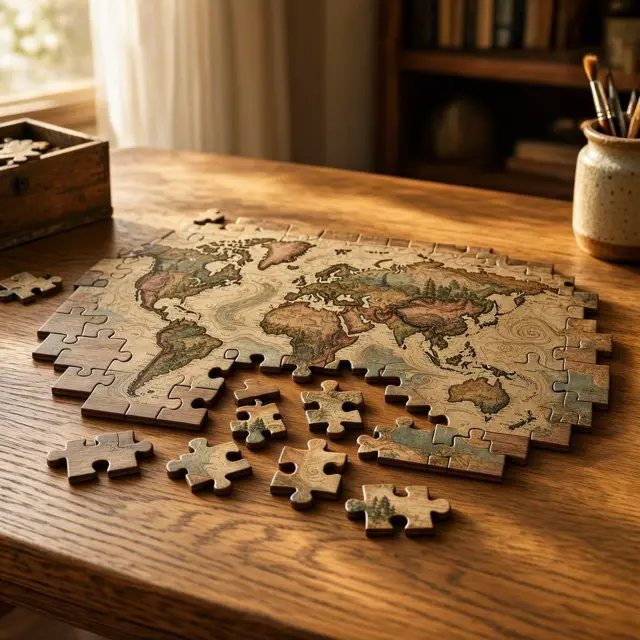
The first jigsaw puzzle was not really a game. It was a school lesson. Around 1760, John Spilsbury, a London mapmaker and engraver, took world maps and cut out each nation with a fine marquetry saw. Students then put the world back together to learn geography.
He was not alone. French author and teacher Jeanne-Marie Leprince de Beaumont was using wooden maps in her lessons as early as 1759. These early puzzles were called dissections. Lady Charlotte Finch, a royal governess, used them to teach the children of King George III and Queen Charlotte.
The famous name came much later. Around 1880, the fretsaw became the tool of choice for cutting the shapes, and the puzzles came to be named after the saws used to make them. The exact term jigsaw puzzle dates back to 1906.
No Picture on the Box
Jigsaws first became a craze among American adults from 1907 to 1910, and reached Europe a year or two later. Those puzzles were tough. They were cut from solid wood, the pieces often did not lock together, and there was usually no picture on the box to guide you.
Puzzle historian Anne Williams links that craze to a weak US economy in 1907, more middle- and upper-class women taking up crafts like puzzle making, and the arrival of the foot-powered scroll saw. Puzzles boomed again in the Great Depression because they were cheap, lasted long and could be reused. Companies even gave them away as ads, so customers pieced together a picture of the product.
Cardboard puzzles appeared in the late 1800s but caught on slowly. Makers feared they would look cheap, and wooden ones earned bigger profits. During the COVID-19 stay-at-home orders, demand surged again, on a scale compared to the Great Depression.
A Giant Cookie Cutter
Most puzzles today are made of paperboard, because it is cheap and easy to mass-produce. A printed picture is glued to cardboard, which is then fed into a press. The press forces a set of hardened steel blades, called a puzzle die, through the board. Foam rubber around the blades pushes the cut pieces back out.
It works much like making shaped cookies with a cookie cutter, only with far greater force. From the 1930s, puzzles were cut on huge hydraulic presses that now cost hundreds of thousands of dollars. Newer roller presses do the same job for less.
Lasers changed things too. Wooden and acrylic puzzles can now be laser-cut to any size or shape, with any number of pieces. Many museums offer acrylic puzzles of their art so visiting children can build the pictures on display. And because the patterns live on a computer, a missing piece can simply be made again.
Why 1,000 Pieces Means 1,026
Puzzle boxes round things off. The most common layout for a thousand-piece puzzle is 38 pieces by 27, which makes 1,026 pieces. Most 500-piece puzzles are 27 by 19, for a total of 513.
The pieces lock together with rounded tabs and matching dents called blanks. In a fully interlocking puzzle, a finished section can sometimes stay together when you lift it by one piece. Puzzles where every piece has the same shape, sometimes called Japanese Style, are harder because the pieces are hard to tell apart. Old wooden puzzles often included whimsies, pieces cut into shapes like animals or objects.
Designers love to make things tricky. Some puzzles are double-sided, so you must work out which side you are looking at. Designer Yuu Asaka made a one-color puzzle with five corner pieces, and another made entirely of corner-style pieces. The most expensive puzzle so far sold for 27,000 US dollars in 2005 at a charity auction.
Half a Million Pieces
The jigsaw with the most pieces ever had 551,232 of them. Students of the University of Economics in Ho Chi Minh City, Vietnam, assembled it on 25 September 2011. It was split into 3,132 sections of 176 pieces each, which were built one by one and then joined. The largest puzzle by area covered 6,122.68 square meters, with 12,320 pieces, and was assembled in Dubai in 2018.
Puzzling is now a competitive sport, with yearly World Jigsaw Puzzle Championships since 2019. Scientists use puzzles too. In a 2021 study, children aged 3 to 5 tried three kinds of puzzles. Older children made fewer errors thanks to stronger mental rotation, the skill of turning an object around in your mind.
Puzzles even shape famous symbols. The Wikipedia logo is a globe made of jigsaw pieces, left unfinished to show there is always room for more knowledge.